Monsoon Deficit Warning and Circular Water Economy Strategies
Source:Indian Express ↗
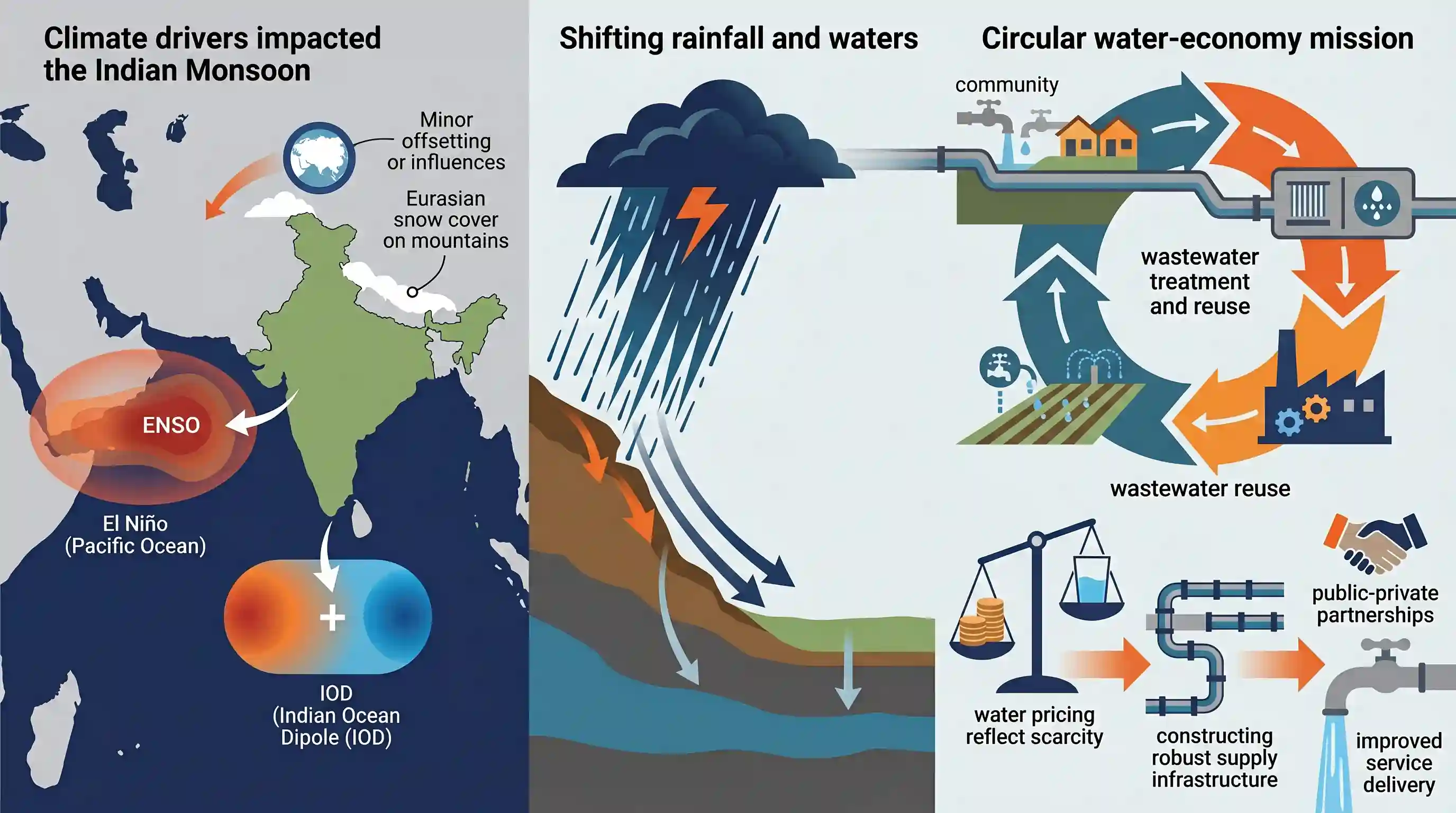
Why It Matters
Understanding the intricate impacts of climatological phenomena like ENSO and IOD on the Indian monsoon is vital for Geography (GS1). Furthermore, the shift in rainfall patterns and subsequent water stress directly tie into resource management, agriculture, and infrastructure planning under GS3, highlighting the necessity of policies like the circular water economy and realistic water pricing.
Summary
The article analyzes the likelihood of a below-normal Indian monsoon due to the El Niño-Southern Oscillation (ENSO), noting minor offsetting effects from the Indian Ocean Dipole (IOD) and Eurasian snow cover. It emphasizes that India's rainfall patterns are shifting temporally and spatially towards short, intense downpours that cause rapid runoff and topsoil erosion rather than steady groundwater recharge. To combat escalating water stress, the authors advocate for a 'circular water-economy mission' to significantly increase wastewater treatment and reuse, which currently stands at just 3% in India. Furthermore, they argue for realistic water pricing that reflects scarcity to fund robust supply infrastructure, necessitating improved service delivery and public-private partnerships.
Key Points
- The IMD forecasts a mostly below-normal monsoon season driven by the rapid development of the El Niño-Southern Oscillation (ENSO) in the Pacific Ocean.
- Minor offsetting factors for the monsoon include below-normal Eurasian snow cover and the development of the Indian Ocean Dipole (IOD) in the latter half of the season.
- Precipitation patterns are shifting towards concentrated, intense downpours (deluges) over shorter intervals, which increases rapid runoff and topsoil loss while hindering groundwater recharge.
- A proposed 'circular water-economy mission' aims to transition India from its current 3% wastewater reuse rate to 50% reuse and 100% treatment capacity by 2035.
- Realistic water pricing reflecting scarcity is necessary to fund infrastructure, but requires improved state capacity, reliable service delivery, and an honest dialogue with citizens.
Important Terms
India Meteorological Department (IMD)

The principal government agency under the Ministry of Earth Sciences responsible for meteorological observations, weather forecasting, and seismology.
UPSC context
GS Paper 1 and 3; critical for monsoon forecasting and disaster management strategies.
El Niño-Southern Oscillation (ENSO)
A periodic climatic phenomenon involving sea surface temperature and atmospheric pressure changes in the tropical Pacific, influencing global weather and the Indian monsoon.
UPSC context
GS Paper 1 (Physical Geography); fundamental for understanding factors causing rainfall variability and drought.
Indian Ocean Dipole (IOD)
An ocean-atmosphere phenomenon in the Indian Ocean characterized by a temperature difference between its western and eastern parts, affecting regional rainfall.
UPSC context
GS Paper 1 (Climatology); important for explaining deviations in the standard Indian monsoon performance.
Water Stress
A condition where annual per-capita water availability is less than 1,700 cubic meters, leading to scarcity and competition among users.
UPSC context
GS Paper 1 and 3; key to discussions on natural resource management and NITI Aayog reports.
Circular Water Economy
An economic model focused on treating and reusing wastewater to minimize waste and ensure the sustainable management of water resources.
UPSC context
GS Paper 3 (Sustainable Development); highlights innovative infrastructure and resource efficiency solutions.
Prelims Trap
Above-normal Eurasian snow cover helps offset the negative impacts of El Nino by strengthening monsoon winds.
This is false. Eurasian snow cover has an inverse relationship with the monsoon. Below-normal snow cover heats the Asian landmass faster, strengthening the thermal contrast needed to attract monsoon winds.
Static Concepts Connected
How do IOD and Eurasian snow cover impact the Indian Monsoon?
- Positive IOD: Warmer western Indian Ocean relative to the eastern part strengthens south-westerly monsoon winds, helping mitigate El Niño's deficit.
- Eurasian Snow: Exhibits an inverse relationship. Below-normal winter/spring snow allows the Asian landmass to heat up intensely, strengthening the low-pressure system.
- Walker Circulation: El Niño warms the central/eastern Pacific, disrupting this east-west atmospheric circulation and dampening moisture-laden winds toward India.
What constitutes India's proposed Circular Water Economy?
- Core Principle: Treating, recovering, and reusing urban and industrial wastewater rather than discharging it, shifting away from a take-make-dispose model.
- Current Deficit: India currently reuses only about 3% of its wastewater, highlighting a massive gap in municipal infrastructure and state capacity.
- Climate Necessity: High-intensity deluges reduce natural groundwater recharge time; engineered wastewater reuse acts as a crucial buffer against freshwater scarcity.
Cross-Topic Patterns
Shifting precipitation and rainfed agriculture
Intense downpours increase topsoil erosion and rapid runoff, threatening rainfed farming stability. This links monsoon climate anomalies directly to the push for climate-smart agriculture and drought-resistant crops like millets.
Water pricing and urban infrastructure
Rational water pricing is politically sensitive but economically necessary to fund urban wastewater treatment networks through Public-Private Partnerships, connecting ecological scarcity to urban governance and municipal finance.

A multi-statement Prelims question evaluating the combined effects of El Niño, IOD, and Eurasian snow cover on the monsoon is highly likely.
Linked PYQs · 3
Linked PYQs · 3
- 2017PrelimsGS1
With reference to 'Indian Ocean Dipole (IOD)' sometimes mentioned in the news while forecasting Indian monsoon, which of the following statements is/are correct? 1. IOD phenomenon is characterised by a difference in sea surface temperature between tropical Western Indian Ocean and tropical Eastern Pacific Ocean. 2. An IOD phenomenon can influence an El Nino's impact on the monsoon. Select the correct answer using the code given below:
- 2024MainsGS3
The world is facing an acute shortage of clean and safe freshwater. What are the alternative technologies which can solve this crisis? Briefly discuss any three such technologies citing their key merits and demerits.
- 2020MainsGS3
Suggest measures to improve water storage and irrigation system to make its judicious use under depleting scenario.
