Belgium Palestinian State Recognition and Sanctions on Israel
Source:Indian Express ↗
Why It Matters
Belgium's decision reflects a growing shift in the stance of several Western and European nations towards the Israel-Palestine conflict. The dual approach of recognizing Palestine and imposing sanctions on Israel underscores increasing international pressure to revive the stalled two-state solution and hold both state and non-state actors accountable under international law.
Summary
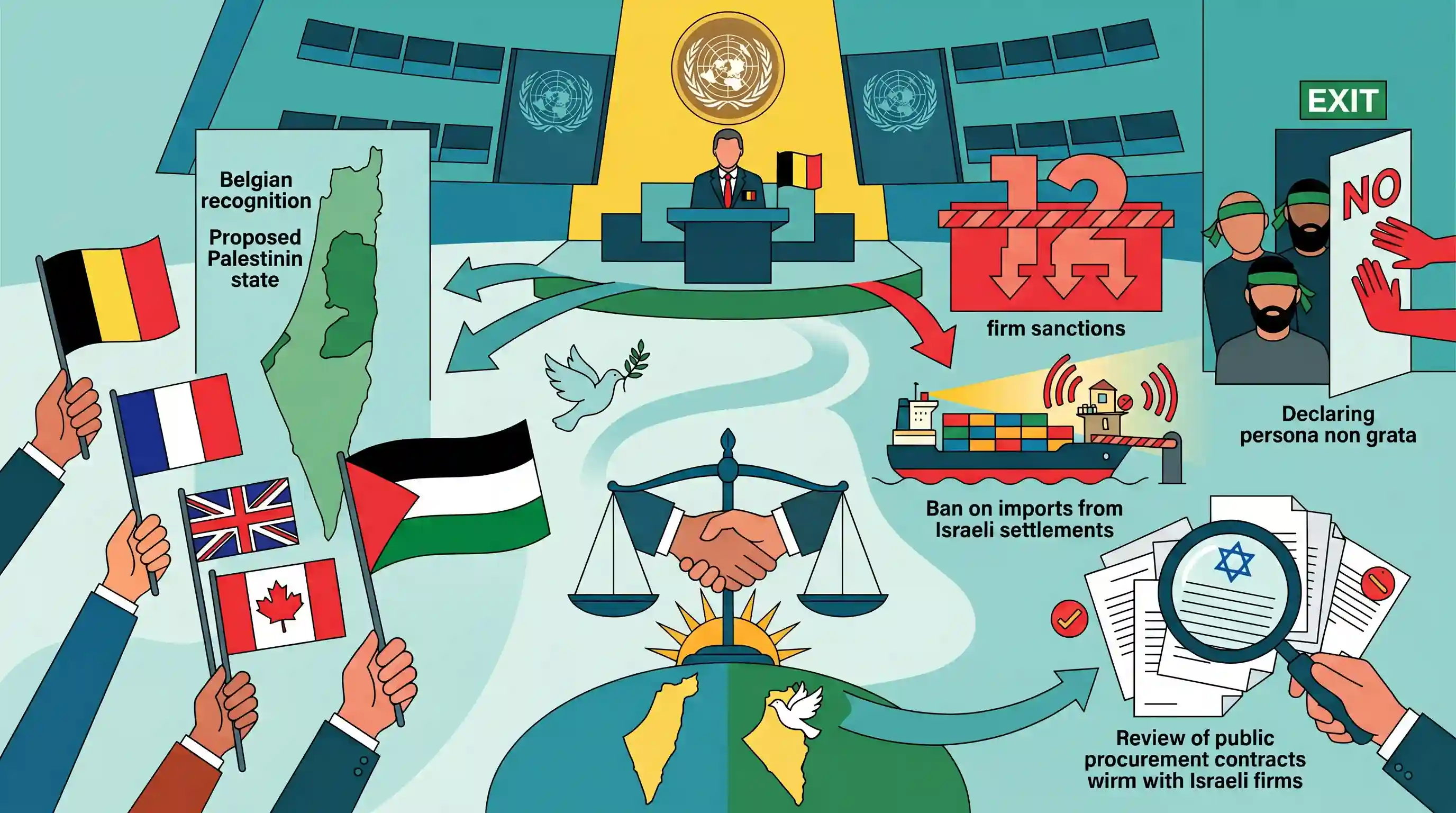
Belgium has announced plans to formally recognize a Palestinian state at the upcoming UN General Assembly session, joining several other Western nations like France, Canada, and the UK. Additionally, Belgium will impose 12 "firm" sanctions against the Israeli government, which include banning imports from Israeli settlements and reviewing public procurement contracts with Israeli firms. Concurrently, Hamas leaders will be declared persona non grata. According to Belgian Foreign Minister Maxime Prevot, these measures are intended to pressure both parties to respect international law and pave the way for a two-state solution, rather than to punish the Israeli public.
Key Points
- Belgium will officially recognize a Palestinian state at the UN General Assembly session in September, joining countries like France, Canada, and the UK.
- Belgium is imposing 12 targeted sanctions on Israel, including banning imports from Israeli settlements and reviewing public procurement policies with Israeli companies.
- Hamas leaders have been declared persona non grata in Belgium.
- Belgian Foreign Minister Maxime Prevot stated the actions aim to pressure the Israeli government and Hamas into respecting international law and achieving a two-state solution.
- The United States maintains that Palestinian statehood should be the result of direct negotiations between Israelis and Palestinians.
Important Terms
Two-state solution

A proposed framework for resolving the Israeli-Palestinian conflict by establishing two independent states—Israel and Palestine—living side-by-side, generally based on the pre-1967 borders with mutually agreed land swaps.
UPSC context
GS Paper 2 (International Relations). Tests understanding of India's long-standing diplomatic position on West Asia and regional stability frameworks.
UN General Assembly (UNGA)
The main deliberative, policymaking, and representative organ of the UN, where all 193 member states have equal representation and a single vote on global issues.
UPSC context
GS Paper 2 (International Institutions). Focuses on multilateral diplomacy, voting procedures, and the role of international bodies in state recognition.
Israeli Settlements
Jewish civilian communities built on Palestinian territories occupied by Israel since the 1967 war, widely considered illegal under Article 49 of the Fourth Geneva Convention.
UPSC context
GS Paper 2 (International Relations). Crucial for understanding barriers to peace and the application of international humanitarian law in occupied territories.
Persona non grata
A Latin term meaning 'unwelcome person,' used in diplomacy to describe a foreign person whose entry or presence is prohibited by a host government under the 1961 Vienna Convention.
UPSC context
GS Paper 2 (International Relations). Tests knowledge of diplomatic protocols, the Vienna Convention, and tools used for formal state-to-state protests.
Hamas
A Palestinian Sunni-Islamic fundamentalist political and militant organization that has governed the Gaza Strip since 2007; recognized as a terrorist group by several Western nations.
UPSC context
GS Paper 2/3 (IR & Internal Security). Relevant for understanding non-state actors in West Asian geopolitics and their impact on regional security.
Sanctions
Compulsory measures, either economic or diplomatic, taken by states or international bodies to coerce a government or group to follow international law or change specific policies.
UPSC context
GS Paper 2 (International Relations). Tests understanding of non-military instruments of foreign policy and their impact on global trade and bilateral ties.
Prelims Trap
The UN General Assembly can unilaterally grant full UN membership to a newly recognized state.
Full UN membership requires a recommendation from the UN Security Council (subject to P5 veto) before the UNGA can vote. UNGA alone can only grant non-member observer state status.
Static Concepts Connected
What is the process for admitting a new member state to the United Nations?
- UNSC Recommendation: The state must first receive a positive recommendation from the UN Security Council, which is subject to the veto power of the P5 nations.
- UNGA Vote: Following UNSC approval, the UN General Assembly must admit the state via a two-thirds majority vote.
- Observer Status exception: The UNGA can unilaterally grant non-member observer status via a simple majority, bypassing the UNSC, but this does not confer voting rights.
What is the legal basis and effect of declaring someone 'Persona Non Grata'?
- Vienna Convention: Article 9 of the 1961 Vienna Convention on Diplomatic Relations codifies this diplomatic principle.
- No justification needed: The receiving state can declare any diplomatic staff unwelcome at any time without having to explain or justify its decision.
- Required recall: The sending state is obligated to either recall the designated person or terminate their functions within the mission.
Cross-Topic Patterns
EU's fragmented foreign policy consensus
The EU lacks a unified stance on Israel-Palestine. Nations like Belgium and Spain independently push for recognition, highlighting structural weaknesses in achieving cohesive EU foreign policy measures.
India's De-hyphenation Strategy
India successfully compartmentalizes its foreign policy, advancing strategic defense ties with Israel while continuing to back UN resolutions supporting the Two-State solution and denouncing illegal settlements.

Expect a multi-statement Prelims question testing the mechanics of UN membership (UNSC vs UNGA roles) alongside the Two-State solution.
Linked PYQs · 2
Linked PYQs · 2
- 2018MainsGS2
“India’s relations with Israel have, of late, acquired a depth and diversity, which cannot be rolled back.” Discuss.
- 2022PrelimsGS1
With reference to the United Nations General Assembly, consider the following statements: 1. The UN General Assembly can grant observer status to the non-member States. 2. Inter-governmental organisations can seek observer status in the UN General Assembly. 3. Permanent Observers in the UN General Assembly can maintain missions at the UN headquarters. Which of the statements given above are correct?
