Supreme Court reviews NIA jurisdiction in Beldanga violence case
Source:The Hindu ↗
Why It Matters
This case is highly relevant for UPSC aspirants as it touches upon the ongoing debate surrounding the potential misuse of stringent anti-terror laws (like UAPA) and the friction between the Centre and States regarding the jurisdiction of federal agencies (like the NIA) in matters traditionally falling under state policing (law and order).
Summary
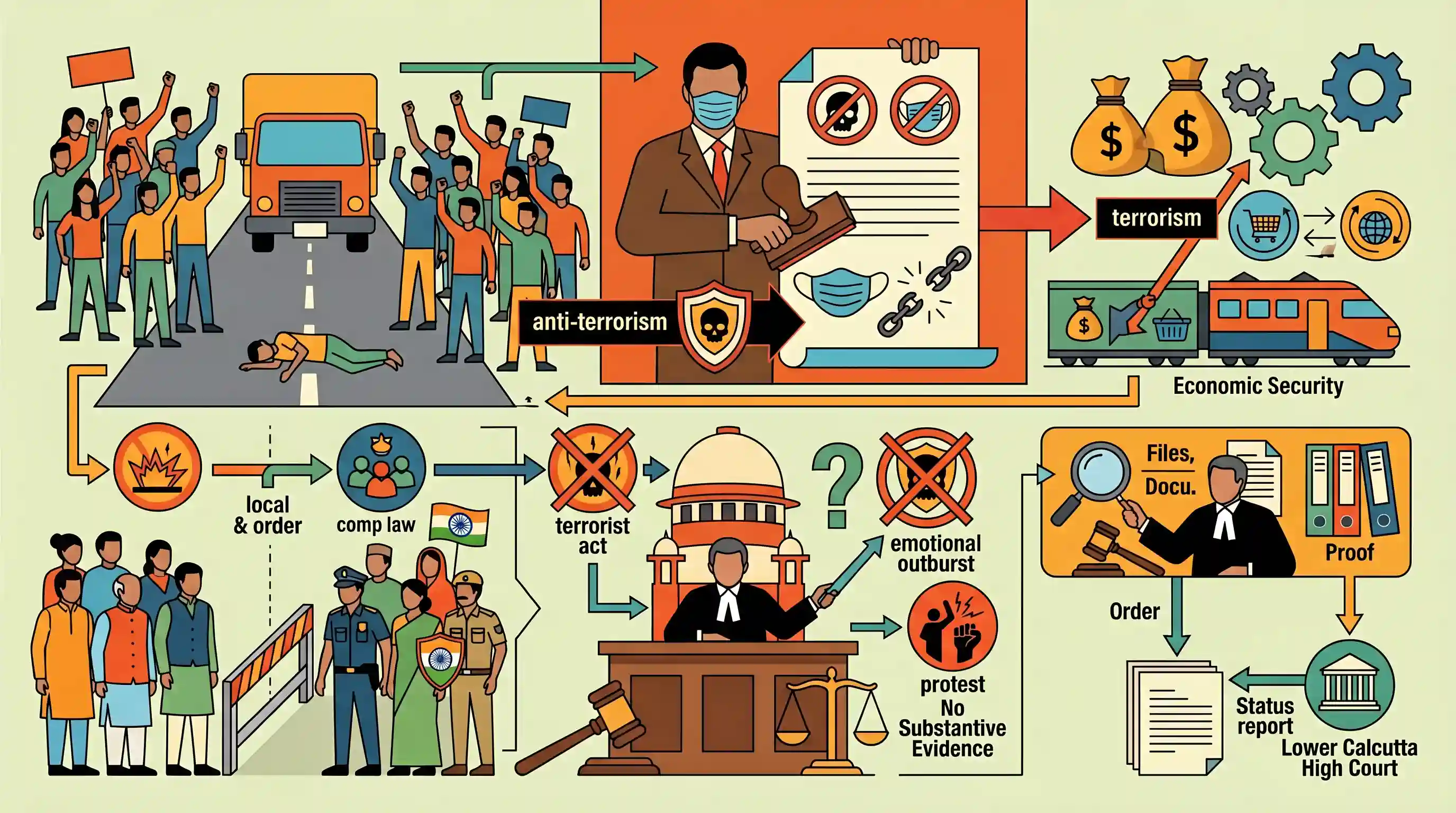
The Supreme Court of India has scrutinized the National Investigation Agency's (NIA) invocation of the Unlawful Activities (Prevention) Act (UAPA) in the Beldanga violence case in West Bengal. The Court criticized the premise that a public disturbance or 'emotional outburst'—in this case, protests over a migrant worker's death that blocked transport routes—could be broadly classified as a 'terrorist act' affecting the nation's economic security without substantive evidence. The West Bengal government contested the NIA's involvement, framing the incident as a local law-and-order issue rather than terrorism. The Court has ordered the NIA to provide a status report to the Calcutta High Court to prove a prima facie case for applying the UAPA, bringing attention to the broader debate on federal jurisdiction and the arbitrary use of anti-terror laws.
Key Points
- The Supreme Court questioned the NIA's rationale for invoking the Unlawful Activities (Prevention) Act (UAPA) over the Beldanga violence, stating that an 'emotional outburst' cannot automatically be labelled a 'terrorist act'.
- The NIA argued that the protests, which involved blocking railway tracks and National Highway 34, disrupted the supply of essential commodities and threatened the economic security of India.
- The West Bengal government opposed the Centre's decision to transfer the probe to the NIA, maintaining that the incident was a local law-and-order issue handled by state police without terrorist links.
- The Supreme Court directed the NIA to submit a status report in a sealed cover to the Calcutta High Court to establish whether there is prima facie material justifying the application of the UAPA.
- The case highlights ongoing federal tensions regarding the jurisdiction of central agencies over state law-and-order matters and the potential misuse of stringent anti-terror legislation.
Important Terms
Unlawful Activities (Prevention) Act (UAPA)

India's primary anti-terror law (1967) that empowers the government to designate individuals/organizations as terrorists and provides for stringent bail conditions and extended detention without charge.
UPSC context
GS Paper 3 (Internal Security); tests understanding of anti-terror frameworks and the balance between national security and civil liberties.
National Investigation Agency (NIA)
A central statutory body established post-26/11 to investigate and prosecute offences affecting India's sovereignty, security, and integrity, with pan-India jurisdiction.
UPSC context
GS Paper 3 (Various Security Forces and Agencies); relevant for its role as a federal agency and its mandate.
NIA Act, 2008
The 2008 legislation governing the NIA; notable for granting the Central Government 'suo motu' power to direct the agency to investigate cases without state government consent.
UPSC context
GS Paper 2 (Federalism); tests knowledge of statutory powers and the division of powers between Centre and States.
Economic Security (under UAPA)
A component of the 'terrorist act' definition under Section 15 of UAPA (added in 2012), covering actions intended to disrupt financial stability, including counterfeit currency or strategic blockades.
UPSC context
GS Paper 3 (Internal Security); tests the expanding legal definition of terrorism and its implications for democratic protests.
Law and Order (State Subject)
A constitutional responsibility of State governments under Entry 1 of the State List (Seventh Schedule), often cited by states to contest central investigative agency intervention.
UPSC context
GS Paper 2 (Centre-State Relations); crucial for understanding federal tensions in criminal justice and security.
Prima Facie Case
The standard of evidence ('at first sight') required to justify UAPA's application or deny bail under Section 43D(5), demanding the court verify if allegations are reasonable.
UPSC context
GS Paper 2 (Judiciary); tests the legal threshold for applying extraordinary criminal laws vs. ordinary penal codes.
Prelims Trap
"The NIA requires prior consent from the State Government to investigate scheduled offences like UAPA."
Unlike the CBI under the DSPE Act, the NIA has concurrent, pan-India jurisdiction under the NIA Act 2008 and does not need state consent.
Static Concepts Connected
How does the NIA's state jurisdiction differ from the CBI's?
- Statutory Basis: CBI operates under the DSPE Act 1946, whereas the NIA was established under the NIA Act 2008 specifically for counter-terrorism.
- State Consent: CBI requires state consent (general or specific) to investigate. NIA has concurrent pan-India jurisdiction for scheduled offences without requiring state permission.
- Scope of Crimes: NIA exclusively handles 'Scheduled Offences' (e.g., UAPA, hijacking). CBI handles a broader spectrum including corruption and conventional economic offences.
How is 'Economic Security' defined under the UAPA?
- 2012 Amendment: The 2012 UAPA amendment expanded Section 15's definition of a 'terrorist act' to include threats to India's economic security.
- Specific Inclusions: It covers the production, smuggling, or circulation of high-quality fake Indian paper currency, coin, or any other material as defined.
- Judicial Scrutiny: Courts strictly require concrete evidence of economic sabotage, rejecting assertions that local public disorder or blockades automatically threaten national economic security.
Cross-Topic Patterns
Federalism vs. Security Agencies
State challenges against the NIA echo similar federal disputes involving the CBI and ED, touching upon the constitutional division of 'Public Order' (State List) versus national security.
Judicial narrowing of UAPA
The SC’s scrutiny of 'emotional outbursts' mirrors recent judgments (like Vernon Gonsalves) that restrict broad interpretations of 'terrorist acts' to prevent misuse of UAPA's strict bail conditions.

Expect a 2026 Prelims question testing the 2012 'economic security' amendment to UAPA alongside NIA's pan-India jurisdiction rules.
Linked PYQs · 2
Linked PYQs · 2
- 2019MainsGS3
Indian Government has recently strengthened the anti-terrorism laws by amending the Unlawful Activities (Prevention) Act (UAPA), 1967 and the NIA Act. Analyze the changes in the context of prevailing security environment while discussing the scope and reasons for opposing the UAPA by human rights organizations.
- 2021MainsGS2
The jurisdiction of the Central Bureau of Investigation (CBI) regarding lodging an FIR and conducting probe within a particular State is being questioned by various States. However, the power of the States to withhold consent to the CBI is not absolute. Explain with special reference to the federal character of India.
