Economic Austerity Measures and Macro Challenges
Source:The Hindu ↗
Why It Matters
The article underscores India's macroeconomic vulnerability to external geopolitical shocks (such as the West Asia conflict) and illustrates the complex policy trade-offs between austerity measures, agricultural productivity (El Niño impacts), and currency stabilization by the RBI.
Summary
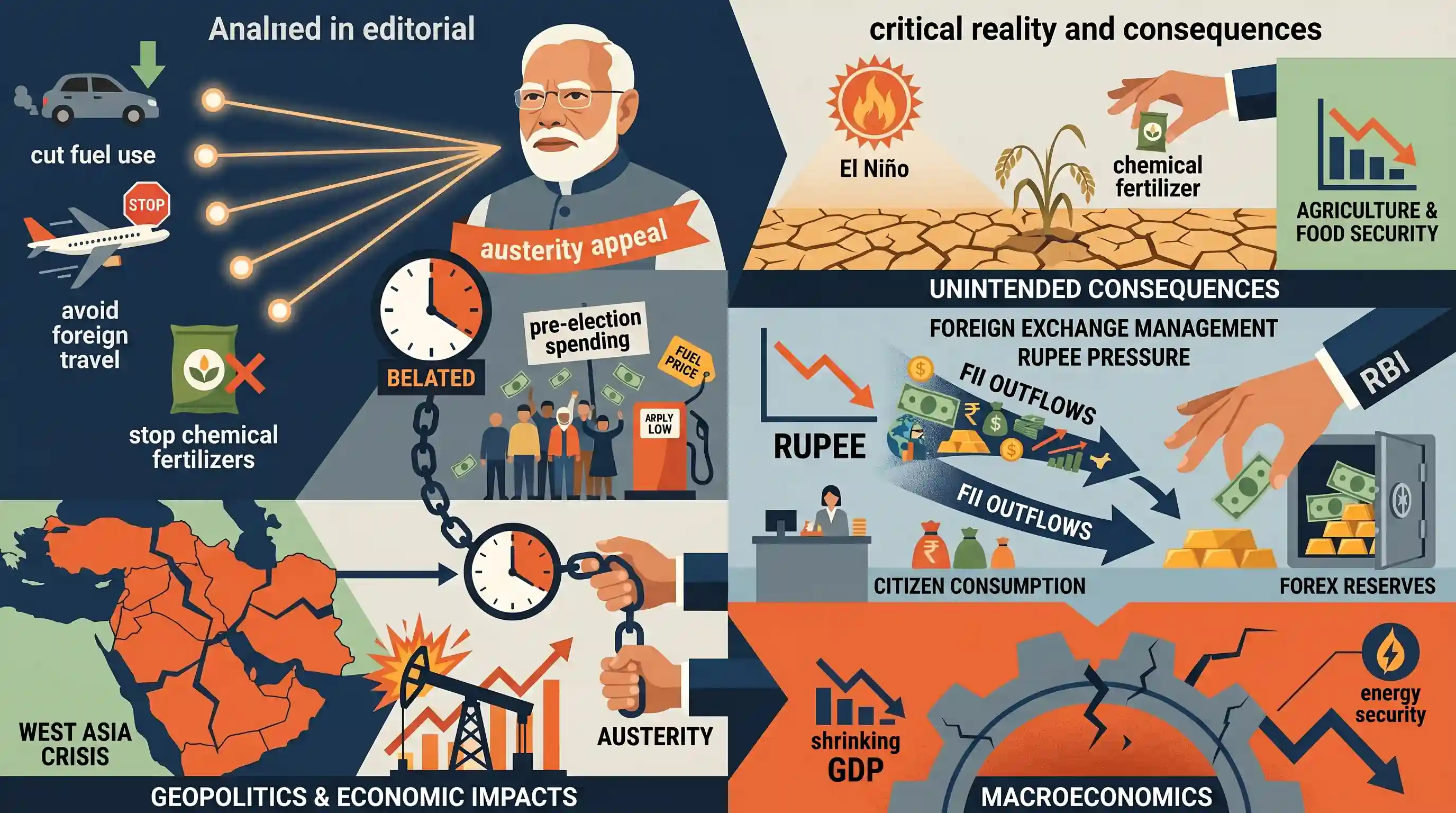
The editorial analyzes Prime Minister Narendra Modi's belated seven-point austerity appeal aimed at countering the economic shocks stemming from the West Asia crisis. While the government urges citizens to cut fuel use, avoid foreign travel, and stop using chemical fertilizers, critics highlight the hypocrisy of delayed action following heavy pre-election spending and artificially suppressed fuel prices. Furthermore, the austerity measures may have unintended consequences: cutting fertilizers could worsen El Niño-induced agricultural stress, and the pressure on the Indian rupee is fundamentally driven by FII outflows rather than citizen consumption, forcing the RBI to deplete foreign exchange reserves.
Key Points
- Prime Minister Narendra Modi issued a seven-point austerity appeal to mitigate the economic fallout of the West Asia crisis and Iran war.
- The proposed measures include reducing fuel consumption, working from home, buying local, avoiding foreign travel, and reducing the use of chemical fertilizers and gold.
- The government faces criticism for the timing of the appeal, as it suppressed fuel prices and downplayed economic risks during the recent election campaigns.
- Halting chemical fertilizer usage poses a significant risk to crop yields, which are already vulnerable due to the effects of El Niño.
- The depreciation of the Indian rupee is primarily driven by capital outflows from Foreign Institutional Investors (FIIs), prompting the RBI to intervene by selling foreign exchange reserves.
Important Terms
Reserve Bank of India (RBI)

India's central bank and regulatory body for the banking system. It formulates monetary policy, issues currency, and manages foreign exchange to ensure price stability and economic growth.
UPSC context
GS-III Economy/Monetary Policy. Tests knowledge of central banking tools (Repo, SLR) and their role in managing inflation and fiscal health.
Foreign Exchange Reserves
Assets held by the central bank in foreign currencies, gold, and Special Drawing Rights. They act as a critical buffer against external shocks and support national currency stability.
UPSC context
GS-III Economy/External Sector. Vital for understanding Balance of Payments (BoP) and the RBI's intervention in the rupee’s valuation.
Foreign Institutional Investors (FIIs)
Large investment entities (e.g., pension funds, banks) based outside India that invest in Indian financial markets. They are highly mobile and can significantly impact market volatility.
UPSC context
GS-III Economy/Investment Models. Tests understanding of capital flows, market stability, and the difference between portfolio and direct investment.
El Niño
A climate phenomenon involving periodic warming of Pacific sea surface temperatures. It weakens the Indian monsoon, often leading to deficient rainfall and agricultural stress.
UPSC context
GS-I Geography/Monsoon and GS-III Agriculture. Crucial for understanding climate risks to food security, irrigation, and rural economic stability.
West Asia Crisis
Ongoing geopolitical conflict in the Middle East affecting global energy supply. For India, it triggers crude oil price spikes, remittance disruptions, and fertilizer supply shocks.
UPSC context
GS-II International Relations and GS-III Economy. Tests analysis of geopolitical impacts on energy security, trade deficits, and macroeconomic stability.
Confederation of Indian Industry (CII)
A non-governmental, industry-led advocacy group founded in 1895. It serves as a bridge between the government and businesses to shape policy and enhance industrial competitiveness.
UPSC context
GS-III Economy/Industry. Relevant for questions on industrial growth, policy advocacy, ease of doing business, and government-industry partnerships.
Prelims Trap
Capital flight (FII outflows) has a negligible impact on currency depreciation compared to citizens' consumption of imported goods like gold.
Rapid currency depreciation is frequently driven by sudden capital account outflows (like FII flight), not just current account imbalances. The RBI depletes forex specifically to counter these sudden capital shocks.
Static Concepts Connected
How does the RBI manage Rupee volatility during severe FII capital flight?
- Spot Interventions: The RBI sells US dollars from its foreign exchange reserves into the open market to absorb Rupee liquidity and prevent steep depreciation.
- Policy Rates: Raising the repo rate widens the interest rate differential with Western central banks, incentivizing foreign capital to remain in India.
- Capital Controls: Easing restrictions on External Commercial Borrowings (ECBs) or offering lucrative NRI deposit schemes to temporarily boost foreign exchange inflows.
Why does El Niño compound agricultural risks when combined with chemical input austerity?
- Monsoon Disruption: El Niño anomalies weaken the Walker Circulation, frequently causing deficient Southwest Monsoon rainfall and resulting in severe soil moisture deficits.
- Yield Vulnerability: During drought-like conditions, maintaining crop yields becomes highly dependent on inputs like chemical fertilizers and irrigation. Abrupt austerity cuts threaten immediate food security.
Cross-Topic Patterns
Geopolitics + Imported Inflation
West Asian instability spikes inelastic import costs (oil/fertilizer), widening the current account deficit and forcing the government to choose between higher imported inflation or bloated domestic subsidy bills.
Monetary Policy + Agricultural Stress
RBI faces a dual bind: El Niño-driven food inflation demands tight money, while FII capital flight limits its ability to manage currency without depleting massive forex reserves.

Expect a 2026 question interlinking El Niño agricultural stress, FII capital flight, and RBI's forex interventions via managed float.
Linked PYQs · 4
Linked PYQs · 4
- 2022PrelimsGS1
With reference to the Indian economy, consider the following statements: 1. If the inflation is too high, Reserve Bank of India (RBI) is likely to buy government securities. 2. If the rupee is rapidly depreciating, RBI is likely to sell dollars in the market. 3. If interest rates in the USA or European Union were to fall, that is likely to induce RBI to buy dollars. Which of the statements given above are correct?
- 2019PrelimsGS1
Which one of the following is not the most likely measure the Government/RBI takes to stop the slide of Indian rupee?
- 2025MainsGS2
"Energy security constitutes the dominant kingpin of India's foreign policy, and is linked with India's overarching influence in Middle Eastern countries.” How would you integrate energy security with India's foreign policy trajectories in the coming years?
- 2017MainsGS2
The question of India's Energy Security constitutes the most important part of India's economic progress. Analyze India's energy policy cooperation with West Asian countries.
