China Economic Stimulus and Trade War Response Strategies
Source:Indian Express ↗
Why It Matters
Understanding China's economic shifts and policy responses is critical for UPSC aspirants, as its domestic slowdown and trade war with the US directly impact global supply chains, international trade dynamics, and India's geopolitical positioning (the 'China Plus One' strategy).
Summary
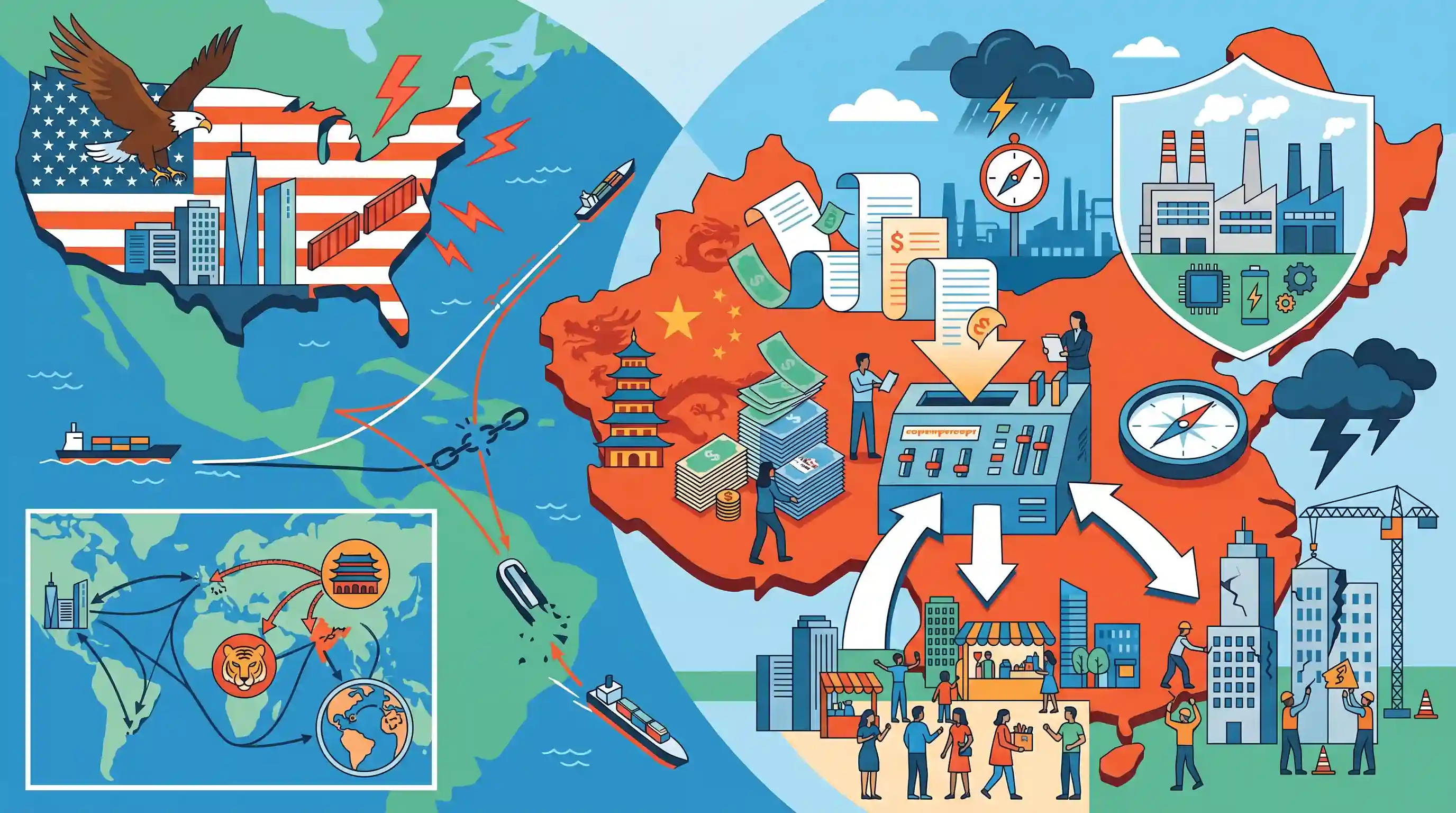
The article analyzes Beijing's economic strategy in response to escalating trade tensions with the United States and domestic structural challenges. Anticipating a prolonged trade war and rising global protectionism, China is introducing new fiscal and monetary tools, heavily relying on the issuance of government bonds to stimulate its slowing economy. The leadership is preparing the country for 'tough times ahead' by shifting focus toward domestic demand, managing local debt crises, and building self-reliance in critical supply chains to insulate itself from external shocks and decoupling pressures.
Key Points
- Beijing is deploying new fiscal and monetary tools, including increased issuance of government bonds, to counter the economic fallout of the US-China trade war.
- The Chinese leadership has issued warnings of a prolonged economic slowdown, signaling a shift towards bolstering domestic consumption and self-reliance.
- Rising protectionism and tariffs are accelerating the decoupling of global supply chains, prompting China to secure its critical technology sectors.
- The stimulus measures are aimed at managing systemic risks, particularly those stemming from local government debt and a distressed real estate market.
Important Terms
People's Bank of China (PBOC)

China's central bank responsible for monetary policy. In 2026, it is deploying 'appropriately loose' measures, including cutting interest rates and the Reserve Requirement Ratio (RRR), to stimulate domestic growth.
UPSC context
GS-II/III: Important for International Relations and Global Economy; central to understanding China’s monetary response to trade shocks.
Ultra-long-term Special Treasury Bonds
Sovereign debt instruments with maturities of 20 to 50 years. Beijing is issuing 1.3 trillion yuan of these in 2026 to fund national security and strategic industrial upgrades.
UPSC context
GS-III: Fiscal Policy; illustrates how major economies use debt to finance long-term strategic self-reliance.
Dual Circulation Strategy
A policy prioritising 'internal circulation' (domestic consumption and production) while maintaining 'external circulation' (foreign trade), aimed at reducing vulnerability to global economic shocks.
UPSC context
GS-II: Effect of policies of developing countries on India; tests understanding of China's inward-looking economic shift.
China Plus One Strategy
A global business strategy where companies diversify supply chains by adding manufacturing bases outside China. India is a primary candidate for this relocation.
UPSC context
GS-III: Indian Economy (Investment Models); crucial for questions on India's manufacturing potential and the PLI scheme.
Hidden Debt (LGFVs)
Debt incurred by local government financing vehicles (LGFVs) that is not officially recorded on government balance sheets, posing a significant systemic risk to China's economy.
UPSC context
GS-III: Global Economy; relevant for understanding structural vulnerabilities in neighboring economies that impact regional stability.
Decoupling and De-risking
The process of breaking interdependencies between economies. 'Selective decoupling' focuses on critical sectors like semiconductors and rare earths to eliminate national security 'chokepoints.'
UPSC context
GS-II: Global Groupings/Agreements; central to the current geopolitical discourse on trade wars and supply chain security.
Prelims Trap
"China's 'Dual Circulation' policy implies a complete shift to closed-door autarky and cessation of foreign trade."
Dual Circulation balances reliance on domestic demand (internal circulation) with targeted global integration (external circulation). It is a derisking strategy, not total isolationism.
Static Concepts Connected
What are the primary trade remedy measures under the WTO framework?
- Anti-Dumping Duty (ADD): Tariffs imposed on goods imported at a price significantly lower than their normal value in the exporting country.
- Countervailing Duty (CVD): Additional import duties designed to offset domestic subsidies provided by the exporting country's government.
- Safeguard Measures: Temporary restrictions (tariffs or quotas) applied when a sudden, unforeseen surge in imports threatens a domestic industry.
How do Local Government Financing Vehicles (LGFVs) function in a macroeconomy?
- Off-balance-sheet borrowing: Investment companies set up by local governments to bypass borrowing limits and fund infrastructure or real estate projects.
- Hidden sovereign risk: Their debt is rarely recorded on the official sovereign ledger, creating massive 'hidden debt' vulnerabilities during property downturns.
Cross-Topic Patterns
Trade War: Dumping vs. Export Opportunities
While US tariffs on China open 'China Plus One' export gaps for Indian textiles and pharma, they simultaneously push cheap Chinese excess capacity into Indian markets, necessitating active trade remedies.
Critical Tech Securitization & Friend-Shoring
The shift from cost-efficiency-driven globalization to security-driven 'friend-shoring' reflects rising sovereign nationalism, directly altering how India navigates critical minerals and semiconductor supply chains.

Expect a GS3 mains question linking China's economic slowdown to dumping risks and India's readiness to leverage 'China Plus One' in 2026.
Linked PYQs · 5
Linked PYQs · 5
- 2024MainsGS2
‘The West is fostering India as an alternative to reduce dependence on China's supply chain and as a strategic ally to counter China's political and economic dominance.’ Explain this statement with examples.
- 2018MainsGS2
What are the key areas of reform if the WTO has to survive in the present context of "Trade War', especially keeping in mind the interest of India?
- 2025MainsGS2
"With the waning of globalization, post-Cold War world is becoming a site of sovereign nationalism.” Elucidate.
- 2021MainsGS2
“The USA is facing an existential threat in the form of a China, that is much more challenging than the erstwhile Soviet Union.” Explain.
- 2023PrelimsGS1
Consider the following statements: Statement-I: Recently, the United States of America (USA) and the European Union (EU) have launched the 'Trade and Technology Council'. Statement-II: The USA and the EU claim that through this they are trying to bring technological progress and physical productivity under their control. Which one of the following is correct in respect of the above statements?
