Diplomatic friction between US and China over Tiananmen Square remarks
Source:The Hindu ↗
Why It Matters
The incident exemplifies the enduring ideological clash between democratic nations and China over human rights, historical memory, and freedom of expression. It is essential for understanding the broader US-China geopolitical rivalry, the strategic positioning of Taiwan, and the implications of stringent security laws on civil society in regions like Hong Kong.
Summary
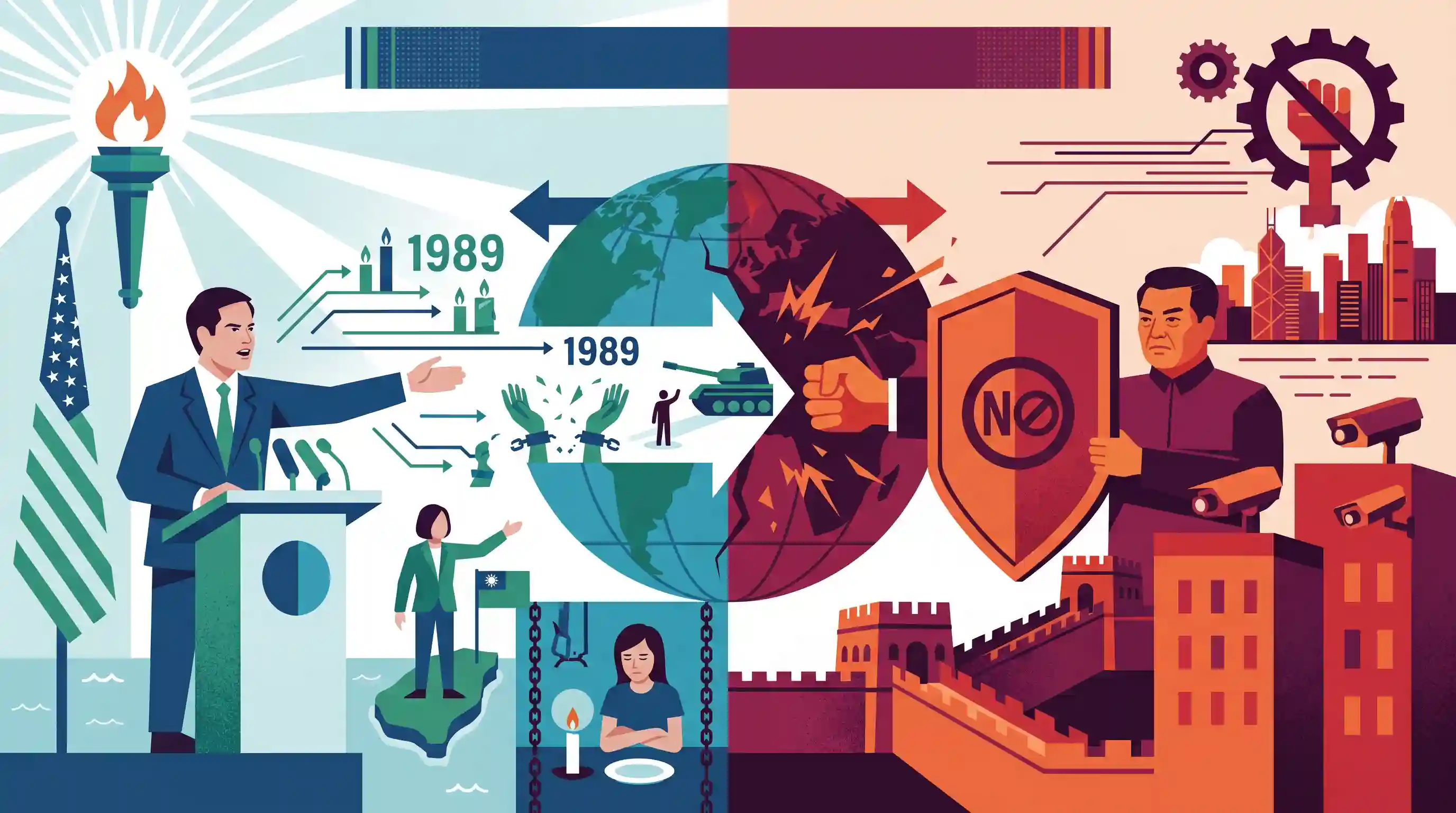
The article outlines the diplomatic friction between China and the United States following US Secretary of State Marco Rubio's condemnation of the 1989 Tiananmen Square crackdown. Beijing strongly criticized the remarks, labeling them as an attack and an interference in its domestic affairs. Concurrently, the anniversary saw a hunger strike by Hong Kong activist Chow Hang-tung, drawing attention to the severe suppression of dissent under Hong Kong's national security law. Taiwanese President Lai Ching-te supported the US stance, underscoring the deep-seated ideological tensions between democratic systems and authoritarian regimes in the broader context of US-China geopolitical rivalry.
Key Points
- US Secretary of State Marco Rubio criticized China for the 1989 Tiananmen Square crackdown on pro-democracy activists, sparking a sharp rebuke from Beijing.
- China condemned the remarks as a malicious distortion of facts and a serious interference in its internal affairs.
- Hong Kong activist Chow Hang-tung initiated a 36-hour hunger strike to mark the anniversary, highlighting the suppression of dissent under Hong Kong's strict national security law.
- Taiwanese President Lai Ching-te echoed Rubio's remarks, using the opportunity to emphasize the contrast between Taiwan's vibrant democracy and authoritarian rule.
Important Terms
Tiananmen Square Protests (1989)

A student-led pro-democracy movement in 1989 calling for political reforms, ending in a violent military crackdown on June 4. It remains a sensitive symbol of human rights and political suppression in China.
UPSC context
GS Paper II: International Relations and Human Rights; GS Paper I: World History. Tests knowledge of historical events shaping modern Chinese governance.
Hong Kong National Security Law (NSL)
Enacted by Beijing in 2020, it criminalizes secession, subversion, terrorism, and collusion with foreign forces. It effectively dismantled Hong Kong's autonomy under the 'One Country, Two Systems' framework to suppress dissent.
UPSC context
GS Paper II: International Relations/Bilateral Agreements. Relevant for understanding shifts in global democratic norms and China's assertive internal policies.
Cross-Strait Relations
The sensitive political and economic relationship between mainland China (PRC) and Taiwan (ROC). It is a central flashpoint in the Indo-Pacific, involving competing claims of sovereignty and 'One China' policies.
UPSC context
GS Paper II: Bilateral and Regional groupings. Crucial for Indo-Pacific security and India’s strategic 'Act East' policy.
Principle of Non-Interference
A core foreign policy tenet (enshrined in Panchsheel) stating that no state should intervene in another's domestic affairs. China uses this to deflect international criticism on human rights or sovereignty issues.
UPSC context
GS Paper II: India and its Neighborhood; Indian Foreign Policy. Tests understanding of the 'Five Principles of Peaceful Coexistence' (Panchsheel).
Democracy vs. Authoritarianism Rivalry
The framing of US-China competition as a struggle between liberal democratic systems (emphasizing individual rights) and authoritarian governance models (prioritizing state stability and centralized party control).
UPSC context
GS Paper II: Global Power Dynamics. Relevant for analyzing 'Strategic Autonomy' and how India navigates the new Cold War-like global landscape.
Prelims Trap
Hong Kong's 2020 National Security Law was passed by its local Legislative Council to curb protests.
The law was controversially enacted directly by Beijing's National People's Congress Standing Committee, intentionally bypassing Hong Kong's local legislature.
Static Concepts Connected
What is the "One Country, Two Systems" constitutional principle?
- Origins: Formulated by Deng Xiaoping in the 1980s, initially aimed at peacefully reuniting Taiwan with mainland China.
- Application: Applied to Hong Kong (1997) and Macau (1999), promising a "high degree of autonomy" for 50 years.
- Core feature: Allows these regions to retain their own capitalist economic, legal, and political systems distinct from the socialist mainland.
What are the five principles of the Panchsheel Agreement (1954)?
- Territorial integrity: Mutual respect for each other's territorial integrity and sovereignty.
- Non-interference: Mutual non-aggression and mutual non-interference in each other's internal affairs (the principle invoked by China here).
- Peaceful co-existence: Equality, mutual benefit, and peaceful co-existence.
Cross-Topic Patterns
Ideological blocks in the Indo-Pacific
The US framing of "Democracy vs Authoritarianism" serves as the ideological glue for Indo-Pacific alliances like Quad and AUKUS, positioning Taiwan and India as democratic anchors against Chinese hegemony.
Sovereignty vs. Universal Human Rights
China's defense relies on the Westphalian concept of absolute sovereignty (non-interference) to deflect criticisms, presenting a classic GS2/GS4 debate between Universal Human Rights and State Sovereignty.

Expect a 2026 GS2 Mains question linking the collapse of HK's 'One Country, Two Systems' to Taiwan's defensive posturing against China.
Linked PYQs · 3
Linked PYQs · 3
- 2021MainsGS2
“The USA is facing an existential threat in the form of a China, that is much more challenging than the erstwhile Soviet Union.” Explain.
- 2025MainsGS2
"The reform process in the United Nations remains unresolved, because of the delicate imbalance of East and West and entanglement of the USA vs. Russo-Chinese alliance.” Examine and critically evaluate the East-West policy confrontations in this regard.
- 2014MainsGS2
What do you understand by the concept "freedom of speech and expression"? Does it cover hate speech also ? Why do the films in India stand on a slightly different plane from other forms of expression ? Discuss.
