Delimitation and Welfare Schemes Drive Electoral Success in Assam
Source:Indian Express ↗
Why It Matters
Offers a comprehensive case study for Mains GS2 and GS3 on how delimitation, direct-benefit welfare schemes, infrastructure development, and identity politics (NRC/CAA) intersect to shape electoral outcomes and governance in the demographically sensitive North East region.
Summary
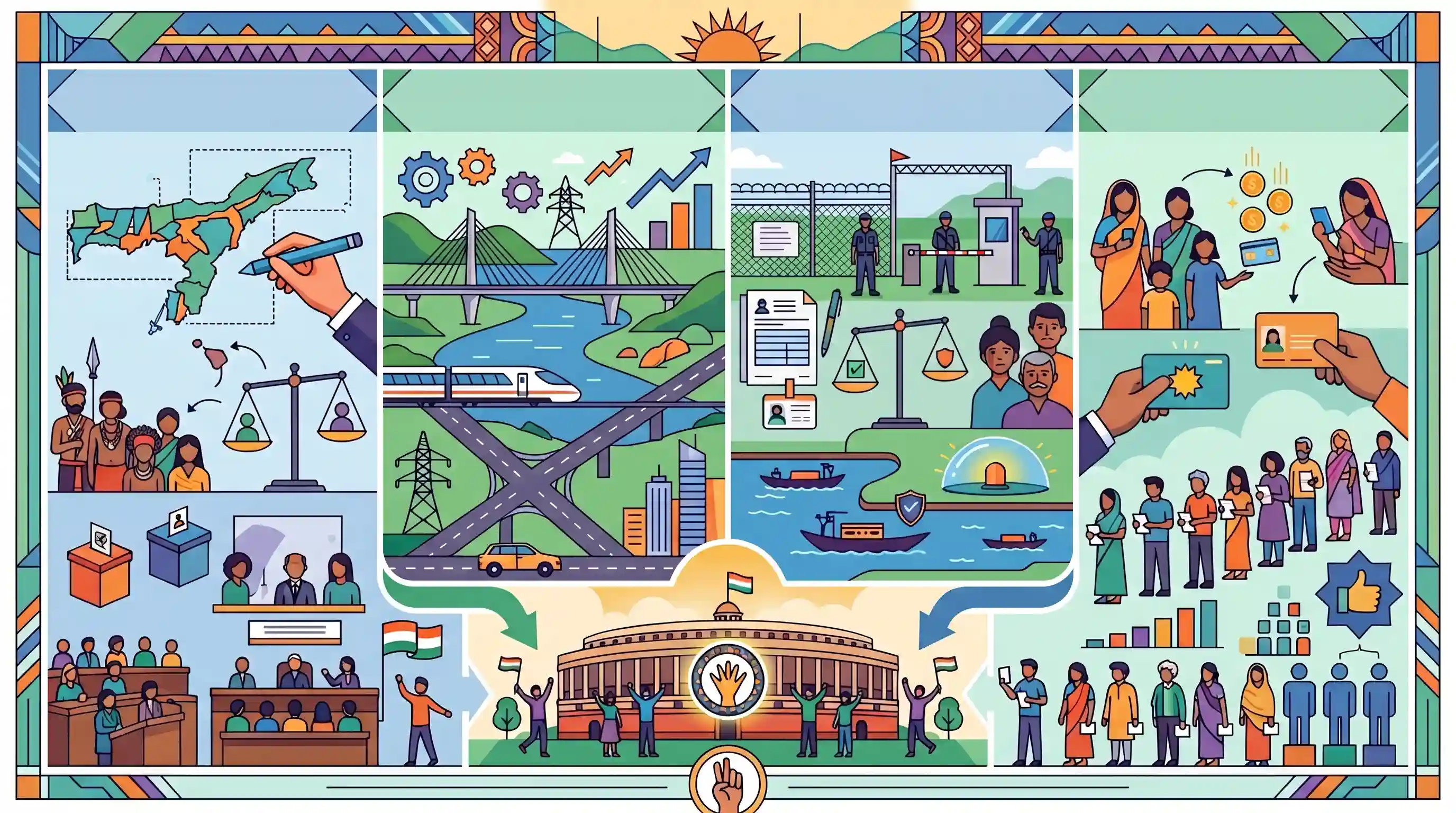
The article deconstructs the political strategies behind the BJP's consecutive electoral victories in Assam. It attributes this success to a multi-pronged approach: the strategic 2023 delimitation exercise that addressed indigenous political anxieties, large-scale infrastructure projects boosting connectivity, the navigation of complex identity issues via the NRC and CAA, and the widespread impact of targeted welfare programs like 'Orunodoi' that created a consolidated beneficiary voting bloc.
Key Points
- The 2023 delimitation exercise in Assam significantly altered the state's political map by increasing SC/ST representation and protecting the political space of indigenous communities.
- The effective implementation of the Direct Benefit Transfer (DBT) scheme 'Orunodoi', targeting women across caste and religious divides, created a massive and loyal 'beneficiary class'.
- Rapid infrastructural development under initiatives like 'Asom Mala' and bridge projects over the Brahmaputra significantly improved connectivity and economic integration in the region.
- Careful navigation of the National Register of Citizens (NRC) and the Citizenship (Amendment) Act (CAA) helped the ruling party address deep-seated ethnic and demographic anxieties concerning illegal migration.
- The creation of a 'rainbow alliance' with regional parties like the AGP and UPPL successfully integrated various ethnic and tribal sub-nationalities into a broader political coalition.
Important Terms
Citizenship (Amendment) Act (CAA) 2019

A 2019 law fast-tracking Indian citizenship for persecuted religious minorities (Hindus, Sikhs, Buddhists, Jains, Parsis, Christians) from Afghanistan, Bangladesh, and Pakistan who entered India before December 31, 2014.
UPSC context
GS Paper II: Citizenship, Secularism, and Article 14. Essential for understanding legal frameworks for migration and religious classification.
National Register of Citizens (NRC)
A record of genuine Indian citizens, updated in Assam under Supreme Court supervision to identify illegal immigrants based on a March 24, 1971, cut-off date.
UPSC context
GS Paper II & III: Governance, Internal Security, and Border Management. Tests knowledge of the Assam Accord and citizenship verification.
Delimitation (Assam 2023)
The 2023 redrawing of Assam's Assembly and Parliamentary constituency boundaries based on the 2001 Census, aimed at reflecting population changes and safeguarding indigenous political representation.
UPSC context
GS Paper II: Elections and Representation. Tests understanding of Article 82, Article 170, and the role of the Election Commission.
Orunodoi Scheme
A flagship Direct Benefit Transfer (DBT) scheme in Assam providing monthly financial assistance (currently ₹1,250) to women in economically vulnerable households to support basic needs.
UPSC context
GS Paper II: Welfare Schemes for vulnerable sections. Analyzes the impact of "Labharthi" (beneficiary) politics and social security.
Lakhpati Baideo
An Assam government initiative to empower 40 lakh women Self-Help Group (SHG) members by providing financial support and training to help them achieve an annual income of ₹1 lakh.
UPSC context
GS Paper II & III: Women Empowerment and Rural Development. Focuses on SHG-led micro-entrepreneurship and population control linkages.
Asom Mala
A flagship road infrastructure program by the Assam government, modeled after the national 'Bharatmala' project, to upgrade state highways and major district roads for enhanced connectivity.
UPSC context
GS Paper III: Infrastructure and Connectivity. Highlights regional integration and the role of state-level projects in national logistics frameworks.
Prelims Trap
The 2023 delimitation increased Assam's total Assembly seats and was based on the 2011 census data.
The 2023 exercise in Assam retained the total 126 seats; it only readjusted boundaries and increased SC/ST reserved seats. Furthermore, it was uniquely based on the 2001 census, not 2011.
Static Concepts Connected
What are the Constitutional provisions and powers of the Delimitation Commission?
- Constitutional Backing: Under Article 82, Parliament enacts a Delimitation Act. The Commission is appointed by the President and usually headed by a retired Supreme Court judge.
- Absolute Authority: Its orders have the force of law and cannot be questioned before any court, ensuring the boundary-drawing process remains free from endless judicial stays.
- No Modifications Allowed: Copies of its orders are laid before the Lok Sabha and the concerned State Legislative Assembly, but they cannot effect any modifications to them.
How does the Citizenship (Amendment) Act (CAA) interact with existing protections in the North-East?
- Sixth Schedule Exemption: The CAA explicitly exempts tribal areas of Assam, Meghalaya, Mizoram, and Tripura that are included in the Sixth Schedule of the Constitution.
- Inner Line Permit: The Act also excludes states and areas protected under the Inner Line Permit (ILP) system notified under the Bengal Eastern Frontier Regulation, 1873.
Cross-Topic Patterns
DBT Schemes & Fiscal Federalism
State-level DBT schemes like Orunodoi yield high political dividends but create fiscal burdens, directly connecting women's empowerment initiatives with ongoing UPSC debates on state debt and 'freebies'.
Delimitation & Demographic Anxieties
Assam's delimitation addresses local indigenous anxieties, serving as a microcosm for the impending post-2026 national delimitation debates regarding demographic shifts and political representation.

Expect a 2026 Mains question analyzing the interplay of delimitation, CAA exemptions, and Sixth Schedule in addressing NE sub-nationalism.
Linked PYQs · 4
Linked PYQs · 4
- 2014MainsGS3
How does illegal transborder migration pose a threat to India's security? Discuss the strategies to curb this, bringing out the factors which give impetus to such migration.
- 2022MainsGS2
Besides the welfare schemes, India needs deft management of inflation and unemployment to serve the poor and the underprivileged sections of the society. Discuss.
- 2017MainsGS2
Poverty alleviation programmes in India remain mere showpieces until and unless they are backed up by political will." Discuss with reference to the performance of the major poverty alleviation programmes in India.
- 2022MainsGS2
“Right of movement and residence throughout the territory of India are freely available to the Indian citizens, but these rights are not absolute.” Comment.
