Winter rain deficit impact on early summer and heatwave conditions
Source:Indian Express ↗
Why It Matters
Western Disturbances and their impact on the Indian climate are core syllabus topics for UPSC Geography. The increasing frequency of heatwaves and changing precipitation patterns directly link physical geography to environmental degradation and agricultural economics, making this crucial for Prelims (conceptual questions on weather systems) and Mains (GS1 Geography, GS3 Disaster Management and Agriculture).
Summary
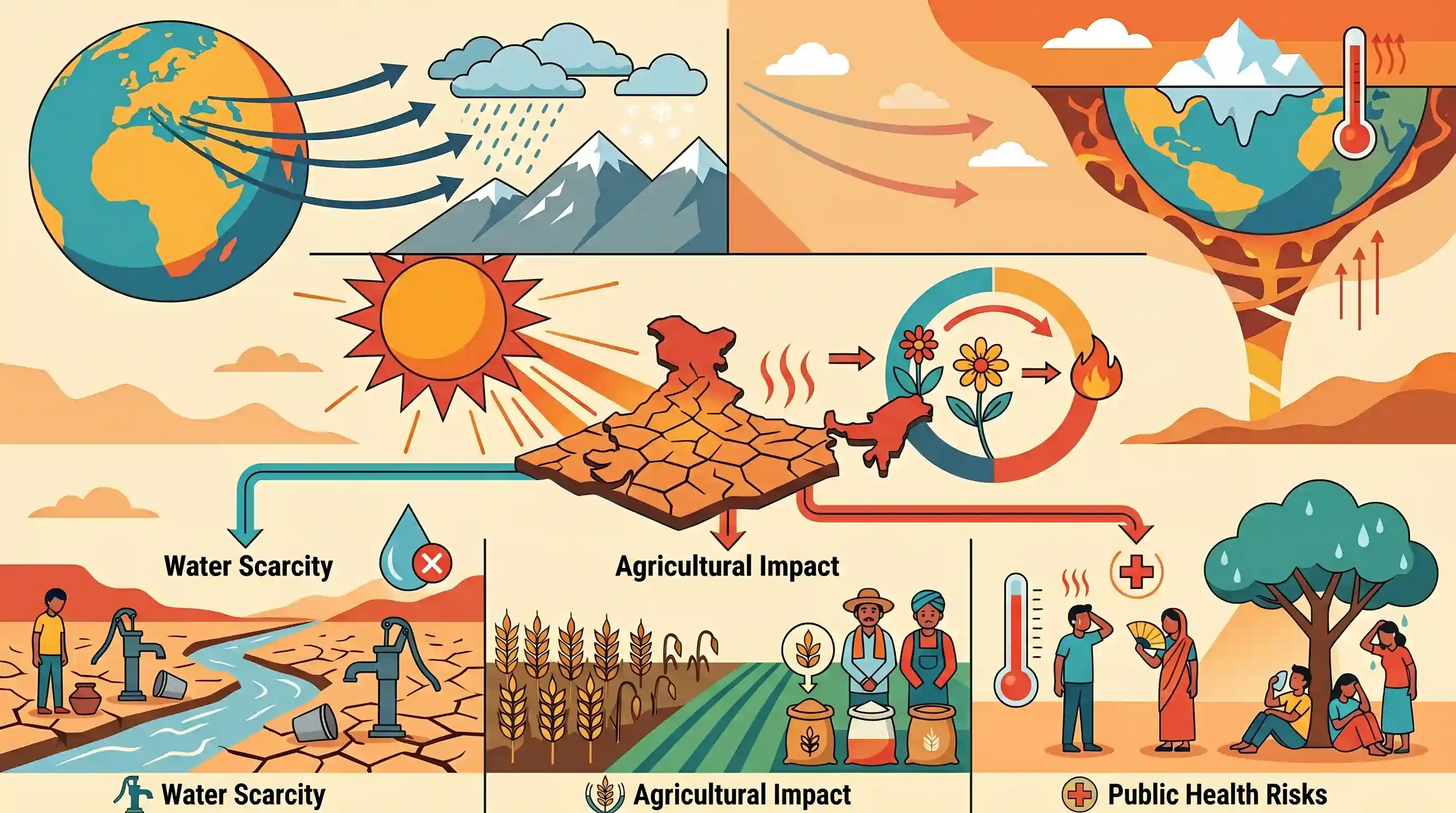
The early onset of severe heatwave conditions in North India is largely driven by a significant deficit in winter precipitation, a consequence of fewer and less active Western Disturbances. These Mediterranean-born weather systems typically bring crucial winter rain to the region, maintaining soil moisture and moderating temperatures through spring. Their absence this year has led to rapid landmass heating, bypassing the spring season altogether. This anomaly highlights the growing impact of climate change on established regional weather patterns, posing serious risks to water availability, agricultural yields (particularly Rabi crops), and public health due to prolonged heat exposure.
Key Points
- North India is experiencing an unusually early onset of summer and heatwave conditions, effectively skipping the spring season.
- The India Meteorological Department (IMD) attributes these anomalous high temperatures to a significant lack of active Western Disturbances during the preceding winter months.
- Western Disturbances are extratropical storms originating in the Mediterranean that are crucial for bringing winter precipitation to northwestern India.
- The absence of adequate winter rainfall has dried out the soil and atmosphere earlier than usual, accelerating the heating of the landmass and raising concerns for Rabi crops (like wheat) and water security.
- Climate change is increasingly disrupting traditional weather patterns, altering the frequency and intensity of Western Disturbances and leading to more erratic climatic anomalies.
Important Terms
Western Disturbances

Extratropical cyclonic storms originating in the Mediterranean region that travel eastwards to bring crucial winter precipitation (rain and snow) to Northwest India.
UPSC context
GS Paper I (Geography/Geophysical phenomena) and GS Paper III (Agriculture). Vital for understanding Indian winter weather and food security.
Heatwave
A period of abnormally high temperatures, defined by IMD when a station's maximum temperature reaches 40°C in plains or 30°C in hills, showing significant departure from the normal.
UPSC context
GS Paper I (Geography) and GS Paper III (Disaster Management). Classified as a silent disaster due to health and economic impacts.
India Meteorological Department (IMD)
India's nodal agency under the Ministry of Earth Sciences (est. 1875) responsible for weather observations, forecasting, and issuing warnings for severe weather like cyclones and heatwaves.
UPSC context
GS Paper I & III. Critical for disaster preparedness, monsoon forecasting, and climate change monitoring.
Rabi Crops
Winter crops sown from October to December and harvested in spring. They thrive in cool temperatures and depend on winter rains and residual soil moisture. Examples: wheat, mustard.
UPSC context
GS Paper III (Agriculture). Yields are highly sensitive to winter precipitation deficits caused by inactive Western Disturbances.
Subtropical Westerly Jet Stream
High-speed winds in the upper troposphere that flow south of the Himalayas in winter. They steer Western Disturbances into India, influencing the region's winter precipitation patterns.
UPSC context
GS Paper I (Climatology). Understanding its seasonal shift is essential for explaining the onset of winter rains and the monsoon.
Prelims Trap
Heatwaves are a Notified National Disaster, making states eligible to use full SDRF funds.
Heatwaves are NOT notified national disasters under the DMA 2005. States are legally restricted to using a maximum of 10% of their SDRF for heatwave relief.
Static Concepts Connected
What is the geographical mechanism behind Western Disturbances?
- Origin: They are extratropical, low-pressure storm systems that originate over the Mediterranean Sea.
- Transport: They are carried eastward into the Indian subcontinent by the Subtropical Westerly Jet Streams in the upper atmosphere.
- Agricultural impact: They provide vital winter winter rainfall to northwestern India, which is crucial for Rabi crops like wheat and barley.
How does the IMD officially classify a heatwave?
- Plains threshold: The maximum temperature must reach at least 40°C.
- Hilly regions threshold: The maximum temperature must reach at least 30°C.
- Normal departure: The recorded temperature must show a departure of 4.5°C to 6.4°C from the region's normal temperature.
Cross-Topic Patterns
Terminal heat stress in Rabi crops
The absence of winter rain directly triggers 'terminal heat stress' during the critical grain-filling stage of wheat, linking shifting climatology to GS3 food security and MSP debates.
Jet stream shifting and climate change
Global climatic anomalies can shift the subtropical westerly jet stream poleward, steering Western Disturbances away from India and disrupting the entire rabi hydrological cycle.

Expect a multi-statement Prelims question linking Western Disturbance mechanisms with IMD heatwave criteria and SDRF funding limitations.
Linked PYQs · 4
Linked PYQs · 4
- 2015PrelimsGS1
Consider the following statements: 1. The winds which blow between 30° N and 60° S latitudes through-out the year are known as westerlies. 2. The moist air masses that cause winter rains in North-Western region of India are part of westerlies. Which of the statements given above is/are correct?
- 2025PrelimsGS1
The World Bank warned that India could become one of the first places where wet-bulb temperatures routinely exceed 35 °C. Which of the following statements best reflect(s) the implication of the above-said report? I. Peninsular India will most likely suffer from flooding, tropical cyclones and droughts. II. The survival of animals including humans will be affected as shedding of their body heat through perspiration becomes difficult. Select the correct answer using the code given below.
- 2011MainsGS1
Discuss the impact of climate change on water resources in India.
- 2014MainsGS1
Bring out the relationship between the shrinking Himalayan glaciers and the symptoms of climate change in the Indian sub-continent.
