Decline of Legislative Scrutiny and Rising Judicial Litigation
Source:The Hindu ↗
Why It Matters
The quality of legislation directly impacts governance, fundamental rights, and the judicial docket. Understanding the institutional mechanisms for law-making (like DRPSCs and PLCP), their recent decline, and the resultant shift of power to the judiciary is a core theme for GS-2 Polity and Governance.
Summary
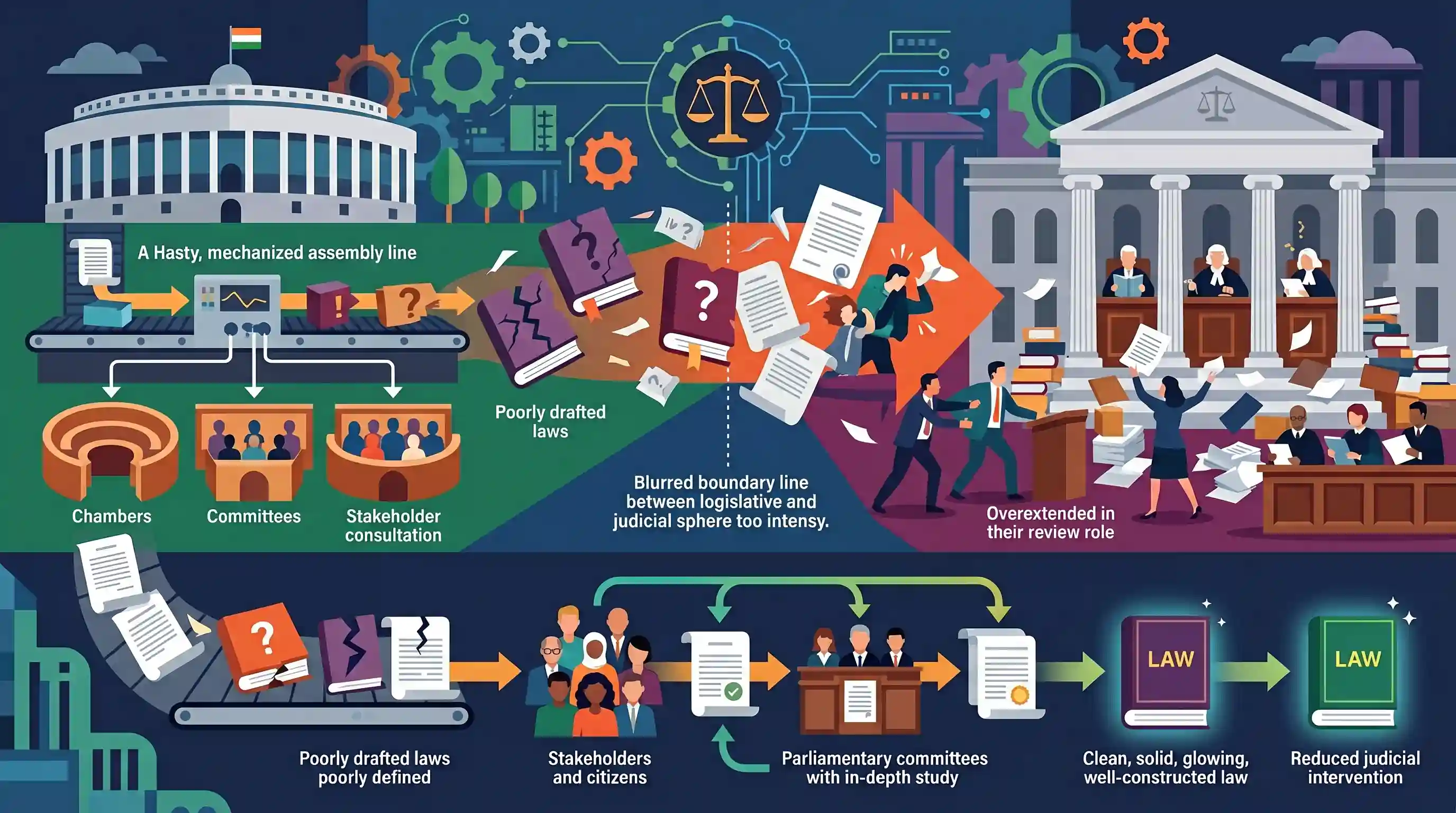
The article critiques the growing trend of bypassing rigorous legislative scrutiny, which results in poorly drafted laws that inevitably face protracted litigation in courts. It highlights the systemic circumvention of Department-related Parliamentary Standing Committees (DRPSCs) and the non-adherence to the Pre-Legislative Consultation Policy (PLCP) of 2014. Hasty legislative processes, devoid of adequate stakeholder feedback or substantive parliamentary debate, often lead to unconstitutional or ambiguous provisions. Consequently, the burden shifts to the judiciary to review and rectify these laws, leading to a blurring of the separation of powers. The piece advocates for institutionalizing mandatory pre-legislative consultation and strengthening parliamentary committees to ensure that legislation is robust, democratic, and less prone to judicial invalidation.
Key Points
- Decline in Parliamentary Scrutiny: A significant drop in the percentage of Bills referred to Parliamentary Standing Committees, reducing the space for bipartisan, detailed evaluation of proposed laws.
- Neglect of Pre-Legislative Consultation: Frequent bypassing of the 2014 Pre-Legislative Consultation Policy (PLCP), which mandates placing draft Bills in the public domain for 30 days for stakeholder feedback.
- Judicial Burden and Separation of Powers: Ambiguous and hastily passed laws inevitably end up in constitutional courts, forcing the judiciary to interpret or strike them down, thereby straining the separation of powers.
- Democratic Deficit: Rushing legislation without adequate debate in Parliament and bypassing public feedback mechanisms undermines democratic consensus building.
- Way Forward: Making the PLCP statutory, mandating the referral of complex Bills to DRPSCs, and ensuring adequate time for legislative debates to prevent 'legislation by litigation'.
Important Terms
Pre-Legislative Consultation Policy (PLCP) 2014

A 2014 directive requiring government departments to proactively share draft legislation for public feedback for at least 30 days before introduction in Parliament.
UPSC context
GS II: Government policies. Tests understanding of transparency and public participation in the law-making process.
Department-related Parliamentary Standing Committees (DRPSCs)
24 permanent joint committees that perform detailed scrutiny of bills, ministry budgets, and annual reports to ensure executive accountability to Parliament.
UPSC context
GS II: Parliament. Tests knowledge of legislative oversight mechanisms and the impact of bypassing committee scrutiny.
Separation of Powers
A constitutional doctrine dividing state functions into Legislative, Executive, and Judicial branches to prevent power concentration and ensure mutual checks and balances.
UPSC context
GS II: Constitutional features. Tests conceptual clarity on functional boundaries and issues like judicial overreach.
Judicial Review
The power of higher courts to examine and potentially invalidate legislative or executive actions that violate constitutional provisions or fundamental rights.
UPSC context
GS II: Judiciary. Focuses on its role in rectifying poorly drafted laws and maintaining constitutional supremacy.
Legislative Scrutiny
The procedural process through which Parliament examines the quality, necessity, and legality of a Bill before it becomes law.
UPSC context
GS II: Parliament—conduct of business. Tests understanding of safeguards that prevent hasty or unconstitutional law-making.
Prelims Trap
The Pre-Legislative Consultation Policy (PLCP) 2014 is a statutory mandate requiring 30-day public feedback.
The PLCP 2014 is purely an executive guideline (established by the Committee of Secretaries), not a statutory or constitutional mandate. Bypassing it currently carries no legal penalty.
Static Concepts Connected
What is the structure and mandate of Department-related Parliamentary Standing Committees (DRPSCs)?
- Composition: Each committee has 31 members (21 from Lok Sabha, 10 from Rajya Sabha), nominated by the Speaker and Chairman respectively.
- Core mandate: They examine Bills referred to them, select demands for grants, annual reports of ministries, and basic long-term policy documents.
- Advisory nature: Their recommendations are not binding on Parliament or the government, but they carry significant persuasive value and facilitate bipartisan consensus.
- Discretionary referral: Once a bill is introduced, referring it to a DRPSC is at the discretion of the Presiding Officer, not a mandatory requirement.
How does the Constitution insulate Parliament from judicial interference?
- Article 122: Courts are prohibited from inquiring into the validity of any parliamentary proceedings on the grounds of any alleged irregularity of procedure.
- Article 105: MPs enjoy parliamentary privileges, shielding them from judicial proceedings for anything said or any vote given in Parliament or its committees.
- Judicial Review limits: While courts cannot review legislative procedures (like bypassing committees), they retain the power of Judicial Review over the final enacted law's constitutionality.
Cross-Topic Patterns
Delegated legislation & executive overreach
Hasty primary legislation increasingly leaves crucial details to delegated legislation (rules made by the executive). This limits parliamentary scrutiny and increases the risk of executive overreach.
Judicial pendency & state capacity
Poorly drafted laws resulting from skipped PLCP or DRPSC scrutiny directly fuel India's judicial backlog, transforming a legislative deficit into a chronic governance and state capacity issue.

Expect a GS-2 Mains question linking the decline in DRPSC referrals directly to the rising trend of judicial overreach and litigation.
Linked PYQs · 4
Linked PYQs · 4
- 2021MainsGS2
Do Department-related Parliamentary Standing Committees keep the administration on its toes and inspire reverence for parliamentary control? Evaluate the working of such committees with suitable examples.
- 2020MainsGS2
Judicial Legislation is antithetical to the doctrine of separation of powers as envisaged in the Indian Constitution. In this context justify the filing of large number of public interest petitions praying for issuing guidelines to executive authorities.
- 2018MainsGS2
Why do you think the committees are considered to be useful for parliamentary work? Discuss, in this context, the role of the Estimates Committee.
- 2023MainsGS2
Explain the structure of the Parliamentary Committee system. How far have the financial committees helped in the institutionalisation of Indian Parliament?
