Indigenous seed sovereignty and agricultural biodiversity conservation
Source:The Hindu ↗
Why It Matters
The transition to indigenous seed preservation is crucial for India's food security and climate-resilient agricultural strategy, particularly for vulnerable tribal populations mitigating the risks of market-driven agricultural monopolies.
Summary
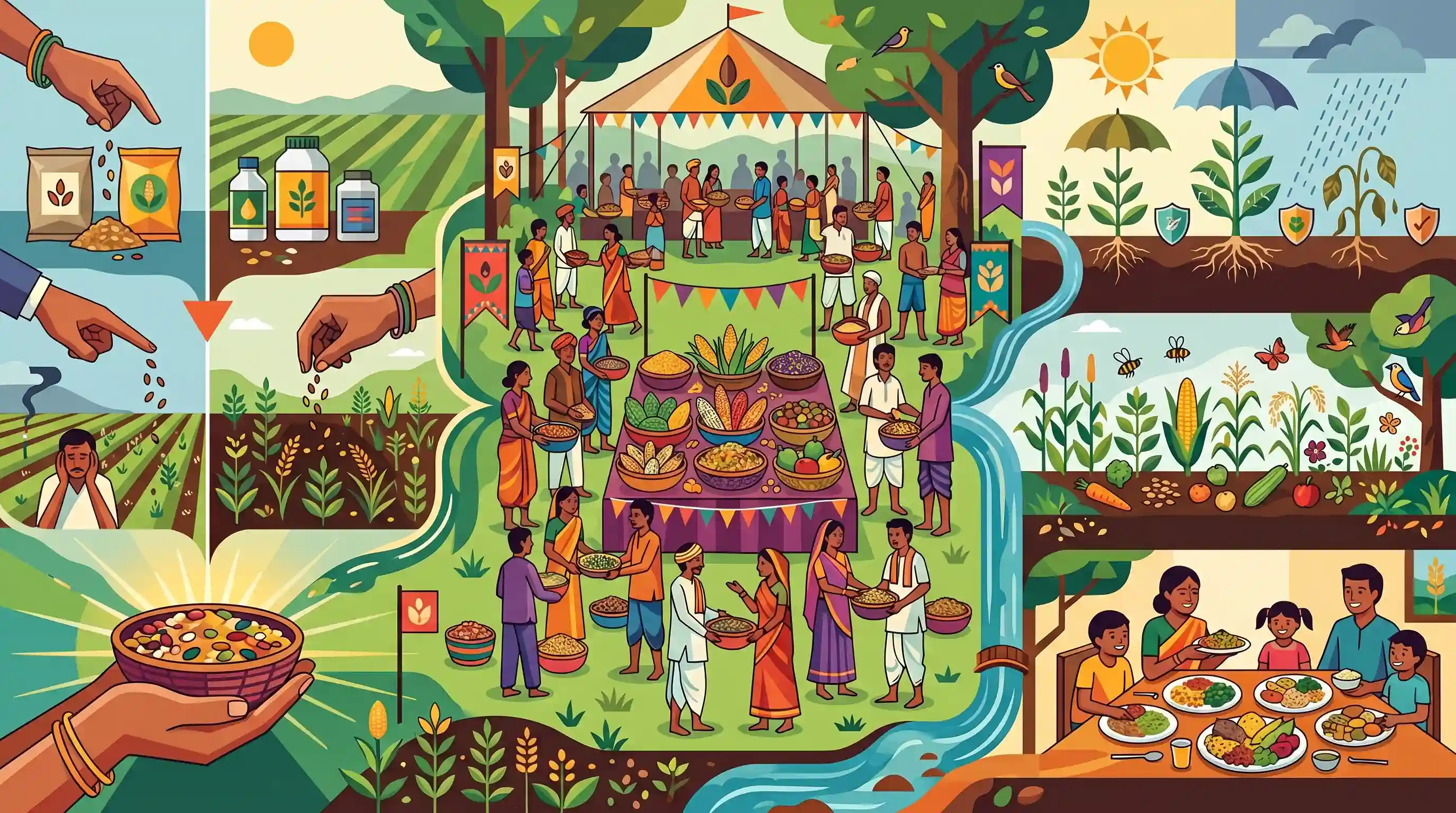
The 'Beej Utsav' organized in the tribal belt of Rajasthan, Madhya Pradesh, and Gujarat has highlighted the critical role of indigenous seeds in ensuring agricultural sustainability. Emphasizing the concept of seed sovereignty, the four-day festival mobilized thousands of tribal farmers to prioritize locally adapted, native crop varieties over expensive and chemical-dependent hybrid seeds. By showcasing traditional varieties of maize, paddy, and wild fruits, the initiative demonstrated that indigenous agricultural practices offer viable, localized solutions for climate change adaptation, biodiversity conservation, and nutritional security.
Key Points
- A four-day 'Beej Utsav' (seed festival) brought together over 9,400 tribal members from the tri-junction of Rajasthan, Madhya Pradesh, and Gujarat to celebrate indigenous seeds.
- Organized across 60 village panchayats by community-led institutions, including Krishi Evam Adivasi Swaraj Sangathan, with support from voluntary group Vaagdhara.
- The event aimed at reclaiming seed sovereignty, encouraging farmers to break away from high-cost, chemical-intensive hybrid seeds pushed by commercial markets.
- Exhibitions featured traditional varieties such as native maize (Doodh Mogar), traditional paddy (Kali Kamod, Dhimri), wild mango, and wild melon.
- Promotion of indigenous seeds was framed as a crucial strategy for climate resilience, biodiversity conservation, and securing food and nutritional security for marginalized communities.
Important Terms
Seed Sovereignty

The right of farmers and communities to save, use, exchange, and sell seeds, ensuring autonomy over food systems and reducing dependence on commercial hybrid or genetically modified seed corporations.
UPSC context
GS Paper III: Agriculture and Food Security. Tests concepts of farmer rights, biodiversity, and sustainable agricultural practices.
Vaagdhara
A Banswara-based voluntary organization facilitating tribal communities in Rajasthan, MP, and Gujarat to achieve 'Swaraj' through indigenous knowledge, climate-resilient farming, and community-led developmental initiatives.
UPSC context
GS Paper II/III: Role of NGOs and Civil Society. Exemplifies grassroots intervention in tribal livelihoods and environmental conservation.
Krishi Evam Adivasi Swaraj Sangathan
A federation of tribal-led organizations in Central India advocating for the preservation of indigenous seeds and traditional agricultural practices to counter market-driven, chemical-heavy industrial farming.
UPSC context
GS Paper III: Major crops and cropping patterns. Relevant for community-driven biodiversity conservation and tribal rights.
Saksham Samooh
A village-level collective specifically for tribal women farmers aimed at promoting sustainable integrated farming, reducing input costs, and establishing community seed banks for economic self-reliance.
UPSC context
GS Paper III: Women in Agriculture. Important for discussing gendered dimensions of agricultural sustainability and grassroots empowerment.
Gram Swaraj Samooh
Inclusive village-level institutions composed of community representatives that work toward local governance, social justice, and the integration of traditional knowledge into modern village development plans.
UPSC context
GS Paper II: Panchayati Raj and Local Governance. Tests models of participatory democracy and indigenous self-rule.
Bal Swaraj Samooh
A community-based youth and children's organization focused on fostering environmental awareness, leadership, and the preservation of tribal cultural heritage among future generations.
UPSC context
GS Paper II: Social Justice. Relevant for issues related to children's rights and youth participation in sustainable development.
Prelims Trap
Farmers have the absolute right to sell seeds of protected varieties, including branded seeds, under the PPV&FR Act.
Under the PPV&FR Act 2001, farmers can save, use, exchange, and sell farm produce including seeds of a protected variety, but they are strictly prohibited from selling them as branded seeds.
Static Concepts Connected
What are the farmer rights under the PPV&FR Act, 2001?
- Seed Rights: Farmers can save, use, sow, resow, exchange, share, or sell unbranded seeds of a protected variety.
- Compensation Right: Farmers can claim compensation if a protected variety fails to provide the expected performance under specified conditions.
- Reward Right: Farmers are eligible for recognition and rewards for conserving wild or traditional plant varieties.
What is the 'Seed Village' concept in Indian agriculture?
- Core Objective: Training local farmers in a village to produce quality seeds of various crops for themselves and neighboring villages.
- Self-sufficiency: It ensures timely and affordable availability of quality seeds at the local level, reducing dependence on external markets.
- Seed Replacement: The model systematically upgrades the quality of farm-saved seeds, boosting the overall Seed Replacement Rate (SRR).
Cross-Topic Patterns
Indigenous seeds & climate resilient agriculture
Native seeds require less water and chemical inputs, linking directly to crop diversification strategies and the National Innovations in Climate Resilient Agriculture (NICRA) initiative.
Tribal rights & agrobiodiversity conservation
The active role of tribal belts in conserving wild fruits and native seeds directly ties into traditional ecological knowledge (TEK) and community rights under the Forest Rights Act.
Seed sovereignty vs. IPR regimes
The push for seed sovereignty counters monopolistic corporate seed patents (like GM crops), highlighting the tension between India's sui generis PPV&FR Act and global UPOV/TRIPS models.

A Prelims matching question pairing native crop varieties (e.g., Doodh Mogar, Kali Kamod) with their respective crop types is highly likely.
Linked PYQs · 3
Linked PYQs · 3
- 2020PrelimsGS1
In the context of India, which of the following is/are considered to be practice(s) of eco-friendly agriculture ? 1. Crop diversification 2. Legume intensification 3. Tensiometer use 4. Vertical farming Select the correct answer using the code given below:
- 2021MainsGS3
What are the present challenges before crop diversification? How do emerging technologies provide an opportunity for crop diversification?
- 2023MainsGS3
Explain the changes in cropping pattern in India in the context of changes in consumption pattern and marketing conditions.
