Beedi workers seek GST cut from 28% to 5% to protect livelihoods
Source:The Hindu ↗
Why It Matters
This issue highlights the tension between public health-oriented taxation (high GST on tobacco products) and the livelihood security of informal sector workers, particularly women. It is highly relevant for GS3 discussions on the impact of GST, MSME/cottage industry policies, and employment in the unorganized sector.
Summary
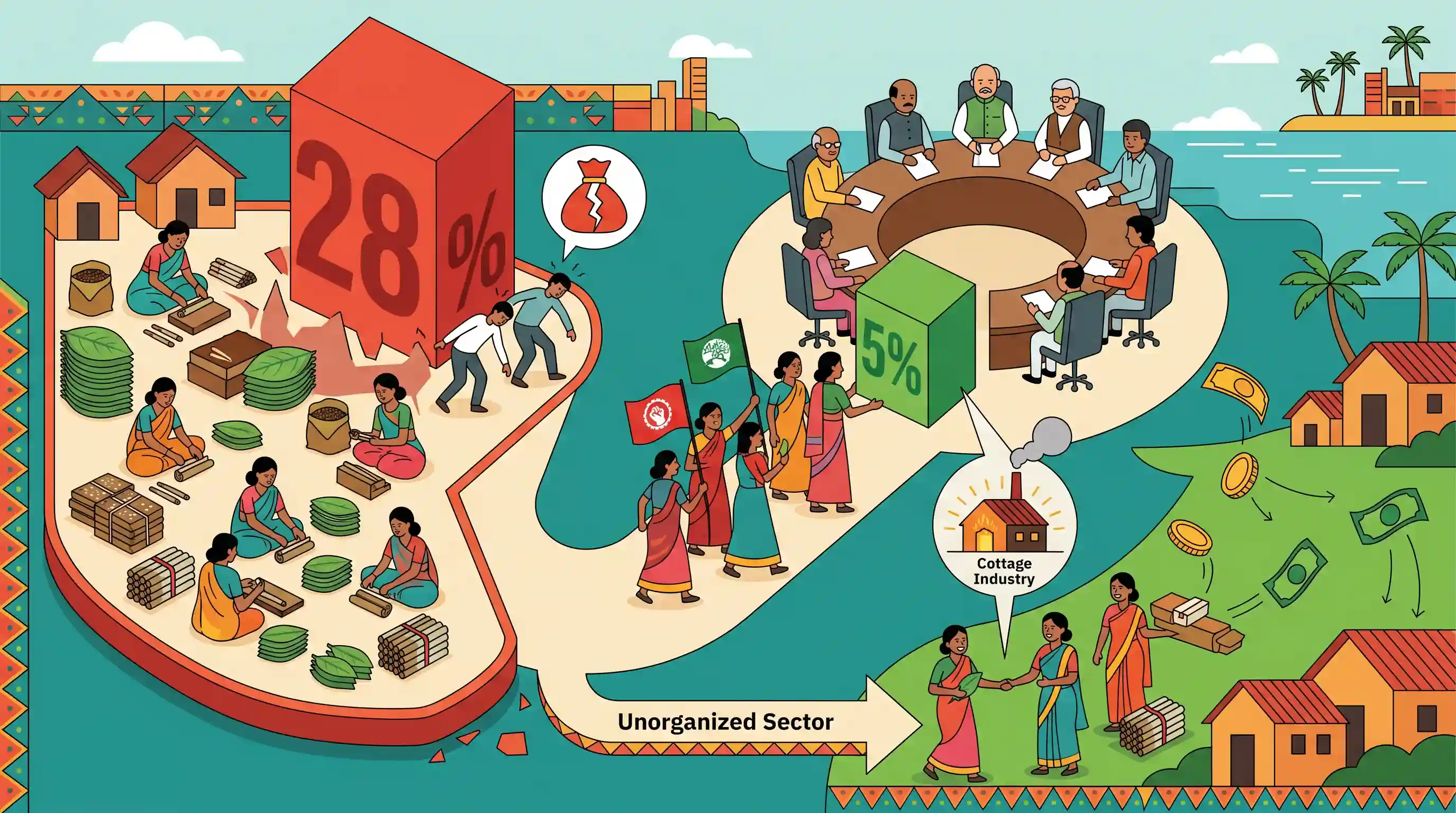
Beedi workers' unions in Karnataka are urging the government to reduce the Goods and Services Tax (GST) on beedis from 28% to 5%. They argue that beedi manufacturing should be treated as a cottage industry, and the current high tax rate threatens the livelihoods of millions of workers in the unorganized sector, a vast majority of whom are women. Union representatives have approached state leaders to advocate for this reduction at the GST Council, emphasizing the crucial economic support the industry provides to marginal families in coastal Karnataka.
Key Points
- Trade unions in Karnataka are demanding a reduction of GST on beedis from the current 28% to 5%.
- The unions argue that beedi manufacturing is essentially a cottage industry and high taxes threaten the livelihoods of millions of workers.
- The industry employs a massive number of unorganized sector workers, primarily women, making the tax policy a significant livelihood issue.
- Unions have petitioned the state's Revenue Minister and Chief Minister to raise the issue with the GST Council.
- Workers currently earn ₹302 for rolling 1,000 beedis and receive additional benefits such as bonuses and child scholarships.
Important Terms
GST Council

A constitutional body (Article 279A) chaired by the Union Finance Minister that recommends GST rates, exemptions, and administrative rules to the Centre and States.
UPSC context
GS Paper II & III: Tests understanding of cooperative federalism and the collective mechanism for deciding India\'s indirect tax policy.
Goods and Services Tax (GST)
A comprehensive, destination-based indirect tax levied on value addition at each stage of the supply chain, replacing multiple central and state taxes.
UPSC context
GS Paper III: Central to Indian Economy; tests knowledge of tax reforms, the cascading effect, and unified national markets.
Unorganized Sector
Small-scale enterprises not registered with the government, where workers lack job security, formal contracts, and social security benefits; accounts for the majority of India\'s workforce.
UPSC context
GS Paper III: Relevant to Inclusive Growth and Employment; tests understanding of labor vulnerabilities and social security requirements.
Cottage Industry
Small-scale, often home-based manufacturing units using family labor and local materials with minimal capital, essential for rural employment and traditional crafts.
UPSC context
GS Paper III: Indian Economy; tests knowledge of MSMEs, rural livelihoods, and the decentralized economic model.
Sin Tax
A high indirect tax (like the 28% GST slab) levied on goods deemed harmful to society, such as tobacco and alcohol, to discourage consumption.
UPSC context
GS Paper III: Economy; tests understanding of fiscal policy used as a tool for public health and social regulation.
Prelims Trap
"The Union Government holds a veto power or 50% voting weightage in the GST Council."
Aspirants often confuse 'effective veto' with voting weight. The Center has 1/3rd weight, states have 2/3rds. A 75% majority is needed, meaning neither can pass decisions alone.
Static Concepts Connected
What is the constitutional mandate and voting structure of the GST Council?
- Article 279A: Inserted by the 101st Constitutional Amendment, it is a constitutional body chaired by the Union Finance Minister.
- Voting Weightage: The Union government holds one-third weight; all state governments collectively hold two-thirds.
- Decision Majority: Requires a 75% (three-fourths) majority of weighted votes cast to pass any resolution.
What defines a cottage industry versus a small-scale industry (SSI)?
- Cottage Industry: Primarily household-based, relies on family labor, uses local raw materials, and simple tools (e.g., beedi rolling).
- Small-Scale Industry: Operates in distinct economic spaces outside the home, generally employing hired labor and minor mechanization.
Cross-Topic Patterns
Female LFPR & unorganized sector
Home-based cottage industries like beedi rolling highlight the overlap between female labor force participation and vulnerability, linking to social security registries like the e-Shram portal.
Public Health vs Livelihood trade-offs
High 'sin taxes' on tobacco pit public health directives (DPSP Article 47) against the economic survival of millions of marginalized cottage industry workers.

GST Council voting mechanics and the tension between 'sin taxes' and unorganized sector livelihoods are highly probable Prelims 2026 targets.
Linked PYQs · 3
Linked PYQs · 3
- 2019MainsGS3
Enumerate the indirect taxes which have been subsumed in the Goods and Services Tax (GST) in India. Also, comment on the revenue implications of the GST introduced in India since July 2017.
- 2023MainsGS3
Faster economic growth requires increased share of the manufacturing sector in GDP, particularly of MSMEs. Comment on the present policies of the Government in this regard.
- 2023MainsGS3
Distinguish between 'care economy' and 'monetized economy'. How can care economy be brought into monetized economy through women empowerment?
