Madhya Pradesh Private BEd Colleges Inspection and Regulatory Fraud
Source:indiatoday ↗
Why It Matters
It exposes deep-rooted administrative corruption and regulatory failures in Madhya Pradesh's higher education system, emphasizing the importance of institutional accountability and judicial oversight in state governance—key themes for MPPSC General Studies.
Summary
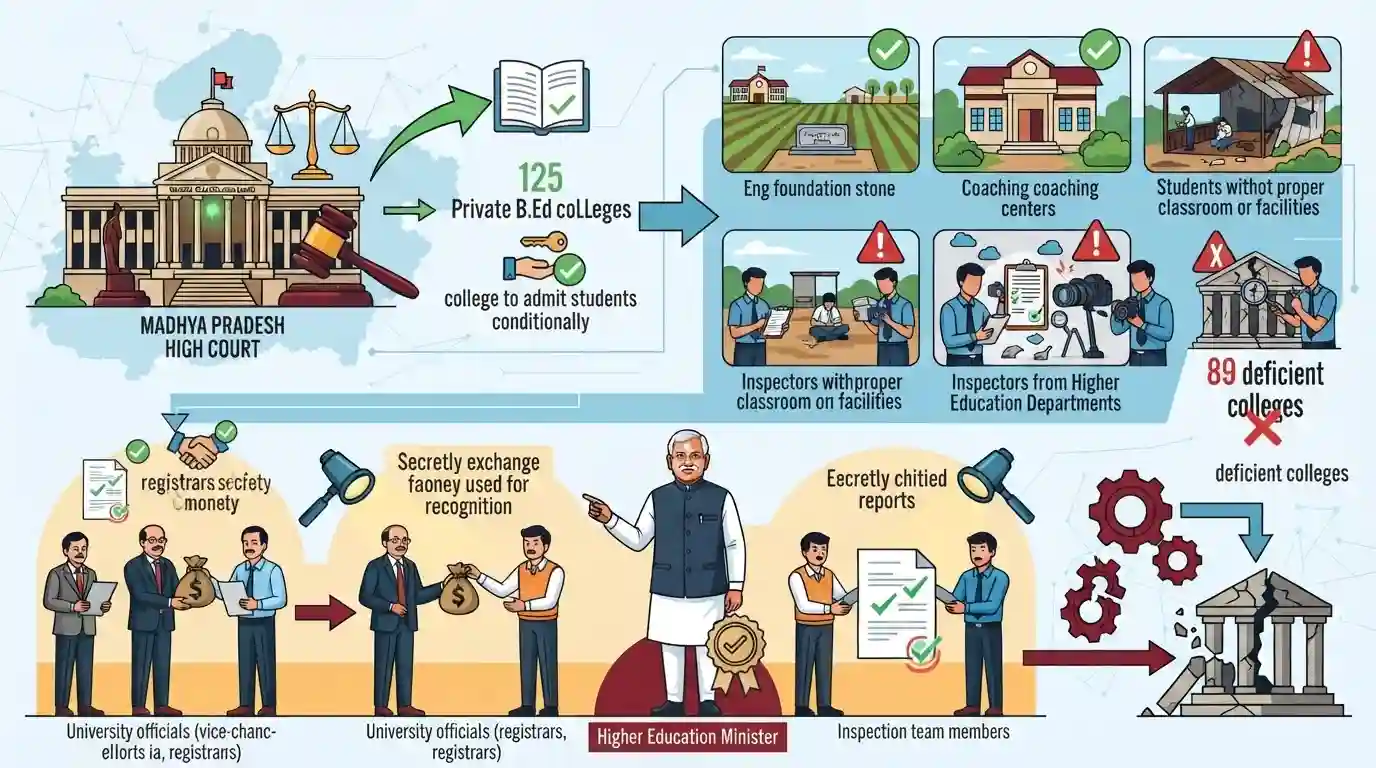
A major scam involving private B.Ed colleges has surfaced in Madhya Pradesh after the MP High Court conditionally permitted 125 such institutes to admit students. Subsequent physical inspections by the Higher Education Department and state universities revealed severe discrepancies in 89 colleges, many of which lacked infrastructure and operated on empty agricultural fields or out of coaching centers. Higher Education Minister Inder Singh Parmar announced a high-level probe against university vice-chancellors, registrars, and inspection teams who had previously submitted falsified 'clean chit' reports to grant these institutions recognition, highlighting systemic regulatory failures in the state's education sector.
Key Points
- The Madhya Pradesh High Court's Jabalpur bench granted conditional approval for student admissions to 125 private B.Ed colleges, which are now under scrutiny.
- Recent state inspections revealed that 89 of these 125 colleges exist only on paper, with designated locations housing agricultural fields, coaching centers, or incomplete buildings.
- Fraudulent 'clean chit' inspection reports had previously allowed these colleges to secure recognition from state universities.
- MP Higher Education Minister Inder Singh Parmar has announced a departmental probe against the Vice-Chancellors, registrars, and inspection committees involved in the irregularities.
Important Terms
Madhya Pradesh High Court

The principal civil and appellate court in Madhya Pradesh. It conditionally permitted 125 private B.Ed colleges to admit students, an interim order that preceded the discovery of a massive "ghost college" scam in the state.
UPSC context
GS Paper II (Judiciary). Tests understanding of how interim judicial orders can inadvertently interact with systemic regulatory failures and governance deficits.
Higher Education Department (Madhya Pradesh)
The state regulatory body responsible for overseeing universities. Its physical inspections revealed that 89 approved B.Ed colleges operated solely on paper, exposing deeply falsified 'clean chit' reports submitted by earlier inspection teams.
UPSC context
GS Paper II (Governance). Relevant for questions on institutional accountability, regulatory capture, and the enforcement of educational standards in India.
Om Sai College (Guna)
One of the private institutions implicated in the Madhya Pradesh B.Ed college scam. It exemplifies "ghost colleges" that exist only in falsified university records without possessing actual educational infrastructure or faculty.
UPSC context
GS Paper II (Education & Transparency). Acts as a factual case study demonstrating the lack of accountability and widespread fraud in teacher-training recognition.
RNT College of Education (Vidisha)
A private teacher-training institute in Madhya Pradesh identified as a fraudulent "paper college." Despite lacking physical infrastructure, it illegally obtained recognition through corrupted inspection teams and university officials.
UPSC context
GS Paper II (Governance). Useful as a specific example of systemic corruption, cronyism, and the failure of regulatory audits in the higher education sector.
Prelims Trap
The University Grants Commission (UGC) is the sole statutory body responsible for recognizing and regulating B.Ed colleges.
Teacher education institutions are specifically regulated by the National Council for Teacher Education (NCTE), a distinct statutory body established under the NCTE Act, 1993.
Static Concepts Connected
What is the statutory mandate of the NCTE?
- Statutory Status: Established in 1995 under the NCTE Act 1993, functioning under the Ministry of Education.
- Core Mandate: Regulates and maintains norms and standards for teacher education programs like B.Ed, M.Ed, and D.El.Ed across India.
What did the Justice J.S. Verma Committee (2012) reveal?
- Ghost Institutes: Exposed that a vast majority of private Teacher Education Institutes (TEIs) were functioning merely 'on paper' without adequate infrastructure.
- Inspection Failure: Highlighted severe corruption in the regulatory inspection processes, demanding systemic overhaul and closure of substandard colleges.
Cross-Topic Patterns
NEP 2020 & Standalone Colleges
To curb substandard standalone B.Ed colleges, NEP 2020 mandates transitioning teacher education into multidisciplinary institutions via a 4-year Integrated Teacher Education Programme (ITEP) by 2030.
Regulatory Capture in Education
This mirrors the 'ghost faculty' and phantom patients scams in private medical colleges, showing a systemic regulatory capture that relies on falsified physical inspection reports.

Mains GS-2 could feature a question on regulatory capture in higher education, linking 'ghost colleges', the Verma Committee, and NEP 2020.
Linked PYQs · 2
Linked PYQs · 2
- 2025MPPSC_PRELIMSGS1
What percentage of the Madhya Pradesh government's total expenditure budget was allocated to education in 2023-24?
- 2020MPPSC_PRELIMSGS1
Who among the following Chief Justice of Madhya Pradesh High Court has not been the Judge at Supreme Court of India?
