West Bengal Observes Sanhati Divas to Promote Communal Amity
Source:The Hindu ↗
Why It Matters
Provides a contemporary case study of political discourse on secularism and communalism in India, while recalling the factual historical detail of Dr. B.R. Ambedkar's initial election to the Constituent Assembly from Bengal.
Summary
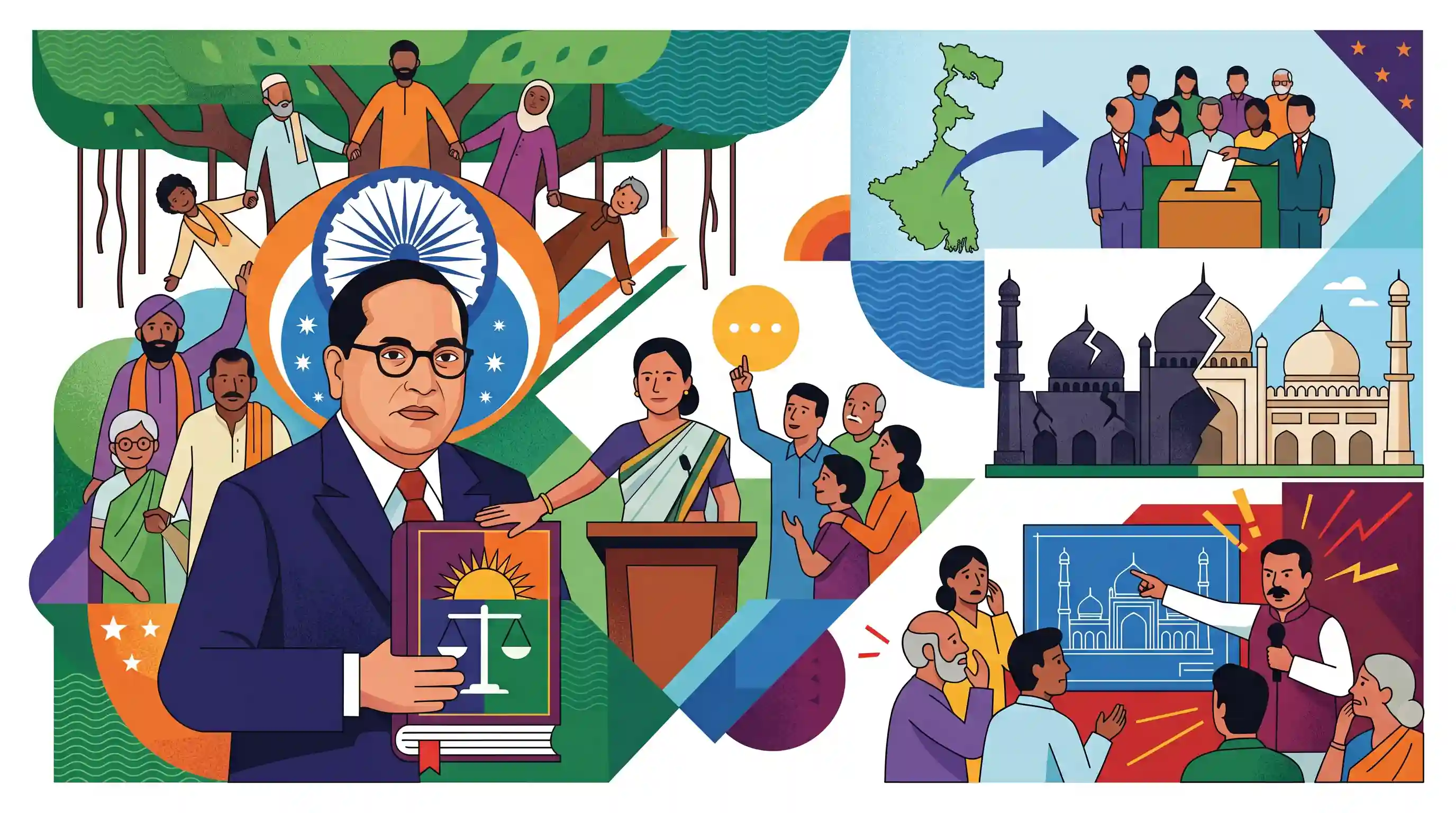
On the anniversary of the Babri Masjid demolition and Dr. B.R. Ambedkar's Mahaparinirvan Diwas, West Bengal Chief Minister Mamata Banerjee reaffirmed her commitment to secularism and the Constitution. Observing the day as 'Sanhati Divas' (Unity Day), she condemned divisive forces and highlighted Bengal's historic role in electing Ambedkar to the Constituent Assembly. Concurrently, a suspended TMC MLA generated controversy by announcing plans to build a Babri-style mosque in Murshidabad.
Key Points
- West Bengal observed December 6 as Sanhati Divas (Unity Day) to promote communal amity on the anniversary of the Babri Masjid demolition.
- Chief Minister Mamata Banerjee emphasized a continued struggle against communal forces and reinforced the state's legacy of unity, invoking icons like Tagore and Vivekananda.
- The occasion also marked Dr. B.R. Ambedkar's Mahaparinirvan Diwas, with Banerjee highlighting his historic election to the Constituent Assembly from the Bengal legislature.
- A parallel controversy unfolded as suspended TMC MLA Humayun Kabir planned to lay the foundation for a Babri-style mosque in Murshidabad district on the same day.
Important Terms
Constitution of India

The supreme legal document of India that outlines the framework for political code, government powers, and fundamental rights. It was adopted on November 26, 1949.
UPSC context
GS Paper II: Essential for understanding the basic structure, fundamental rights, and the functioning of the Indian democratic state.
Constituent Assembly
The representative body formed in 1946 under the Cabinet Mission Plan to draft the Indian Constitution. It functioned as India's first (provisional) Parliament.
UPSC context
GS Paper II: Historical underpinnings and evolution of the Constitution; tests knowledge of its composition and key committees.
Mahaparinirvan Diwas
Observed on December 6, it marks the death anniversary of Dr. B.R. Ambedkar. The term refers to the Buddhist concept of ultimate liberation from the cycle of birth.
UPSC context
GS Paper I: Modern Indian history and social reformers. Tests knowledge of Ambedkar’s legacy and Buddhist philosophy.
Sanhati Divas
Observed by the West Bengal government and TMC on December 6 to promote communal harmony and secularism, coinciding with the anniversary of the Babri Masjid demolition.
UPSC context
GS Paper I/II: Relevant to communalism, secularism, and state-level political observances regarding national unity.
Trinamool Congress
A regional political party in India, currently the ruling party in West Bengal, founded by Mamata Banerjee in 1998 after splitting from the Indian National Congress.
UPSC context
GS Paper II: Political parties and pressure groups. Tests awareness of regional political dynamics and their impact on federalism.
Prelims Trap
"Dr. B.R. Ambedkar was originally elected to the Constituent Assembly from the Bombay Presidency."
Ambedkar was first elected from undivided Bengal. After Partition, his constituency went to East Pakistan, necessitating his re-election from Bombay (Pune).
Static Concepts Connected
How was Dr. B.R. Ambedkar elected to the Constituent Assembly?
- Bengal Province: Initially elected in 1946 from the Jessore-Khulna region of undivided Bengal, supported by the Scheduled Castes Federation.
- Partition Impact: Following the partition, his constituency became part of East Pakistan, causing him to lose his Assembly seat.
- Bombay Re-election: He was subsequently re-elected from the Bombay Presidency (Pune seat) after M.R. Jayakar resigned, ensuring his crucial presence.
What distinguishes Indian Secularism from the Western model?
- Principled Distance: Unlike the strict US/French state-religion separation, India follows 'principled distance' where the state can engage with religion to reform it.
- Reformative Role: The Indian Constitution allows the state to intervene in religious affairs to eradicate social evils (e.g., abolishing untouchability under Article 17).
- Positive Equality: The state respects all religions equally (Sarva Dharma Sambhava) and can provide equitable support, such as subsidies or managing minority institutions.
Cross-Topic Patterns
Ambedkar's Buddhism & Constitution
His Navayana Buddhism directly influenced his vision of Constitutional Morality, explicitly deriving 'Liberty, Equality, Fraternity' from the teachings of the Buddha rather than the French Revolution.
Communalism in Post-Independence India
The 1992 Babri Masjid demolition is a watershed GS1 topic, often analyzed alongside the rise of identity politics, secularism challenges, and the evolution of the Representation of the People Act.

Expect a tricky Prelims statement tracing Ambedkar’s Constituent Assembly journey from his initial Bengal seat to Bombay post-Partition.
Linked PYQs · 4
Linked PYQs · 4
- 2022MainsGS1
Are tolerance, assimilation and pluralism the key elements in the making of an Indian form of secularism? Justify your answer.
- 2017MainsGS1
Distinguish between religiousness/religiosity and communalism giving one example of how the former has got transformed into the latter in independent India.
- 2024MainsGS2
Discuss India as a secular state and compare with the secular principles of the US constitution.
- 2015MainsGS1
Mahatma Gandhi and Dr. B.R. Ambedkar, despite having divergent approaches and strategies, had a common goal of amelioration of the downtrodden. Elucidate.
