Bodhghat Hydroelectric Project Cleared in Bastar
Source:The Hindu ↗
Why It Matters
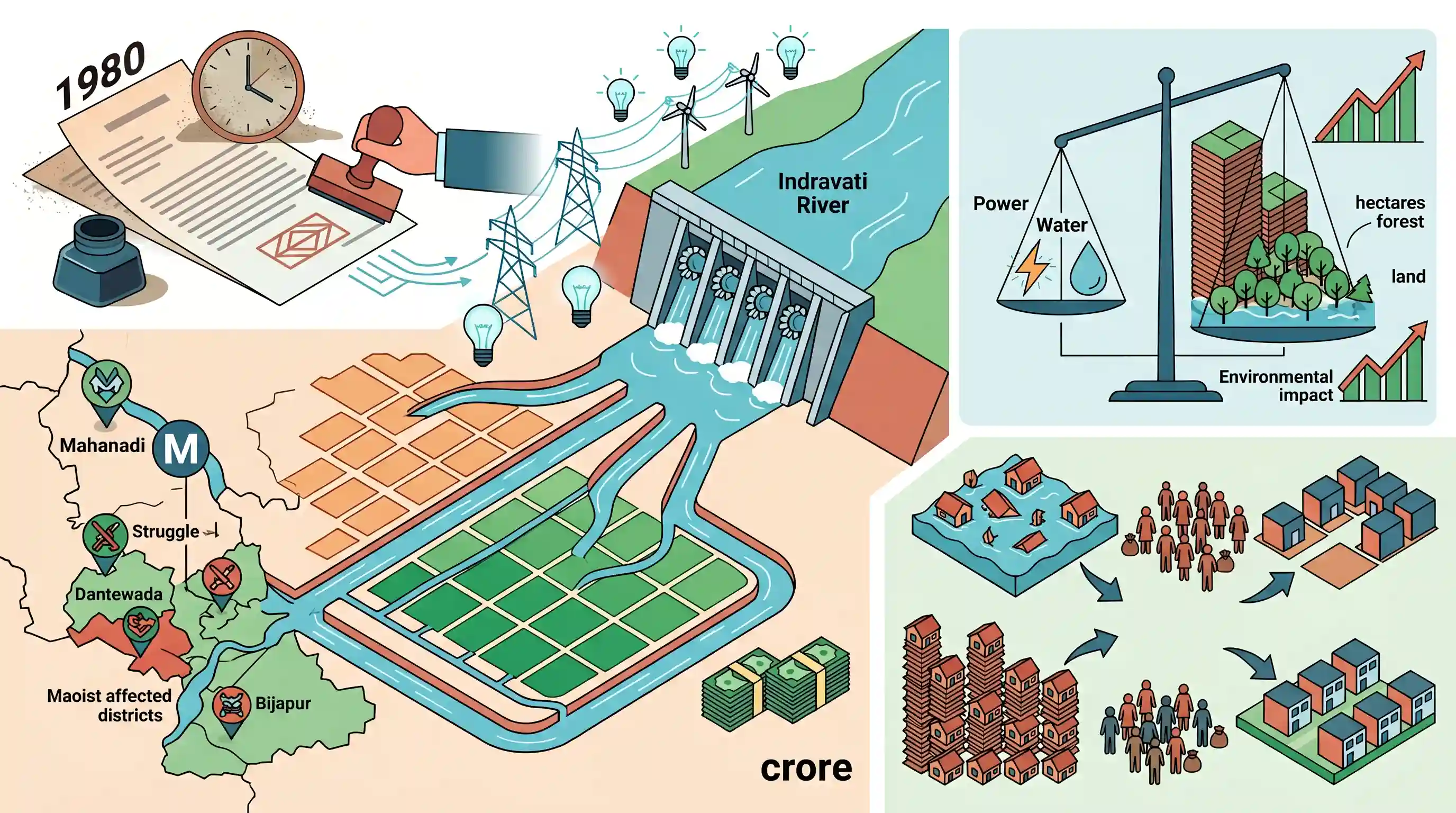
The Bodhghat project serves as a perfect case study for the 'development vs. displacement' debate in Left Wing Extremism (LWE) affected regions. It highlights the friction between building crucial infrastructure to counter Maoism and the socio-ecological costs of displacing tribal populations and submerging forest lands.
Summary
The Bodhghat multipurpose hydroelectric and irrigation project on the Indravati River in Chhattisgarh’s Bastar region has been cleared by the Prime Minister after a 45-year delay. Initially conceptualised in 1980, the ₹49,000 crore project will generate 125 MW of electricity and irrigate 7 lakh hectares across Maoist-affected districts like Dantewada, Sukma, and Bijapur, while linking with the Mahanadi River to benefit central plains. However, it requires significant ecological and social trade-offs, needing 13,783 hectares of land (including 5,704 hectares of forest land), submerging 38 villages, and displacing over 2,000 families.
Key Points
- The ₹49,000 crore Bodhghat project on the Indravati river in Chhattisgarh has received PM approval after a 45-year delay primarily caused by Maoism, regulatory, and social hurdles.
- The multipurpose project aims to irrigate 7 lakh hectares in the Left Wing Extremism (LWE)-affected Bastar region (Dantewada, Sukma, Bijapur) and will be linked with the Mahanadi river to benefit central plains.
- It is designed to generate 125 MW of hydropower and produce approximately 4 lakh tonnes of fish annually, providing a significant boost to the local economy.
- The project demands 13,783 hectares of land, including 5,704 hectares of forest land, leading to the displacement of over 2,000 families and the submergence of 38 villages (24 completely, 14 partially).
Important Terms
Bodhghat Multipurpose Project

A ₹49,000 crore multipurpose project on the Indravati River in Chhattisgarh's Bastar region. It aims to provide 125 MW of hydroelectric power and irrigate 7 lakh hectares in Maoist-affected districts.
UPSC context
GS-III: Infrastructure (Irrigation and Energy); significant for developmental interventions in Left-Wing Extremism (LWE) zones.
Indravati River
A 535 km long major tributary of the Godavari River originating in Odisha's Kalahandi district. Known as the 'lifeline of Bastar,' it hosts the Chitrakote Falls and the Indravati National Park.
UPSC context
GS-I: Geography (Drainage Systems); crucial for Prelims mapping and Mains questions on inter-state river basins.
Left-Wing Extremism (LWE)
Also known as Maoism, this insurgency affects India's 'Red Corridor.' The government uses a multi-pronged strategy of security operations and development (like the Bodhghat project) to address this challenge.
UPSC context
GS-III: Internal Security; tests the link between lack of development and the spread of extremism.
Indravati-Mahanadi Interlinking Project
A proposal to transfer surplus water from the Indravati (Godavari basin) to the Mahanadi River to benefit central Chhattisgarh. It utilizes Chhattisgarh’s unspent water share allocated by the Godavari Water Disputes Tribunal.
UPSC context
GS-I/III: Geography and Infrastructure; relates to inter-basin water transfer, water security, and environmental trade-offs.
PESA Act, 1996
A law empowering Gram Sabhas in tribal (Fifth Schedule) areas to protect indigenous rights and resources. Project clearances in Bastar often require mandatory consent under this Act and the Forest Rights Act.
UPSC context
GS-II: Polity (Tribal Governance); central to disputes involving land acquisition and tribal displacement.
Godavari Water Disputes Tribunal (GWDT)
The quasi-judicial body that adjudicated water sharing between riparian states of the Godavari. It allocated 301 TMC of Indravati water to Chhattisgarh, a quota the Bodhghat project seeks to utilize.
UPSC context
GS-II: Statutory Bodies and Federalism; relevant for inter-state water governance and constitutional mechanisms (Article 262).
Prelims Trap
"The Indravati river is a major tributary of the Mahanadi basin."
Indravati is actually a major tributary of the Godavari. The Bodhghat project interlinks the Indravati to the Mahanadi, representing an inter-basin water transfer.
Static Concepts Connected
What is the course and significance of the Indravati River?
- Origin: Rises in the Eastern Ghats of Kalahandi district in Odisha.
- Course: Flows westward through the Bastar region of Chhattisgarh before joining the Godavari river in Maharashtra.
- Key Feature: The famous Chitrakote Falls (often called the Niagara of India) is situated on this river.
How does infrastructure act as a counter-LWE strategy?
- SAMADHAN doctrine: Emphasizes multi-pronged strategies, including massive developmental interventions, to win local trust and cut off Naxal support.
- Development deficit: Addressing gaps via targeted irrigation, telecom, and road projects (RRP-LWE) in Aspirational Districts like Sukma, Bijapur, and Dantewada.
- Tribal alienation: Heavy infrastructure causes displacement. Strict compliance with PESA and FRA is needed so alienation doesn't inadvertently fuel extremism.
Cross-Topic Patterns
LWE + Infrastructure vs Ecology
Mega-projects in Bastar aim to counter Maoism via development but risk tribal alienation due to mass displacement and forest loss, which historically fuels extremist narratives.
Inter-basin River Linking
The Indravati-Mahanadi link transfers water from the Godavari basin to Chhattisgarh's plains, mirroring the Ken-Betwa logic of linking surplus and deficit river basins.

Expect a multi-statement Prelims question mapping Godavari tributaries (Indravati), inter-basin linkages, and EIA applicability.
Linked PYQs · 4
Linked PYQs · 4
- 2022MainsGS3
Naxalism is a social, economic and developmental issue manifesting as a violent internal security threat. In this context, discuss the emerging issues and suggest a multilayered strategy to tackle the menace of Naxalism.
- 2015MainsGS3
The persisting drives of the Government for development of large industries in backward areas have resulted in isolating the tribal population and the farmers who face multiple displacements. With Malkangiri and Naxalbari foci, discuss the corrective strategies needed to win the Left Wing Extremism (LWE) doctrine affected citizens back into the mainstream of social and economic growth.
- 2015PrelimsGS1
Consider the following rivers: 1. Vamsadhara 2. Indravati 3. Pranahita 4. Pennar Which of the above are tributaries of Godavari?
- 2020MainsGS1
The interlinking of rivers can provide viable solutions to the multi-dimensional inter-related problems of droughts, floods and interrupted navigation. Critically examine.
