Manipur Barn Swallows Show Shift Toward Permanent Resident Status
Source:The Hindu ↗
Why It Matters
Provides a concrete case study for UPSC Mains on how climate change and human habitat alteration (synanthropic relationships) impact migratory species. It also serves as an excellent example for GS1/GS3 of community-led conservation rooted in cultural beliefs (Meitei community).
Summary
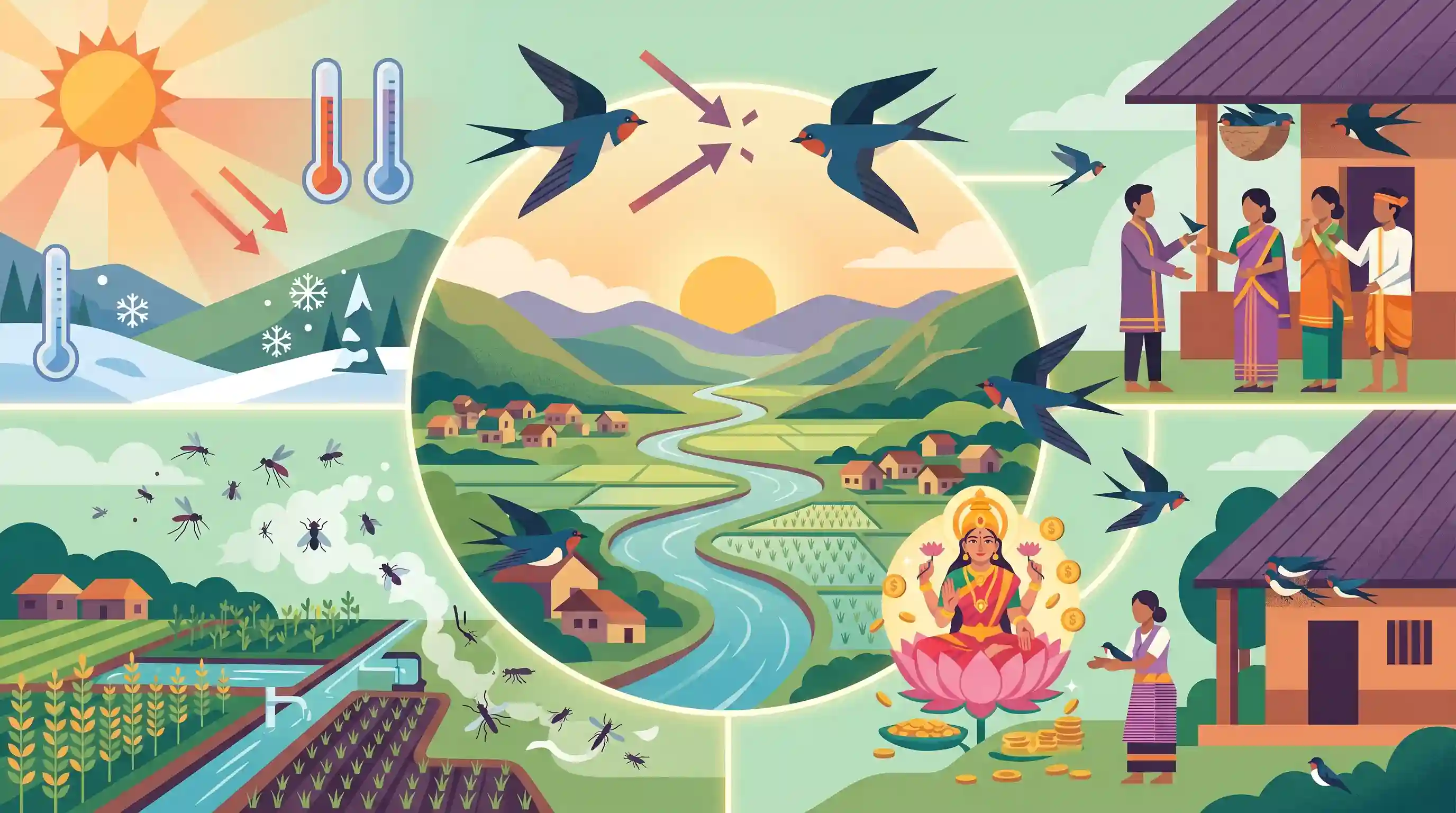
A recent study by the Wildlife Institute of India (WII) suggests that barn swallows in Manipur's Imphal Valley are abandoning their migratory behaviors to become permanent residents. This behavioral shift is driven by favorable environmental conditions such as mild winters and a continuous supply of insects due to agricultural and land-use changes. Additionally, the local Meitei community provides safe havens for the birds, revering them as symbols of Goddess Lakshmi and prosperity. This development underscores the complex interplay between climate change, human-altered habitats, and community-led conservation in reshaping wildlife behavior.
Key Points
- A study by the Wildlife Institute of India indicates that barn swallows (Hirundo rustica) in Manipur's Imphal Valley have established a resident breeding population, potentially shedding their migratory trait.
- Barn swallows are a synanthropic species that thrive near human habitats; their behavioral shift is attributed to mild winters, abundant flying insects year-round, and available nesting structures due to land-use changes.
- The Meitei community in Manipur plays a crucial role in this phenomenon by protecting the birds and their nests, as they revere the barn swallow as a symbol of Goddess Lakshmi, prosperity, and good fortune.
- This localized adaptation highlights how a combination of climate change, anthropogenic habitat alteration, and cultural conservation can significantly impact the behavioral ecology of migratory species.
Important Terms
Wildlife Institute of India (WII)

An autonomous institution under the Ministry of Environment, Forest and Climate Change (MoEFCC), established in 1982 in Dehradun, dedicated to wildlife research, management, and training.
UPSC context
GS Paper III (Environment); essential for understanding India's institutional framework for biodiversity conservation and wildlife policy.
Barn Swallow (Hirundo rustica)
A globally widespread migratory passerine bird with blue upperparts and a deeply forked tail, traditionally known for seasonal long-distance travel between breeding and wintering grounds.
UPSC context
GS Paper III (Biodiversity); tests knowledge of species in news and how climate change impacts migratory patterns.
Meitei Community
The predominant ethnic group of Manipur whose cultural reverence for Barn Swallows (Sambraang) as symbols of Goddess Lakshmi facilitates significant community-led wildlife protection.
UPSC context
GS Paper I (Society) & III (Environment); illustrates the role of traditional beliefs and culture in grassroots conservation efforts.
Synanthropic Species
Wild species that live near and benefit from human-modified environments, such as buildings or farms, without being domesticated or under human control.
UPSC context
GS Paper III (Ecology); relevant for questions on urban biodiversity and species adaptation to human-altered landscapes.
Resident Population
A group of animals that stays in one geographic area year-round for both breeding and non-breeding seasons, abandoning their species' typical seasonal migratory behavior.
UPSC context
GS Paper III (Environment); key concept for understanding behavioral ecology and species' responses to climate and land-use changes.
Imphal Valley
A central high-altitude plain in Manipur that provides a unique microclimate and suitable nesting sites, supporting the transition of migratory birds to sedentary residents.
UPSC context
GS Paper I (Geography); significant for regional geography and ecological studies in Northeast India.
Prelims Trap
Barn swallows are an endemic resident bird species found exclusively in the Imphal Valley of Manipur.
Barn swallows are globally widespread migratory birds. Only a specific localized population in Manipur has recently shed its migratory trait to become permanent residents due to climate and habitat changes.
Static Concepts Connected
What defines a synanthropic species in ecological terms?
- Wild adaptation: They are ecologically wild species that naturally adapt to live near and actively benefit from human-altered environments or settlements (e.g., house sparrows, macaques).
- Not domesticated: Unlike livestock or pets, their breeding, diet, and genetics are not controlled or artificially selected by humans.
What is the organizational status and mandate of the Wildlife Institute of India (WII)?
- Autonomous body: Established in 1982 in Dehradun, it operates as an autonomous institution under the Ministry of Environment, Forest and Climate Change (MoEFCC).
- Advisory role: It conducts specialized wildlife research, trains personnel, and provides critical scientific advice to the government for wildlife clearances and conservation policies.
Cross-Topic Patterns
Culture-driven conservation models
The Meitei protection of barn swallows parallels Bishnoi Blackbuck conservation and the Bugun tribe's protection of the Bugun Liocichla. UPSC loves pairing local cultural beliefs with distinct ecological outcomes.
Climate-induced behavioral shifts
Shedding migratory traits due to mild winters aligns with broader phenological changes, like altered breeding cycles or early plant flowering, demonstrating the complex ecological ripple effects of a warming climate.

Expect a multi-statement question defining 'synanthropic species' and linking climate-induced behavioral shifts with Meitei conservation.
Linked PYQs · 2
Linked PYQs · 2
- 2023PrelimsGS1
Which of the following organisms perform waggle dance for others of their kin to indicate the direction and the distance to a source of their food?
- 2017MainsGS3
'Climate change' is a global problem. How India will be affected by climate change? How Himalayan and coastal states of India will be affected by climate change?
