Jan Suraaj Approaches Election Commission Demanding CAPF in Bypoll
Source:newindianexpress ↗
Why It Matters
This article highlights crucial aspects of electoral management, constitutional provisions (Article 324), welfare institutions (JEEVIKA in Bihar), and security administration (CAPF) during by-elections, all of which are frequent target areas for the BPSC Prelims and Mains.
Summary
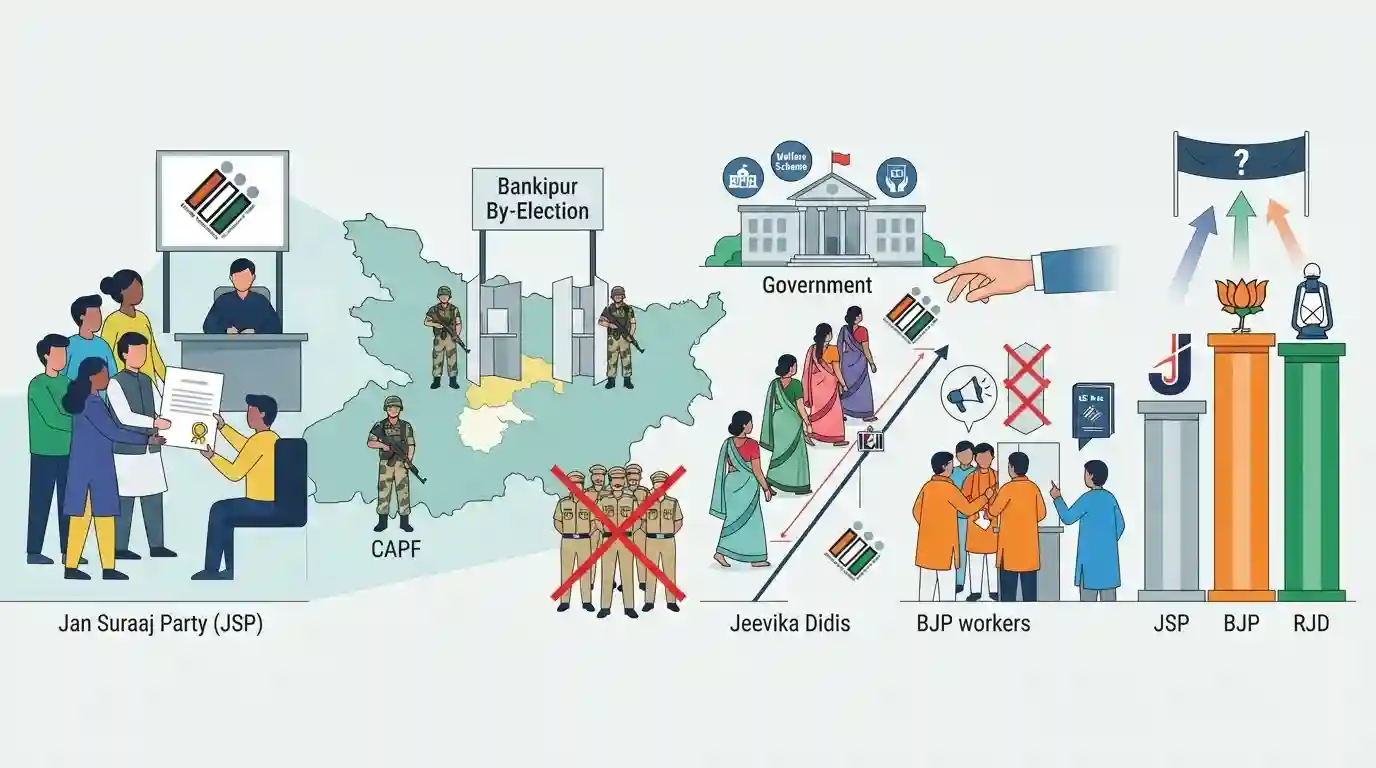
The Prashant Kishor-led Jan Suraaj Party (JSP) submitted a formal memorandum to Bihar's Chief Electoral Officer ahead of the Bankipur Assembly by-election. JSP state president Manoj Bharti demanded the deployment of Central Armed Police Forces (CAPF) at all booths and urged the Election Commission to ensure that state 'Jeevika Didis' are not utilized or misused by government machinery during the poll. The JSP also alleged multiple Model Code of Conduct violations by BJP workers, setting the stage for a high-stakes three-way contest between JSP, BJP, and RJD.
Key Points
- Jan Suraaj Party (JSP), led by Prashant Kishor, submitted a memorandum to Bihar's Chief Electoral Officer in Patna demanding fair electoral practices for the Bankipur assembly by-election.
- JSP requested the full deployment of Central Armed Police Forces (CAPF) inside and at all polling booths to ensure smooth and secure polling.
- The memorandum urged the Election Commission to prevent the 'misuse' of Jeevika Didis (associated with the state's JEEVIKA scheme) inside or outside polling stations by the government machinery on polling day.
- JSP state president Manoj Bharti accused the BJP of violating the Model Code of Conduct (MCC) by putting up misleading posters targeting Kishor, removing JSP posters from private houses, and posing as municipal employees.
- The high-profile Bankipur bypoll is a crucial contest featuring Prashant Kishor making his electoral debut against Neeraj Kumar Sinha (BJP) and Rekha Kumari/Gupta (RJD).
- Janshakti Janata Dal (JJD) candidate Veena Manvi's nomination papers were rejected during scrutiny.
Important Terms
Election Commission of India

An autonomous, constitutional body responsible for administering Union and State election processes in India, including elections to Parliament, State Legislatures, and the offices of the President and Vice President.
UPSC context
GS Paper II: Constitutional Bodies. Crucial for understanding electoral administration, reforms, and the preservation of free and fair elections.
Article 324 of the Constitution of India
A constitutional provision vesting the superintendence, direction, and control of elections in the Election Commission of India, securing its independence to conduct free and fair elections.
UPSC context
GS Paper II: Indian Constitution. Core article governing the structure, powers, and independence of the Indian electoral machinery.
Model Code of Conduct
A set of consensus-based guidelines issued by the Election Commission of India to regulate the conduct of political parties and candidates during elections, ensuring a level playing field.
UPSC context
GS Paper II: Electoral Reforms. Vital for questions regarding electoral integrity, campaign ethics, and the powers of the Election Commission.
JEEVIKA Project
A World Bank-assisted rural livelihoods project launched by the Government of Bihar in 2007, aiming to empower the rural poor, especially women, through self-help groups and financial inclusion.
UPSC context
GS Paper II/III: Welfare Schemes/Rural Development. Illustrates grassroots poverty alleviation and women’s economic empowerment models.
Bihar Rural Livelihoods Promotion Society
An autonomous body under the Department of Rural Development, Government of Bihar, designated as the State Rural Livelihoods Mission to implement poverty alleviation programs like JEEVIKA.
UPSC context
GS Paper II: State-level developmental bodies. Crucial for understanding institutional governance and implementation of state welfare programs.
Jan Suraaj Party
A political party in Bihar founded by political strategist Prashant Kishor on October 2, 2024, focusing on participatory governance, grassroots campaigns, and ending caste-centric politics.
UPSC context
GS Paper II: Political Parties. Analyzes regional party dynamics, voting behavior, and the role of grassroots campaigns.
Prelims Trap
A by-election to fill any vacant legislative seat must always be held within six months of the vacancy.
Under Section 151A of the RPA 1951, this six-month mandate does not apply if the remaining term of the vacant seat is less than one year.
Static Concepts Connected
What are the statutory rules and exceptions for conducting legislative by-elections in India?
- Timeframe mandate: Section 151A of the RPA, 1951, requires filling any legislative vacancy within six months of its occurrence.
- The one-year exception: The six-month mandate is waived if the remainder of the member's term is less than one year.
- ECI deferral power: The election can be deferred if ECI and the Centre certify that holding it is exceptionally difficult.
How does the ECI command security forces during state assembly elections?
- Article 324 mandate: Article 324 vests absolute superintendence, direction, and control of elections in the ECI, overriding local administrative hesitation.
- State vs Centre jurisdiction: Though public order is a State Subject, CAPF units deployed during elections operate under the ECI's direct operational guidelines.
Cross-Topic Patterns
SHGs & Electoral Neutrality
Connects rural livelihood schemes like JEEVIKA to electoral integrity under GS-2, analyzing how state-funded women groups are insulated from political mobilization.
Federalism and CAPF Deployment
Examines tension between state-list control over public order and Article 324 plenary powers of the ECI to deploy central forces during state-level elections.

An assertion-reasoning question on ECI's supremacy over state police vs CAPF deployment during assembly by-elections is highly probable in 2026.
Linked PYQs · 2
Linked PYQs · 2
- 2020BPSC_PRELIMSGS1
Which Article in the Indian Constitution is related with the establishment of the Election Commission of India?
- 2016BPSC_PRELIMSGS1
'JEEVIKA' is an initiative of Bihar Govt for:
