Bankipur Bypoll Triggers Allegations Over Jeevika Mobilisation
Source:The Hindu ↗
Why It Matters
Understanding the intersection of state welfare programs like JEEVIKA and electoral politics is crucial for BPSC aspirants. It highlights the practical challenges in enforcing the Model Code of Conduct and the potential misuse of administrative machinery and self-help groups for political gains in state elections.
Summary
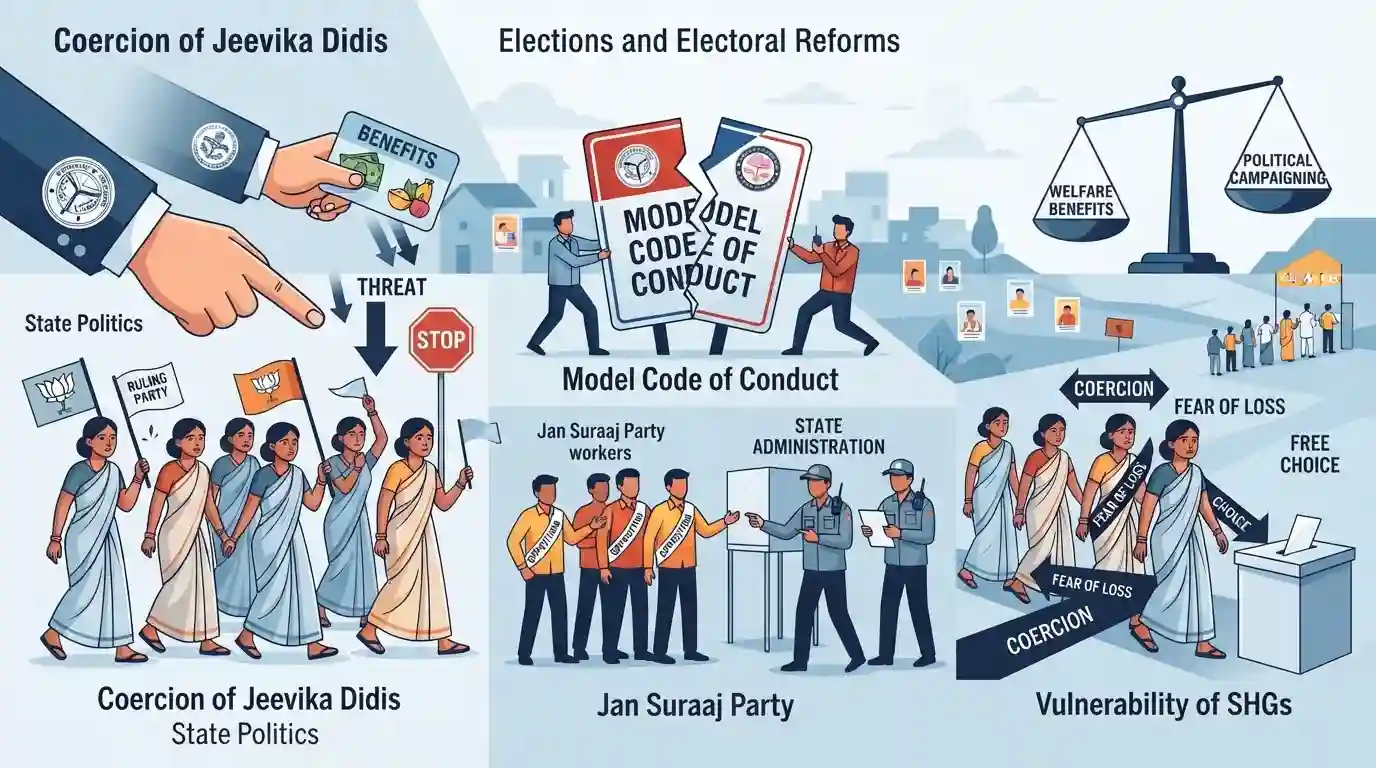
Ahead of the Bankipur Assembly bypoll in Bihar, Jan Suraaj Party founder Prashant Kishor has leveled serious allegations against the ruling BJP. Kishor claims the BJP is engaging in unfair electoral practices, including using the state administrative machinery to harass his party workers and intimidate voters. Notably, he accused the ruling alliance of coercing 'Jeevika Didis'—women associated with the Bihar Rural Livelihoods Project (JEEVIKA)—into campaigning for them by threatening to withhold welfare benefits. This highlights issues surrounding the enforcement of the Election Model Code of Conduct and the vulnerability of state-sponsored self-help groups to political exploitation during elections.
Key Points
- Jan Suraaj Party founder Prashant Kishor accused the BJP of deploying unfair campaign practices ahead of the Bankipur Assembly bypoll in Bihar.
- Kishor alleged that the ruling coalition was using the state administration to harass political opponents and intimidate voters.
- A specific claim was made regarding the use of \'Jeevika Didis\' (members of state-run women\'s self-help groups) for campaigning, with threats of cutting off their welfare benefits if they did not comply.
- These allegations raise concerns about violations of the Model Code of Conduct and the politicization of state welfare and rural livelihood programs like JEEVIKA.
Important Terms
Bihar Rural Livelihoods Project (JEEVIKA)

A Bihar government initiative, supported by the World Bank, aiming to empower the rural poor through self-managed community institutions, microfinance, and sustainable livelihood promotion.
UPSC context
GS Paper II (Welfare Schemes) and GS Paper III (Inclusive Growth); crucial for studying poverty alleviation and rural development.
Jan Suraaj Party
A political party in Bihar founded by former strategist Prashant Kishor in October 2024, originating from a grassroots movement advocating governance reforms and socio-economic empowerment.
UPSC context
GS Paper II (Representation of People’s Act, regional parties); tests understanding of political mobilisation and electoral dynamics in federal politics.
Model Code of Conduct (MCC)
A set of consensus-based guidelines issued by the Election Commission of India to regulate political parties and candidates, ensuring free, fair, and ethical campaigns during elections.
UPSC context
GS Paper II (Electoral Reforms, Article 324); vital for understanding free and fair elections, level playing fields, and administrative neutrality.
Election Commission of India (ECI)
An autonomous constitutional body established under Article 324 of the Indian Constitution, responsible for administering and supervising national and state-level elections in India.
UPSC context
GS Paper II (Constitutional Bodies); tests knowledge of electoral oversight, constitutional mandates, and institutional independence in a democracy.
Self-Help Groups (SHGs)
Informal, peer-controlled associations of individuals with similar socio-economic backgrounds who voluntarily pool savings to access microfinance, generate income, and foster collective community empowerment.
UPSC context
GS Paper II (Role of NGOs/SHGs) and GS Paper III (Inclusive Growth); essential for analyzing women's empowerment and grassroots-level social security.
Prelims Trap
The Model Code of Conduct derives its statutory backing directly from the Representation of the People Act, 1951.
The MCC is a consensus-based guideline lacking statutory backing. It is enforced by the ECI using constitutional powers under Article 324, not the RPA.
Static Concepts Connected
What constitutes "undue influence" under the Representation of the People Act (RPA), 1951?
- Statutory Basis: It is explicitly categorized as a "corrupt practice" under Section 123(2) of the RPA, 1951.
- Definition: Any direct or indirect interference, or attempt to interfere, by a candidate with the free exercise of any electoral right.
- Included Threats: Threatening voters with physical injury, social ostracism, excommunication from caste, or divine displeasure falls under undue influence.
What are the structural vulnerabilities of Self-Help Groups (SHGs) in India?
- Political Clientelism: Structural dependence on state microfinance and grants makes them highly vulnerable to political coercion and vote-bank mobilization.
- Elite Capture: Socially or economically dominant members frequently hijack decision-making processes and appropriate the majority of available credit.
- Credit Dependency: A persistent reliance on government subsidies and subsidized bank linkages hinders transition to independent, self-sustaining wealth creation.
Cross-Topic Patterns
SHGs + Electoral Clientelism
The intersection of rural development schemes (like JEEVIKA) and electoral politics demonstrates how state-sponsored social capital can be leveraged or coerced into captive vote banks.
Article 324 + Welfare Schemes
The Election Commission's mandate under Article 324 to ensure a level playing field routinely clashes with the 'Party in Power' administering ongoing welfare schemes and state machinery.

Expect a Mains question evaluating the politicization of SHGs, linking rural women's empowerment schemes to electoral clientelism.
Linked PYQs · 2
Linked PYQs · 2
- 2016BPSC_PRELIMSGS1
'JEEVIKA' is an initiative of Bihar Govt for:
- 2020BPSC_PRELIMSGS1
Which Article in the Indian Constitution is related with the establishment of the Election Commission of India?
