Jan Suraaj Party Breaches BJP Bastion in Bankipur Bypoll
Source:The Hindu ↗
Why It Matters
BPSC Prelims frequently asks questions about political dynamics, regional parties, and specific assembly constituencies or key elected members in Bihar. The emergence of the Jan Suraaj Party is a major development in the state's electoral landscape.
Summary
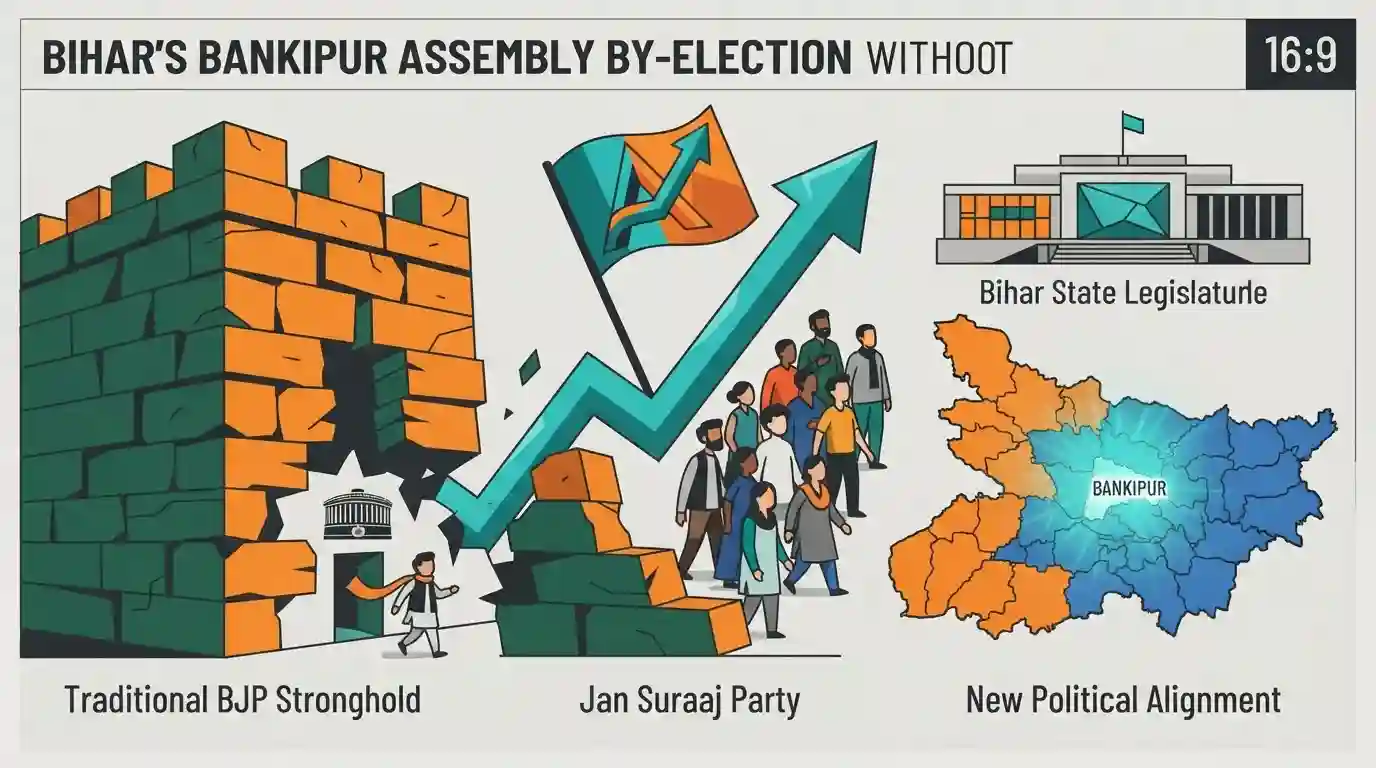
Prashant Kishor's Jan Suraaj Party won the Bankipur Assembly by-election in Bihar, breaching a three-decade BJP stronghold. The bypoll was triggered by the resignation of former BJP MLA Nitin Nabin after his election to the Rajya Sabha. The outcome highlights the emergence of the Jan Suraaj Party as a significant regional force altering traditional political alignments in Bihar.
Key Points
- Jan Suraaj Party chief Prashant Kishor secured a victory in the Bankipur Assembly by-election in Bihar, defeating BJP candidate Neeraj Kumar.
- The Bankipur constituency had been a BJP stronghold for nearly three decades, previously held by Nitin Nabin and his father.
- The bypoll was necessitated due to a vacancy created after BJP MLA Nitin Nabin resigned upon being elected to the Rajya Sabha.
- The victory marks a significant political milestone for the newly formed Jan Suraaj Party, signaling changing political dynamics in Bihar.
Important Terms
Representation of the People Act, 1951

A key parliamentary act governing the conduct of elections, specifying candidate qualifications and disqualifications, political party registration, and election dispute resolution.
UPSC context
GS Paper II: Polity & Governance; tests knowledge of the legal framework and electoral reforms.
Jan Suraaj Party
An Indian political party founded by Prashant Kishor on October 2, 2024. Rooted in Gandhian principles, it secured its first electoral victory in the 2026 Bankipur Assembly by-election.
UPSC context
GS Paper II: Polity; tests understanding of regional political parties, electoral dynamics, and grassroots movements.
Bharatiya Janata Party (BJP)
One of India's principal national political parties, founded in 1980 with roots in the Bharatiya Jana Sangh. It is characterized by right-wing politics, cultural nationalism, and Hindutva.
UPSC context
GS Paper II: Polity; tests comprehension of the national party system, political ideologies, and electoral competition.
Election Commission of India
An autonomous, permanent constitutional body established under Article 324, responsible for administering free, fair, and credible national and state elections in India.
UPSC context
GS Paper II: Constitutional Bodies; tests command over constitutional provisions, powers, and duties of the election watchdog.
By-elections
Special elections conducted to fill legislative vacancies caused by the resignation, death, disqualification, or expulsion of a sitting member.
UPSC context
GS Paper II: Electoral Processes; tests grasp of parliamentary procedures and provisions under the Representation of the People Act.
Prelims Trap
If a sitting MLA is elected to Parliament and fails to resign, their state assembly seat automatically becomes vacant.
Under the Prohibition of Simultaneous Membership Rules 1950, if dual membership is not resolved in 14 days, the seat in Parliament becomes vacant, not the State Assembly seat.
Static Concepts Connected
What are the ECI criteria for recognition as a State Party?
- 6% vote + seats: Secure at least 6% of valid votes in Assembly elections and win at least 2 Assembly seats in the state.
- Assembly seat share: Win at least 3% of the total seats in the Legislative Assembly, or 3 seats, whichever is more.
- Pure vote share: Secure at least 8% of the total valid votes polled in the state in either Assembly or Lok Sabha elections.
What rules govern simultaneous membership of Parliament and State Legislatures?
- Constitutional basis: Article 101(2) of the Constitution bars dual membership and delegates the operational rules to the President.
- The 14-day rule: The Prohibition of Simultaneous Membership Rules 1950 require resigning the State seat within 14 days.
- Default penalty: Failure to resign the State Assembly seat within the timeline results in the Parliamentary seat automatically becoming vacant.
Cross-Topic Patterns
Simultaneous Elections vs RPA Section 151A
The Law Commission's 'One Nation One Election' recommendations clash with RPA Section 151A, demanding a constitutional rethink on how casual legislative vacancies are handled mid-term.
Regional parties and Rajya Sabha dynamics
By-election victories by nascent regional parties disrupt state-level dominance, which directly alters the future seat distribution and coalition mathematics in the Rajya Sabha.

Dual membership resignation timelines and RPA 151A exceptions are highly testable for a multi-statement UPSC Prelims Polity question.
Linked PYQs · 4
Linked PYQs · 4
- 2019BPSC_PRELIMSGS1
Aam Admi party is a
- 2020BPSC_PRELIMSGS1
Which Article in the Indian Constitution is related with the establishment of the Election Commission of India?
- 2024-EBPSC_PRELIMSGS1
Who decides the disqualification of members of State Legislative Assembly, for matters other than those in the tenth schedule of the Constitution?
- 2024-EBPSC_PRELIMSGS1
Shreyasi Singh, Member of the Legislative Assembly, who has represented India in shooting in Paris Olympics 2024 was elected from which constituency in Bihar?
