External Benchmark Lending Rates and Monetary Policy Transmission
Source:The Hindu ↗
Why It Matters
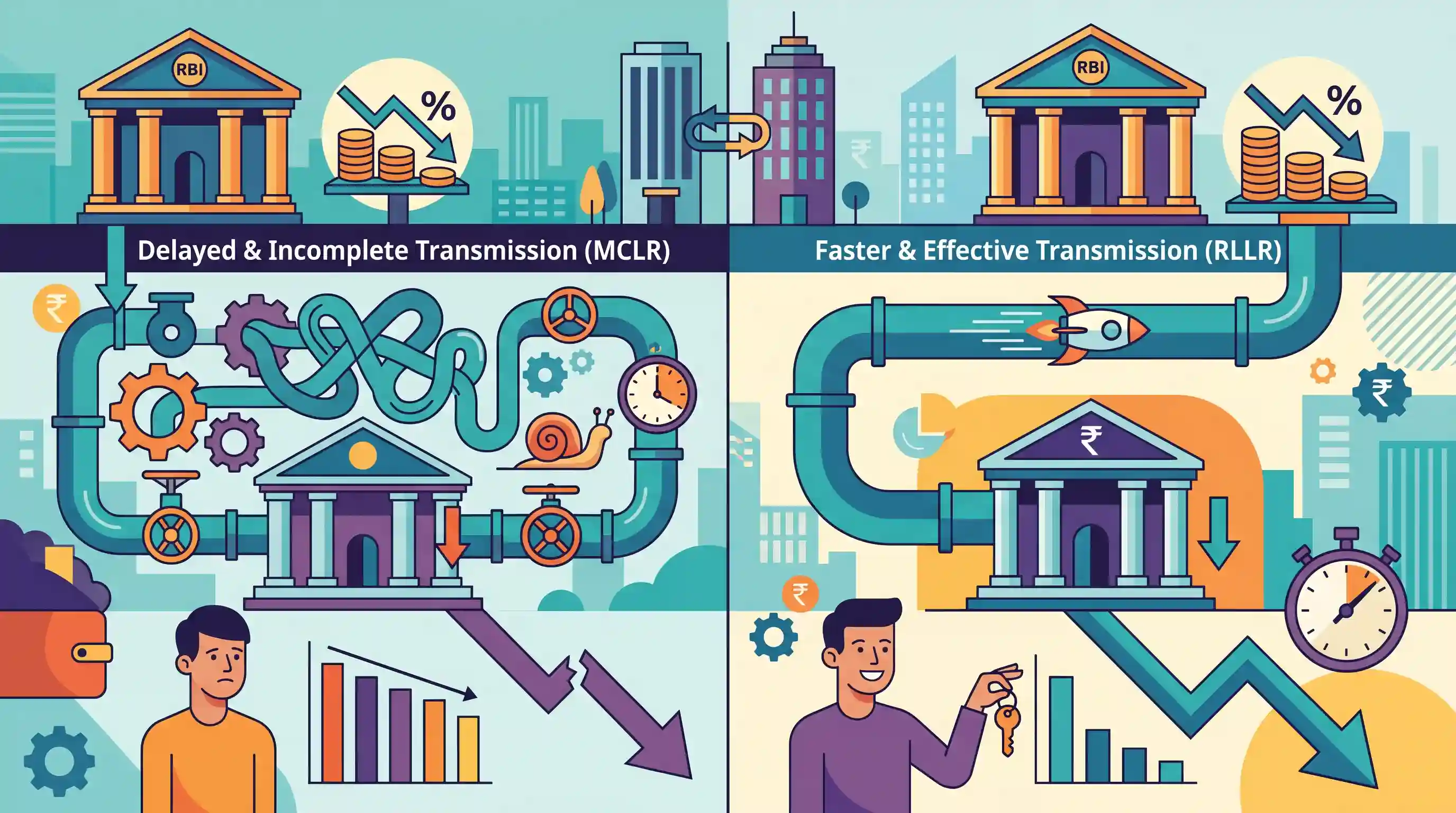
The shift from internal benchmarks (like Base Rate and MCLR) to external benchmarks (like RLLR) is a critical evolution in India's banking sector. It addresses the historical problem of poor monetary transmission, ensuring that RBI's rate cuts or hikes directly and swiftly impact consumer and corporate borrowing costs, which is fundamental to controlling inflation and stimulating economic growth.
Summary
Bank of Baroda cut its Repo Linked Lending Rate (RLLR) by 50 basis points to 8.15%, mirroring the Reserve Bank of India's (RBI) recent 50 bps reduction in the repo rate to 5.5%. This immediate adjustment highlights the effectiveness of the external benchmark-linked framework in ensuring faster transmission of central bank monetary policy actions to end borrowers. The shift to external benchmarks like the repo rate was mandated to rectify the delayed and incomplete rate transmission often experienced by borrowers under older, internal bank frameworks like the Marginal Cost of Funds based Lending Rate (MCLR).
Key Points
- Bank of Baroda reduced its Repo Linked Lending Rate (RLLR) by 50 basis points to 8.15%.
- The rate cut is a direct response to the Reserve Bank of India (RBI) lowering the policy repo rate by 50 basis points to 5.5%.
- This immediate adjustment demonstrates the effectiveness of linking lending rates to external benchmarks for faster monetary policy transmission to consumers.
Important Terms
Monetary Policy Transmission

The process through which changes in the central bank's policy rates (like the Repo Rate) influence market lending rates, credit availability, inflation, and overall economic growth.
UPSC context
GS Paper III: Indian Economy. Tests understanding of how central bank actions impact the broader financial system and borrowers.
External Benchmark Lending Rate (EBLR)
Lending rates tied to independent external indicators (e.g., Repo Rate, T-Bill yields) to ensure faster and more transparent interest rate adjustments for retail and MSME borrowers.
UPSC context
GS Paper III: Indian Economy. Key banking reform to address delayed interest rate transmission under internal bank frameworks.
Repo Linked Lending Rate (RLLR)
A specific type of EBLR where the loan interest rate is directly linked to the RBI's repo rate, allowing for immediate adjustments in borrower EMIs.
UPSC context
GS Paper III: Indian Economy. Tests knowledge of modern, market-linked interest rate mechanisms in the Indian banking sector.
Marginal Cost of Funds based Lending Rate (MCLR)
The internal benchmark rate used by banks (since 2016) based on their marginal cost of funds, replaced for new loans by the more responsive EBLR framework.
UPSC context
GS Paper III: Indian Economy. Important for understanding the evolution of lending rate benchmarks and their limitations.
Repo Rate
The interest rate at which the Reserve Bank of India lends liquidity to commercial banks against government securities, acting as the primary tool of monetary policy.
UPSC context
GS Paper III: Indian Economy. Core concept for questions on inflation control, liquidity management, and RBI operations.
Prelims Trap
"RBI mandates all commercial bank loans to be linked exclusively to the Repo Rate under the EBLR framework."
The mandate applies only to floating-rate personal, retail, and MSME loans. Additionally, banks can choose from four benchmarks (Repo, T-Bills, or FBIL rates), not just the Repo Rate.
Static Concepts Connected
How does EBLR differ from the older MCLR framework?
- Internal vs External: MCLR relies on internal factors like the bank's own marginal cost of funds, while EBLR links directly to external market rates like the repo rate.
- Transmission Speed: EBLR ensures near-immediate transmission of central bank rate cuts to consumers. MCLR often resulted in delayed and incomplete monetary policy transmission.
- Spread Adjustment: Under EBLR, banks charge a fixed credit risk premium, preventing arbitrary margin changes unless the borrower's credit assessment actively changes.
What are the RBI-approved external benchmarks for EBLR?
- Policy Repo Rate: The key lending rate at which RBI lends short-term funds to banks.
- Treasury Bill Yields: Yields on 91-day or 182-day Treasury Bills, reflecting short-term government borrowing costs.
- FBIL Benchmarks: Any other benchmark market interest rate developed and published by Financial Benchmarks India Pvt. Ltd.
Cross-Topic Patterns
EBLR's impact on MSME competitiveness
Immediate transmission of repo rate cuts directly reduces borrowing costs for MSMEs, aiding their operational recovery and tightly integrating RBI monetary policy with industrial sector growth.
Role of FBIL in market transparency
The reliance on Financial Benchmarks India Pvt Ltd (FBIL) for external benchmarks connects banking transparency to institutional architecture, a theme UPSC frequently tests in prelims.

Expect a multi-statement question on EBLR applicability (retail/MSME vs corporate) and the institutional role of FBIL in 2026 Prelims.
Linked PYQs · 1
Linked PYQs · 1
- 2016PrelimsGS1
What is/are the purpose/purposes of the 'Marginal Cost of Funds based Lending Rate (MCLR)' announced by RBI? 1. These guidelines help improve the transparency in the methodology followed by banks for determining the interest rates on advances. 2. These guidelines help ensure availability of bank credit at interest rates which are fair to the borrowers as well as the banks. Select the correct answer using the code given below.
