Bangladesh Tribunal Jails Army Officers
Source:The Hindu ↗
Why It Matters
The article is highly relevant for GS2 (International Relations) and GS3 (Internal Security) as it highlights civil-military friction and political volatility in Bangladesh, a critical neighbor for India. Instability in Bangladesh can directly impact India's border security, cross-border migration, and regional stability. Furthermore, it touches on themes of transitional justice, extrajudicial killings, and human rights, which are pertinent to GS2 Governance.
Summary
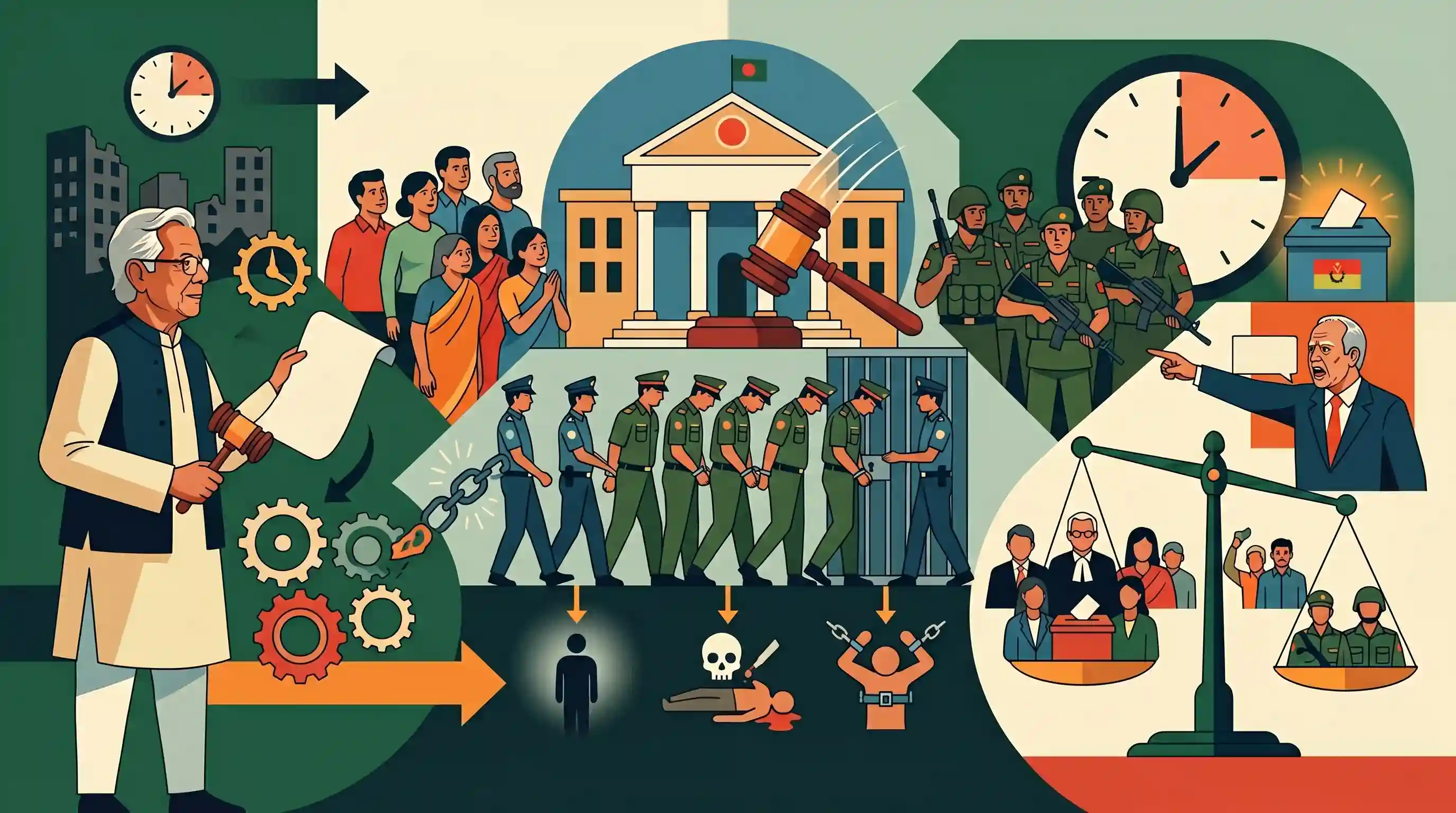
Bangladesh's International Crimes Tribunal (ICT-BD) has ordered 15 serving military officers to be jailed to face trial for enforced disappearances, murders, and custodial torture committed during former Prime Minister Sheikh Hasina's regime. The interim government under Muhammad Yunus amended the tribunal's laws to try these cases in civil courts rather than under military law. This move has sparked unease within the armed forces, prompting the Bangladesh Nationalist Party (BNP) to warn against creating civil-military imbalances ahead of the country's general elections in early 2026.
Key Points
- Bangladesh's International Crimes Tribunal (ICT-BD) sent 15 serving military officers to jail for alleged enforced disappearances, murders, and custodial torture during Sheikh Hasina's tenure.
- The interim government led by Muhammad Yunus amended the ICT-BD law to facilitate the trial of leaders and personnel from the Hasina regime in civil courts.
- Trying serving military personnel in a civil court, rather than under military law, has caused unease and raised concerns about affecting the morale of the armed forces.
- The Bangladesh Nationalist Party (BNP) cautioned the interim government against alienating the military ahead of the general elections scheduled for February 2026.
- The ICT-BD was originally formed in 2010 to try collaborators from the 1971 Liberation War but is now being repurposed to address recent human rights abuses.
Important Terms
International Crimes Tribunal (ICT-BD)

A domestic court in Dhaka established to prosecute genocide and war crimes. Its mandate was recently expanded to try human rights violations from the 2009–2024 Sheikh Hasina regime.
UPSC context
GS Paper II (IR); important for understanding transitional justice mechanisms and political stability in India's neighborhood.
International Crimes Tribunal Act
The 1973 legislation (amended in 2024) providing the legal framework for the ICT-BD. Recent amendments allow civil courts to try military personnel for crimes against humanity.
UPSC context
GS Paper II (Governance/Law); tests knowledge of special statutes and the evolution of human rights law in South Asia.
Bangladesh Army
The land warfare branch of Bangladesh's Armed Forces. It is currently facing unprecedented civil trials for its role in internal security operations under the previous administration.
UPSC context
GS Paper II (International Relations); relevant for civil-military relations and their impact on regional democratic stability.
Bangladesh Nationalist Party (BNP)
A major right-wing political party in Bangladesh led by Khaleda Zia. It currently advocates for a balanced civil-military approach to avoid instability before the 2026 elections.
UPSC context
GS Paper II (IR); essential for analyzing the internal political dynamics and future leadership of a key Indian neighbor.
Awami League
The secular-leaning political party led by Sheikh Hasina that governed Bangladesh from 2009 to 2024. Its leaders now face prosecution for alleged systematic human rights abuses.
UPSC context
GS Paper II (IR); critical for understanding historical India-Bangladesh ties and the impact of the 2024 regime change.
Border Guard Bangladesh (BGB)
The primary paramilitary force responsible for Bangladesh's borders. It frequently assists in internal security and was recently deployed to secure the ICT-BD proceedings.
UPSC context
GS Paper III (Internal Security); relevant for India-Bangladesh border management and trans-border security challenges.
Prelims Trap
The International Crimes Tribunal in Bangladesh (ICT-BD) is a UN-backed international tribunal analogous to the ICC.
Despite its name, ICT-BD is a purely domestic, national tribunal set up by Bangladesh under a 1973 law, not an international UN-backed court.
Static Concepts Connected
What is 'Transitional Justice' in the context of regime changes?
- Core definition: Judicial and non-judicial mechanisms employed by a society transitioning from conflict or authoritarianism to address systemic human rights abuses.
- Key mechanisms: It typically encompasses criminal prosecutions, truth commissions, reparations programs, and institutional reforms.
- Primary objective: It aims to ensure accountability, deliver justice for victims, and promote long-term peace and reconciliation.
How does India balance military discipline and civil jurisdiction?
- Article 33: Article 33 of the Constitution allows Parliament to restrict or abrogate the Fundamental Rights of armed forces personnel to ensure discipline.
- Armed Forces Tribunal (AFT): Established under the Armed Forces Tribunal Act, 2007, to handle disputes regarding commission, appointments, and appeals against court-martial decisions.
- Civil oversight: The Supreme Court and High Courts retain writ jurisdiction, allowing limited judicial review of military tribunal decisions.
Cross-Topic Patterns
Transitional Justice + Neighbourhood First
Bangladesh's transitional justice mechanisms targeting Hasina's regime complicate India's 'Neighbourhood First' policy, requiring New Delhi to recalibrate its diplomatic stance amid anti-India sentiments.
Civil-military tension + Border Management
Civil-military friction in Bangladesh raises risks of political instability, directly impacting India's border management challenges (illegal migration, smuggling) along the porous 4,096-km boundary.

Transitional justice mechanisms and civil-military friction in India's neighborhood are highly probable analytical themes for Mains GS-2.
Linked PYQs · 3
Linked PYQs · 3
- 2022MainsGS2
India is an age-old friend of Sri Lanka.’ Discuss India's role in the recent crisis in Sri Lanka in the light of the preceding statement.
- 2021MainsGS2
Though the Human Rights Commissions have contributed immensely to the protection of human rights in India, yet they have failed to assert themselves against the mighty and powerful. Analyzing their structural and practical limitations, suggest remedial measures.
- 2020MainsGS3
Analyze internal security threats and transborder crimes along Myanmar, Bangladesh and Pakistan borders including Line of Control (LoC). Also discuss the role played by various security forces in this regard.
