Political Party Bans and Democratic Backsliding in Bangladesh
Source:The Hindu ↗
Why It Matters
The evolving political crisis in Bangladesh directly impacts India's internal security, border management, and diplomatic relations under the 'Neighborhood First' policy. Furthermore, it serves as a critical case study for UPSC aspirants regarding the fragility of democratic institutions, the implications of political party bans on multi-party democracies, and the intersection of human rights and governance.
Summary
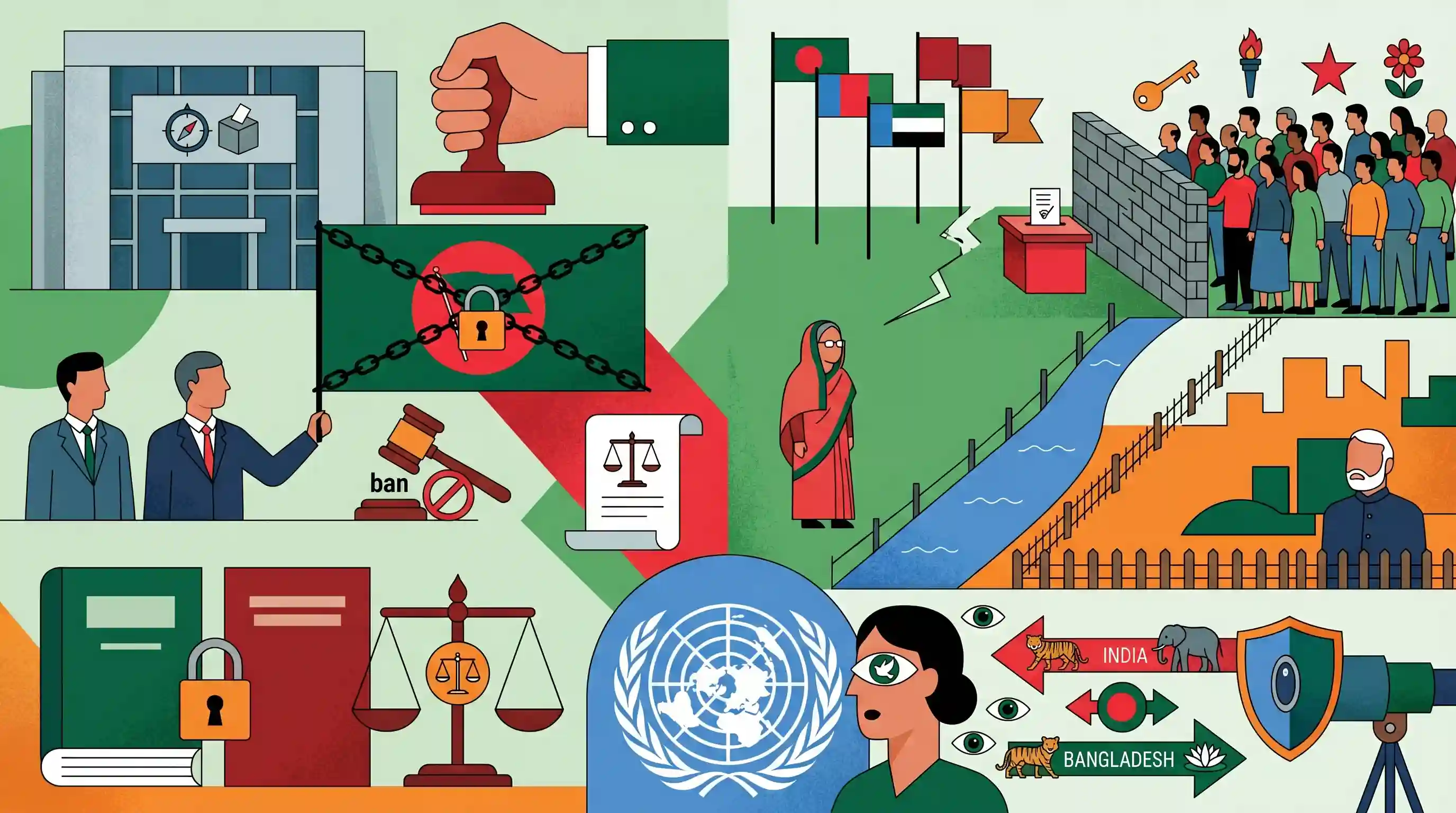
Bangladesh's Election Commission has stripped the former ruling Awami League of its political registration, enforcing a ban imposed by the interim government under the Anti-Terrorism Act. The move bars the party, led by ousted Prime Minister Sheikh Hasina who is currently in India, from contesting the next national elections and participating in any political activity. While the interim government asserts the ban will last until a special tribunal trial concludes, the UN Human Rights Office has warned that such bans undermine the return to genuine multi-party democracy and risk disenfranchising voters. This political shift presents significant diplomatic and security implications for India's neighborhood policy.
Key Points
- The Bangladesh Election Commission cancelled the political registration of the Awami League, following the interim government's ban on the party under the Anti-Terrorism Act.
- The ban effectively prevents the party from participating in future elections and prohibits any physical, online, or social media activities.
- The interim government, headed by Nobel laureate Muhammad Yunus, has threatened arrests for anyone posting comments supporting the Awami League.
- The UN Human Rights Office cautioned against political party bans, stating they undermine multi-party democracy and disenfranchise a large portion of the electorate.
- The ousted Prime Minister Sheikh Hasina is currently in exile in India, adding a layer of diplomatic complexity to India-Bangladesh relations.
Important Terms
Awami League

One of Bangladesh's oldest political parties, led by ousted PM Sheikh Hasina; recently banned and deregistered following the 2024 mass uprising and subsequent political transition.
UPSC context
GS Paper 2: India and its Neighborhood. Tests understanding of how internal political shifts in neighboring states affect India's strategic and security interests.
Interim Government of Bangladesh
The transitional administration led by Nobel laureate Muhammad Yunus, formed in August 2024 to manage state affairs and democratic reforms following the collapse of the previous government.
UPSC context
GS Paper 2: Governance and International Relations. Relevant for analyzing stability in South Asia and India's diplomatic engagement with non-elected transitional regimes.
Anti-Terrorism Act (Bangladesh)
A 2009 law (amended in 2025) used to ban political entities; Section 18 grants the executive broad power to outlaw organizations suspected of involvement in or support for terrorism.
UPSC context
GS Paper 2: Comparative Constitutions and Laws. Examines the use of special legislations to regulate political participation and its impact on democratic norms.
Bangladesh Election Commission
The constitutional body responsible for political party registration and election management; it enforced the ban on the Awami League by stripping it of its legal status to contest polls.
UPSC context
GS Paper 2: Statutory and Regulatory bodies. Analyzes the role of electoral institutions in maintaining multi-party democracy during political crises.
International Crimes Tribunal (Bangladesh)
A domestic court established to prosecute crimes against humanity; the interim government has linked the lifting of the Awami League's ban to the conclusion of trials here.
UPSC context
GS Paper 2: Judiciary and Human Rights. Focuses on the intersection of transitional justice, criminal accountability, and political rights in neighboring countries.
Neighborhood First Policy
India’s strategic framework prioritizing relations with immediate neighbors; the political upheaval in Bangladesh poses challenges to this policy regarding security, connectivity, and regional stability.
UPSC context
GS Paper 2: India and its Neighborhood. A foundational concept for questions on regional diplomacy, border security, and the Siliguri Corridor.
Prelims Trap
The Election Commission of India has explicit statutory powers to deregister a recognized political party.
Under the RPA 1951, the ECI registers parties but lacks explicit statutory power to deregister them, except in rare, Supreme Court-defined scenarios like fraud.
Static Concepts Connected
Does the Election Commission of India (ECI) have power to deregister a political party?
- Registration power: Section 29A of the Representation of the People Act, 1951, grants the ECI the express power to register political parties.
- Deregistration limits: The ECI lacks explicit statutory power to deregister parties. It can only do so under exceptions defined by the Supreme Court (e.g., obtaining registration through fraud).
- Delisting vs. Deregistration: While the ECI can 'delist' inactive unrecognised parties to clean up data, outright deregistration of a functioning party requires legislative amendment.
What are the key security and diplomatic mechanisms between India and Bangladesh?
- Extradition Treaty: Signed in 2013 and amended in 2016 to expedite the extradition of fugitives; heavily tested now given Sheikh Hasina's current political exile in India.
- Border Management: The Coordinated Border Management Plan (CBMP) aims to secure the 4,096 km boundary against insurgency, illegal migration, and smuggling amidst political vacuums.
Cross-Topic Patterns
Extradition Treaties vs. Diplomatic Asylum
Hasina's exile tests the 2013 India-Bangladesh Extradition Treaty. UPSC often links bilateral extradition frameworks with international law concepts like political asylum, non-refoulement, and strategic sovereignty.
Neighbourhood First & Regime Changes
Over-reliance on personality-driven diplomacy exposes India to strategic shocks. This connects to broader GS-2 themes on institutionalizing foreign policy engagement regardless of internal political volatility in the neighborhood.

Expect a comparative Polity MCQ on the ECI's limited powers to deregister political parties under the RPA 1951, inspired by Bangladesh.
Linked PYQs · 2
Linked PYQs · 2
- 2022MainsGS2
India is an age-old friend of Sri Lanka.’ Discuss India's role in the recent crisis in Sri Lanka in the light of the preceding statement.
- 2022MainsGS2
Discuss the role of the Election Commission of India in the light of the evolution of the Model Code of Conduct.
