Bangladesh High Court rejects bail plea of detained Hindu monk
Source:The Hindu ↗
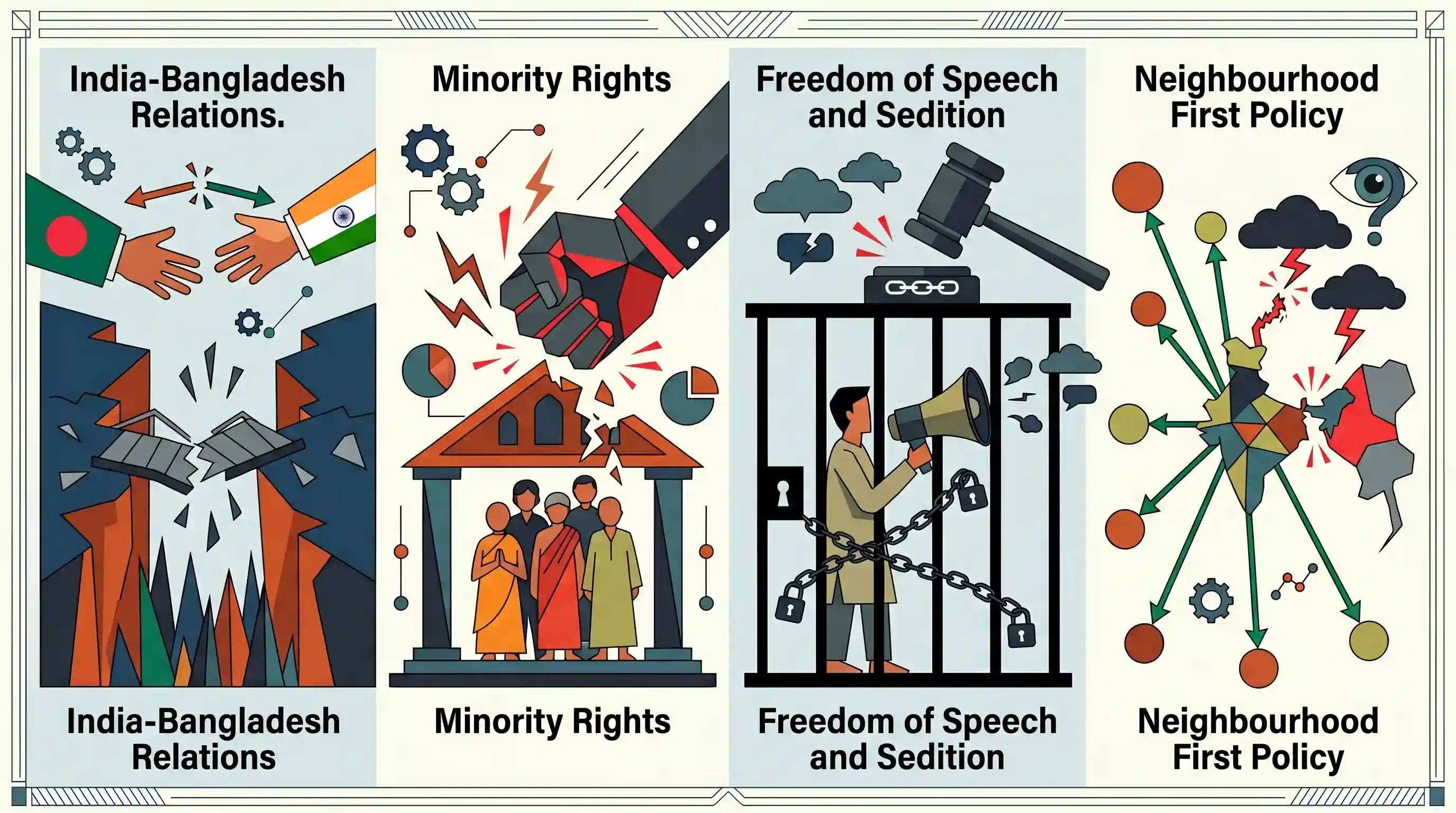
Why It Matters
Internal political instability and human rights issues in neighboring countries directly impact India's foreign policy and border security. The treatment of minorities in Bangladesh is a sensitive issue that frequently tests Dhaka-New Delhi diplomatic ties.
Summary
The Bangladesh High Court rejected the bail petition of detained Hindu monk Brahmachari Chinmoy Krishna Das due to procedural omissions in his application. A former ISKCON leader, Das was arrested on sedition charges and is also under trial for a lawyer's murder. His detention, alongside attacks on Hindu minorities—who constitute about 8% of Bangladesh's population—following the ouster of former Prime Minister Sheikh Hasina, has sparked widespread protests by groups like Sammilito Sanatan Jagaran Jote. These developments are significantly straining diplomatic relations between New Delhi and Dhaka, raising concerns about the safety and rights of minorities in India's neighborhood.
Key Points
- The Bangladesh High Court rejected the bail plea of former ISKCON leader Brahmachari Chinmoy Krishna Das, citing procedural lapses.
- Das faces sedition charges and is being tried in connection with the murder of a lawyer, escalating tensions.
- Following the ouster of Sheikh Hasina, Hindu minorities (about 8% of the population) have faced targeted attacks, prompting widespread protests.
- The detention of the monk and the broader issue of minority rights protection are significantly straining India-Bangladesh diplomatic relations.
Important Terms
Neighbourhood First Policy

A core pillar of India's foreign policy prioritizing stable, secure, and cooperative relations with immediate neighbors through non-reciprocal economic integration and development assistance to ensure a peaceful regional periphery.
UPSC context
GS Paper 2: International Relations; crucial for analyzing India's strategic engagement and challenges with South Asian neighbors.
Sammilito Sanatan Jagaran Jote
An umbrella organization in Bangladesh advocating for the security of religious minorities. It gained prominence post-August 2024, pushing an 8-point demand list including minority protection laws and special tribunals.
UPSC context
GS Paper 2: IR/Social Justice; illustrates the role of non-state actors in cross-border minority rights issues.
ISKCON
A global Vaishnava religious organization (International Society for Krishna Consciousness). Recently scrutinized in Bangladesh after the arrest of former leader Chinmoy Krishna Das on sedition charges.
UPSC context
GS Paper 1: Religious Movements/Social Issues; tests knowledge of religious pluralism and global cultural diplomacy.
Sedition
A criminal charge involving speech or actions intended to incite hatred or disaffection towards the government. In Bangladesh, used recently against minority leaders for allegedly disrespecting national symbols.
UPSC context
GS Paper 2: Polity/Constitution; examines Article 19 freedoms and legal restrictions in democratic governance.
Bangladesh High Court
The upper tier of the subordinate judiciary in Bangladesh with the power to issue writs and adjudicate on criminal bail and constitutional matters.
UPSC context
GS Paper 2: Comparative Politics; useful for comparing judicial structures and independence across South Asia.
Prelims Trap
CAA 2019 grants expedited citizenship to minorities fleeing post-Hasina persecution in Bangladesh.
The CAA's cut-off date is strictly December 31, 2014. It provides no legal protection or accelerated citizenship to minorities fleeing recent (2024-25) political transitions.
Static Concepts Connected
What are the core provisions of the Citizenship Amendment Act 2019?
- Eligible groups: Non-Muslim minorities (Hindus, Sikhs, Buddhists, Jains, Parsis, Christians) from Pakistan, Bangladesh, and Afghanistan.
- Cut-off date: Applicants must have entered India on or before December 31, 2014.
- Exemptions: Does not apply to 6th Schedule areas (e.g., Meghalaya, Mizoram) and Inner Line Permit (ILP) regions.
Which Indian states share a land border with Bangladesh?
- Total length: India shares its longest international land border (4,096.7 km) with Bangladesh.
- Bordering states: West Bengal, Assam, Meghalaya, Tripura, and Mizoram.
- Guarding force: The Border Security Force (BSF) secures this highly porous, often riverine boundary.
Cross-Topic Patterns
Refugee influx and border demographics
Persecution in Bangladesh risks triggering migration into bordering Indian states, linking international diplomacy directly to GS3 internal security challenges and ethnic tensions in the Northeast.
CAA and Article 14 reasonable classification
Ongoing violence against Bangladeshi Hindus is often cited to justify the CAA's 'intelligible differentia' under Article 14, connecting GS2 IR events to core Polity debates.

A combined GS2/GS3 Mains question on how political instability in Bangladesh impacts India's internal security and border demographics.
Linked PYQs · 3
Linked PYQs · 3
- 2020MainsGS3
Analyze internal security threats and transborder crimes along Myanmar, Bangladesh and Pakistan borders including Line of Control (LoC). Also discuss the role played by various security forces in this regard.
- 2024MainsGS2
Discuss India as a secular state and compare with the secular principles of the US constitution.
- 2014MainsGS2
What do you understand by the concept "freedom of speech and expression"? Does it cover hate speech also ? Why do the films in India stand on a slightly different plane from other forms of expression ? Discuss.
