Bangladesh shifts cotton imports to US under trade agreement
Source:The Hindu ↗
Why It Matters
This development is highly relevant for UPSC aspirants as it demonstrates how third-party bilateral trade agreements (US-Bangladesh) can directly undermine India's economic interests and export markets. It also serves as a practical example of the shift from multilateralism to conditional bilateralism, impacting regional supply chains and neighbourhood relations.
Summary
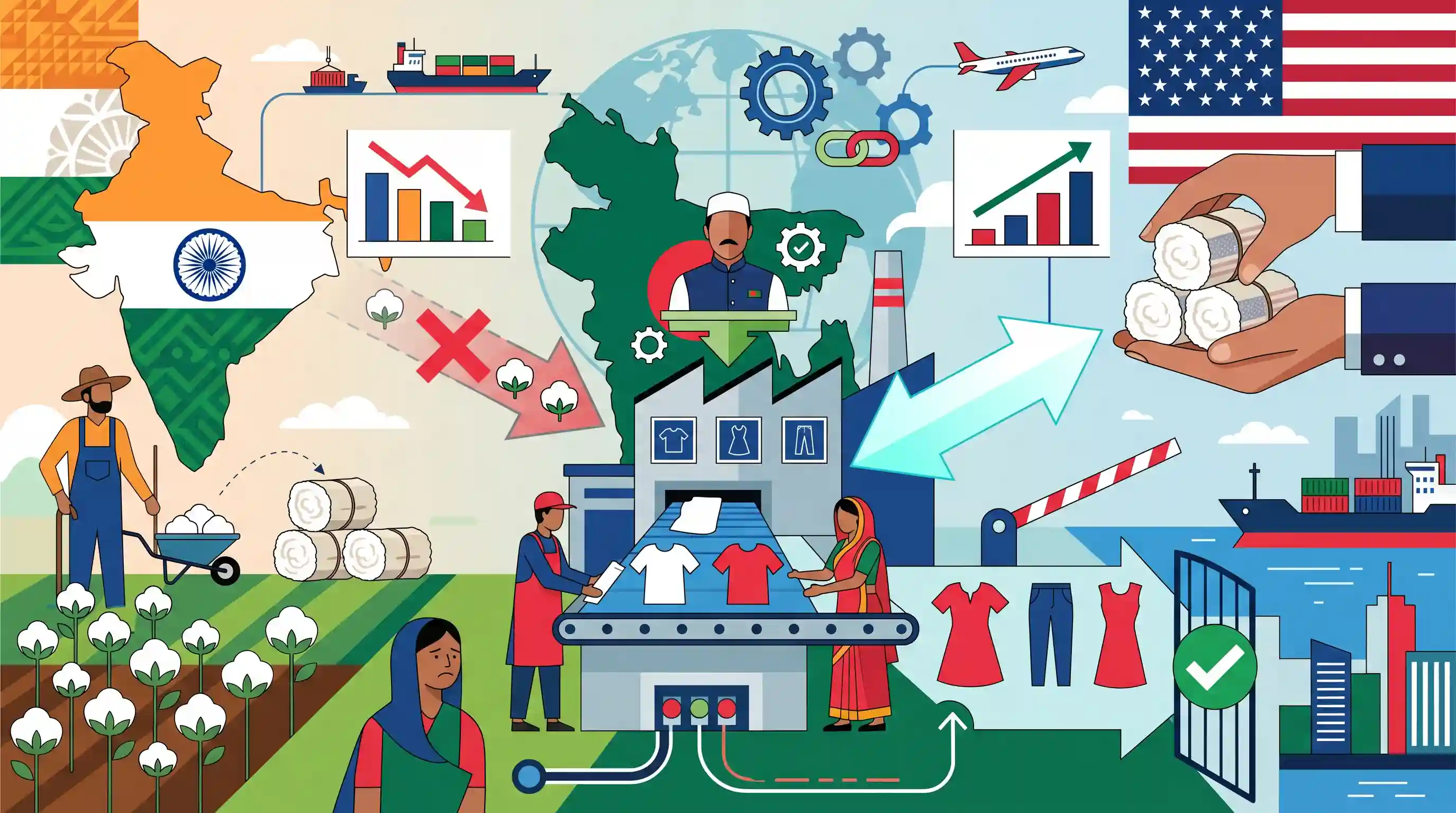
Bangladesh's interim government has decided to replace Indian cotton with U.S.-produced cotton as part of a new bilateral trade deal between the United States and Bangladesh. The agreement eliminates a 19% tariff on Bangladeshi readymade garments entering the U.S. market, provided they are manufactured using U.S. cotton or manmade fibres. This strategic shift threatens India's export market, as India has traditionally been a primary supplier, exporting $1.6 billion of cotton yarn to Bangladesh in 2024. The development underscores the growing impact of conditional bilateral trade agreements on regional supply chains and highlights the shifting geopolitical dynamics in India's neighbourhood following recent bilateral trade frictions.
Key Points
- Bangladesh's interim government plans to replace Indian cotton imports with U.S. cotton under a new bilateral trade agreement.
- The deal offers zero-tariff access for Bangladeshi textiles to the U.S. market (waiving the usual 19% tariff) on the condition that U.S. cotton or manmade fibres are used.
- This move directly impacts India's textile sector, which exported $1.6 billion worth of cotton yarn to Bangladesh in 2024.
- The development follows recent tit-for-tat trade restrictions between India and Bangladesh on cotton, yarn, and readymade garments.
- Economists caution that while the tariff waiver is beneficial, the shift may increase freight costs and present challenges regarding cotton quality compared to Indian or Egyptian varieties.
Important Terms
Agreement on Reciprocal Trade (ART)

A 2026 bilateral pact where the U.S. reduced tariffs on Bangladeshi goods to 19% in exchange for market access and adherence to U.S. labor and digital standards.
UPSC context
GS II: Bilateral agreements involving India's interests; GS III: Effects of policies of developed countries on India's economy.
Cotton-for-Garments Provision
A specific conditionality in the ART granting zero-duty access to the U.S. market for Bangladeshi apparel, provided it is manufactured using U.S.-sourced cotton or fibers.
UPSC context
GS III: Indian agriculture and textile sector; tests understanding of trade-linked sourcing shifts and their impact on Indian farmers.
Reciprocal Tariff
A trade policy where a country matches the import duty levels imposed by a trading partner on its own exports, rather than applying a standard uniform rate.
UPSC context
GS III: International trade and economy; illustrates shifts from multilateralism to bilateral reciprocity in global trade norms.
Rules of Origin (RoO)
Criteria used to determine the national source of a product; under the ART, these rules favor U.S. raw materials over Indian cotton for tariff exemptions.
UPSC context
GS III: Trade agreements; tests how technical trade clauses can cause trade diversion from traditional partners like India.
Neighborhood First Policy
India's foreign policy priority to foster stable, integrated ties with immediate neighbors; challenged by Bangladesh’s economic pivot toward the U.S. and away from Indian imports.
UPSC context
GS II: India and its neighborhood-relations; tests ability to analyze strategic competition and economic friction in South Asia.
Prelims Trap
"Goods assembled in a partner country automatically enjoy duty-free access under FTAs regardless of raw material sourcing."
False. Preferential market access relies on strict 'Rules of Origin' (RoO). The US-Bangladesh pact mandates using US-origin cotton, preventing third-party (Indian) raw materials from benefiting.
Static Concepts Connected
What are 'Rules of Origin' (RoO) in international trade agreements?
- Core definition: The criteria needed to determine the national source of a product, used to assign duties, quotas, and preferential access.
- Primary purpose: Prevents 'trade deflection' where third-party nations route goods through an FTA partner to bypass tariffs.
- CAROTAR 2020: India's own strict customs rules enforcing RoO to check the influx of routed goods from ASEAN via FTAs.
What are the primary geographical conditions required for cotton cultivation?
- Climate requirements: Needs 21-30°C temperature, abundant sunshine, and crucially, 210 frost-free days during the growing period.
- Rainfall ideal: Requires moderate rainfall of 50-100 cm. In drier regions like Punjab and Haryana, it requires irrigation.
- Soil preference: Thrives best in well-drained, deep black soils (Regur) of the Deccan plateau due to excellent moisture retention.
Cross-Topic Patterns
Rules of Origin as geopolitical tools
Similar to US Inflation Reduction Act rules for EV minerals, the US-Bangladesh deal uses 'Rules of Origin' conditions to strategically reshape regional supply chains away from India.
Textile sector export stagnation
The loss of the $1.6B Bangladesh yarn market exacerbates India's declining global apparel share, reinforcing the urgency of operationalizing PM MITRA parks to achieve economies of scale.

Expect a 2026 prelims question linking 'Rules of Origin' in trade pacts to regional supply chain shifts and India's textile challenges.
Linked PYQs · 2
Linked PYQs · 2
- 2013MainsGS1
Analyze the factors for the highly decentralized cotton textile industry in India.
- 2025MainsGS3
What are the challenges before the Indian economy when the world is moving away from free trade and multilateralism to protectionism and bilateralism? How can these challenges be met?
