Bangladesh Replaces Indian Cotton Imports with US Trade Deal
Source:The Hindu ↗
Why It Matters
This development is crucial for understanding the evolving geopolitical and economic dynamics in South Asia. It illustrates how bilateral trade agreements with extra-regional powers (like the US) can disrupt traditional neighborhood supply chains, directly impacting India's agricultural exports and its textile sector's competitiveness.
Summary
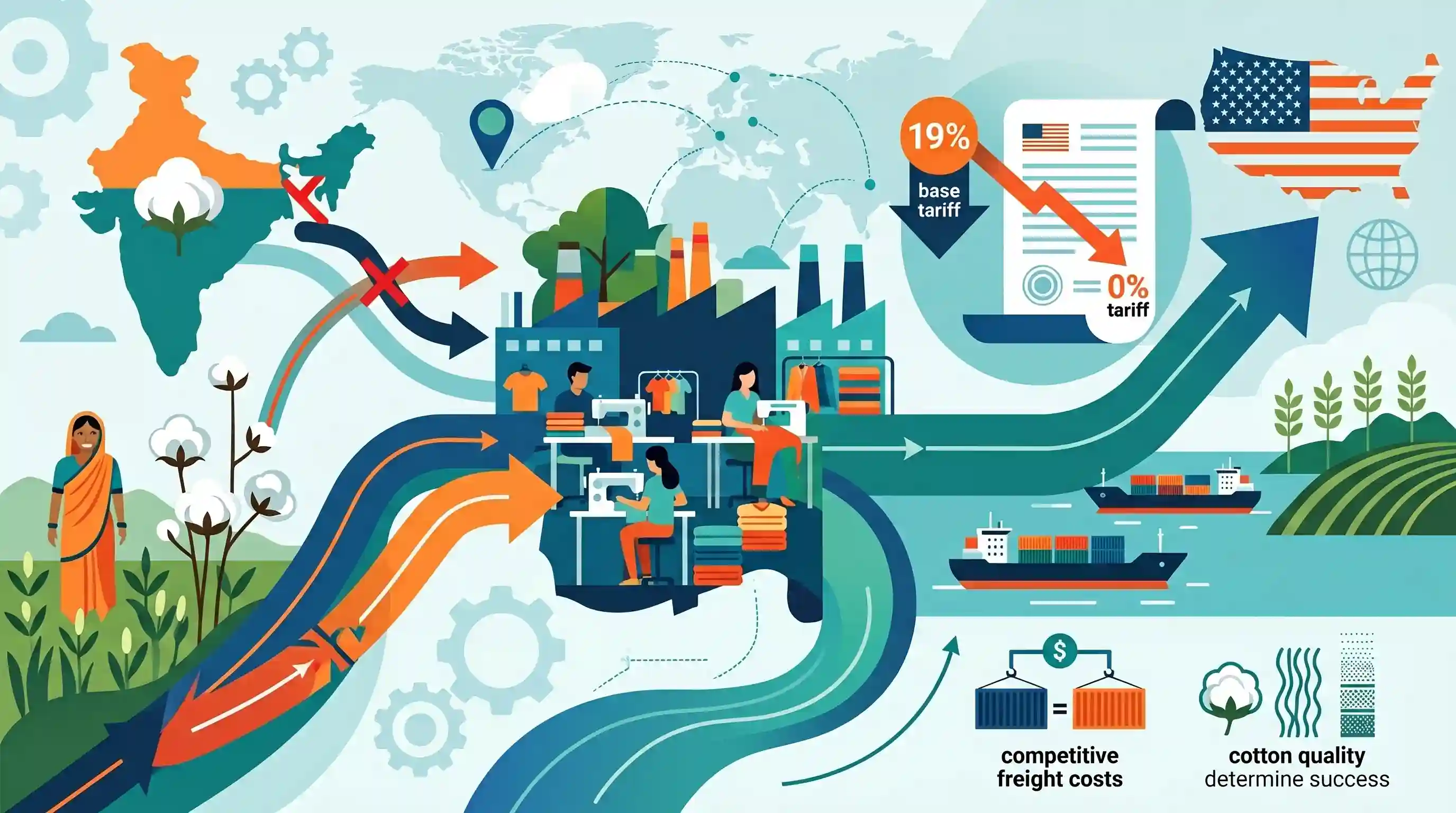
Bangladesh's interim government has announced a strategic shift to replace Indian cotton imports with US-produced cotton under a newly signed US-Bangladesh trade deal. The agreement offers a tariff reduction to zero—from a base of 19%—if Bangladesh's textile industry uses US cotton or manmade fibres. This pivot comes in the wake of recent trade frictions and tit-for-tat restrictions between New Delhi and Dhaka in 2025. While securing a dedicated market for US agriculture, the move challenges India's traditional role as a primary supplier to Bangladesh's critical garment sector, though its ultimate success will depend on competitive freight costs and cotton quality.
Key Points
- Bangladesh's interim government plans to replace Indian raw cotton imports with US-produced cotton following a new bilateral trade deal signed in February 2026.
- The US-Bangladesh agreement stipulates a 19% tariff rate, which can be reduced to zero if Bangladeshi manufacturers use US cotton or manmade fibres.
- This shift threatens India's agricultural exports, as Bangladesh has traditionally relied heavily on India and Central Asia for raw materials for its massive garment sector.
- The decision is partly a fallout from tit-for-tat trade restrictions on cotton, yarn, and textiles that occurred between India and Bangladesh in mid-2025.
- The economic viability of importing US cotton will depend on freight costs and whether the quality matches that of Indian or Egyptian cotton.
- The deal strategically benefits the US by securing a captive market for its agricultural output while restricting Bangladesh from exploring other major cotton-producing countries.
Important Terms
US-Bangladesh Agreement on Reciprocal Trade

A 2026 bilateral pact where the US reduced tariffs on Bangladeshi goods to 19% and offered zero-duty access for garments using US-origin cotton/fibres.
UPSC context
GS Paper II (International Relations); tests understanding of bilateral trade shifts and their impact on India’s neighborhood policy and exports.
Rules of Origin
Criteria determining the national source of a product; in this deal, it mandates using US cotton/man-made fibres to qualify for duty-free entry into the US.
UPSC context
GS Paper III (Economy); relevant for topics on international trade, preferential trade agreements, and non-tariff barriers.
Zero Reciprocal Tariff
A trade policy where a country allows duty-free imports from a partner, provided the partner offers equivalent duty-free access for specified goods.
UPSC context
GS Paper III (Economy); tests knowledge of trade mechanisms and competitive advantages in global supply chains.
Man-made Fibres (MMF)
Synthetic or semi-synthetic textile fibres (e.g., polyester, viscose); a key component of the trade deal alongside cotton to diversify textile raw materials.
UPSC context
GS Paper III (Major Crops/Economy); important for industrial policy and India’s goal to increase MMF sector competitiveness.
Tit-for-Tat Trade Restrictions
A series of 2025 trade barriers where Bangladesh restricted Indian yarn imports via land ports, and India responded with curbs on Bangladeshi readymade garments.
UPSC context
GS Paper II (International Relations); relevant to India-Bangladesh bilateral tensions and trade diplomacy challenges.
Interim Government of Bangladesh
The temporary administration led by Muhammad Yunus, established in 2024, which pivoted Bangladesh’s trade focus toward the US to reduce dependence on India.
UPSC context
GS Paper II (International Relations); tests understanding of political transitions in the neighborhood and their strategic impact on India.
SAFTA (South Asian Free Trade Area)
A free trade agreement among SAARC members; currently provides Bangladeshi garments duty-free access to India, now complicated by the US-Bangladesh pivot.
UPSC context
GS Paper II (International Relations); important for regional integration and analyzing the effectiveness of South Asian trade blocs.
Prelims Trap
"The US-Bangladesh trade agreement provides unconditional zero-tariff access for all Bangladeshi textile exports."
The zero-tariff access is strictly conditional on a "Rules of Origin" clause—Bangladeshi manufacturers must use US-origin cotton or manmade fibres to avail the benefit.
Static Concepts Connected
What is the "Yarn Forward Rule" in Free Trade Agreements?
- Definition: It mandates that apparel must be produced from the yarn stage onwards using inputs from FTA member nations to get tariff benefits.
- Rules of Origin: It acts as a strict "Rule of Origin" to prevent trade deflection, stopping third countries from routing cheap raw materials through an FTA country.
- Strategic Purpose: Developed nations use it to secure captive markets for their domestic agricultural or yarn producers (e.g., US cotton farmers).
What are the geographical conditions required for cotton cultivation?
- Climate Requirements: It is a subtropical crop requiring at least 210 frost-free days and bright sunshine during the ripening stage.
- Rainfall: Requires moderate rainfall of 50 to 100 cm. The crop is highly sensitive to frost and waterlogging.
- Soil: Thrives in highly moisture-retentive soils, ideally the deep black soils (Regur) of the Deccan plateau.
Cross-Topic Patterns
Rules of Origin vs. Regional Supply Chains
Strict FTA clauses by developed nations can artificially sever natural regional supply chains, acting as a non-tariff barrier that hinders South Asian economic integration and regional connectivity.
Labour-intensive Exports & Geopolitics
India's struggle to boost labour-intensive textile exports is compounded when geopolitical friction (Neighbourhood First challenges) disrupts captive raw-material export markets like Bangladesh's massive RMG sector.

Expect a mixed-concept Prelims question in 2026 linking cotton's geographical crop requirements with 'Rules of Origin' trade concepts.
Linked PYQs · 4
Linked PYQs · 4
- 2011MainsGS2
Compared to the South Asian Free Trade Area (SAFTA), the Bay of Bengal Initiative for Multisectoral Technical and Economic Cooperation Free Trade Area (BIMSTEC FTA) seems to be more promising." Critically evaluate.
- 2017MainsGS3
Account for the failure of manufacturing sector in achieving the goal of labour-intensive exports. Suggest measures for more labour-intensive rather than capital-intensive exports.
- 2020PrelimsGS1
"The crop is subtropical in nature. A hard frost is injurious to it. It requires at least 210 frost-free days and 50 to 100 centimeters of rainfall for its growth. A light well-drained soil capable of retaining moisture is ideally suited for the cultivation of the crop." Which one of the following is that crop?
- 2022PrelimsGS1
Which of the following activities constitute real sector in the economy? 1. Farmers harvesting their crops 2. Textile mills converting raw cotton into fabrics 3. A commercial bank lending money to a trading company 4. A corporate body issuing Rupee Denominated Bonds overseas Select the correct answer using the code given below:
