Bangladesh Referendum and July National Charter Constitutional Reforms
Source:Indian Express ↗
Why It Matters
Political transformations in neighboring countries are highly relevant for UPSC GS2. A peaceful democratic transition and constitutional reform process in Bangladesh impact India's border security, regional connectivity initiatives, and the broader 'Neighborhood First' policy. It also serves as a comparative study on democratic instruments like referendums.
Summary
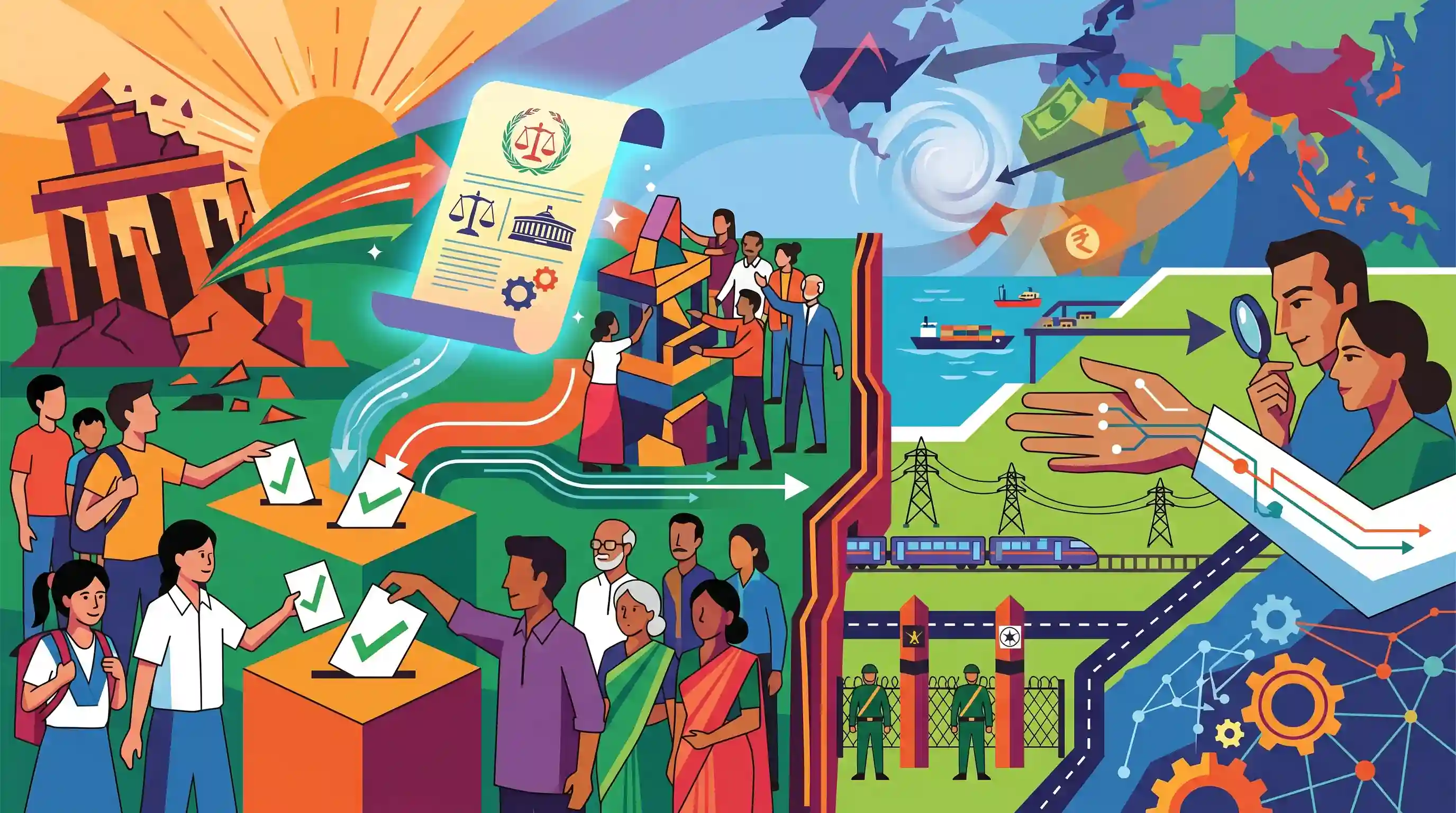
Bangladesh has overwhelmingly voted "Yes" in a referendum endorsing the 'July National Charter', a comprehensive framework for constitutional and institutional reforms. The charter was born out of the July student-led mass uprising that led to the ouster of the previous regime. The positive verdict grants significant public legitimacy to the interim government's mandate to restructure democratic institutions, electoral processes, and governance systems before holding fresh general elections. For India, observing the political restructuring of its eastern neighbor is vital, as stability in Bangladesh directly affects bilateral connectivity, border security, and broader South Asian geopolitics.
Key Points
- Bangladesh held a referendum on the 'July National Charter', which contains sweeping constitutional and democratic reforms proposed after the July mass uprising.
- The public delivered a 'Yes' verdict, legally and politically backing the implementation of these systemic changes.
- The referendum results legitimize the interim government's mandate to restructure political institutions before conducting the next general elections.
- This political transition carries significant implications for regional stability in South Asia and India's 'Neighborhood First' diplomatic and security interests.
Important Terms
July National Charter

A comprehensive reform blueprint signed by Bangladesh's interim government and political parties following the 2024 uprising, proposing structural changes like bicameralism, term limits for Prime Ministers, and judicial independence.
UPSC context
Relevant for GS Paper-II (Neighboring relations and democratic transitions), testing understanding of constitutional reforms and political stability in South Asia.
Interim Government of Bangladesh
A transitional administration led by Muhammad Yunus, formed in August 2024 to restore order and oversee democratic reforms and fresh elections after the ouster of Sheikh Hasina's regime.
UPSC context
GS Paper-II (International Relations); important for analyzing regime changes and their impact on India's bilateral ties and border security.
July Uprising
A student-led mass movement in mid-2024 against quota systems and authoritarianism, which culminated in the resignation of Prime Minister Sheikh Hasina and initiated major constitutional restructuring in Bangladesh.
UPSC context
GS Paper-II; highlights the role of civil society and youth in democratic transitions, a frequent theme in international governance modules.
Doctrine of Necessity
A legal principle used by the Bangladesh Supreme Court to validate the extra-constitutional interim government, citing the urgent need to address a constitutional vacuum and maintain state affairs.
UPSC context
GS Paper-II (Polity/Constitution); tests conceptual understanding of legal frameworks during political crises and the judiciary's role in governance.
Second Republic
A proposed vision for a reformed Bangladesh, aiming to transition from the current centralized system to a more inclusive, democratic framework with balanced executive and legislative powers.
UPSC context
GS Paper-II (Comparative Polity); useful for discussing transformative constitutional shifts and long-term political stability in India's neighborhood.
Non-Party Caretaker Government
A neutral, non-partisan administrative system intended to oversee general elections in Bangladesh to ensure fairness, a core demand of the July 2024 movement.
UPSC context
GS Paper-II; relates to electoral reforms and institutional measures for transparency and accountability in democratic processes.
Prelims Trap
"The 'July National Charter' is a recent bilateral connectivity pact signed between India and Bangladesh."
It is purely a domestic constitutional reform framework within Bangladesh following an internal uprising, not a bilateral treaty or pact with India.
Static Concepts Connected
What are the primary tools of direct democracy?
- Referendum: A direct vote in which an entire electorate is invited to vote on a particular proposal, as seen in Bangladesh's recent charter endorsement.
- Initiative: A process that enables citizens to bypass their legislature by directly placing proposed statutes or constitutional amendments on the ballot.
- Recall: A democratic procedure by which voters can remove an elected official from office through a direct vote before their term ends.
- Plebiscite: A direct vote by the people of an entire country or region to decide on an important public question, such as a change of sovereignty.
Which major connectivity frameworks shape India-Bangladesh bilateral relations?
- Maitri Setu: A major bridge built over the Feni river connecting Sabroom in Tripura to Ramgarh in Bangladesh, enhancing access to the Chittagong port.
- Akhaura-Agartala Rail: A critical cross-border railway link connecting Bangladesh's Akhaura to Tripura, significantly boosting trade and transit for India's landlocked Northeast.
- PIWTT: A bilateral agreement allowing the transit of goods using inland waterways between the two nations, reducing dependence on the Siliguri Corridor.
Cross-Topic Patterns
Democratic transition vs Constitutionalism
The shift from a mass uprising to a formal referendum highlights the transition from revolutionary change to constitutional legitimacy, a core conceptual theme in GS2 Polity.
Dhaka's stability & Northeast security
A stable Dhaka is a prerequisite for India's internal security in the Northeast, as cooperative regimes in Bangladesh are vital to denying safe havens to insurgents.

Expect a Prelims pair-matching question on the "July National Charter" and Bangladesh, or a GS2 Mains Q on neighborhood transitions.
Linked PYQs · 3
Linked PYQs · 3
- 2022MainsGS2
India is an age-old friend of Sri Lanka.’ Discuss India's role in the recent crisis in Sri Lanka in the light of the preceding statement.
- 2025PrelimsGS1
Consider the following statements in respect of BIMSTEC : I. It is a regional organization consisting of seven member States till January 2025. II. It came into existence with the signing of the Dhaka Declaration, 1999. III. Bangladesh, India, Sri Lanka, Thailand and Nepal are founding member States of BIMSTEC. IV. In BIMSTEC, the subsector of 'tourism' is being led by India. Which of the statements given above is/are correct?
- 2016PrelimsGS1
Consider the following pairs: Community sometimes mentioned in the news : In the affairs of 1. Kurd : Bangladesh 2. Madhesi : Nepal 3. Rohingya : Myanmar Which of the pairs given above is/are correctly matched?
