Regional diplomatic shifts and trade protectionism concerns
Source:Indian Express ↗
Why It Matters
The evolving Bangladesh-Pakistan relationship is highly relevant for GS-2 (India and its neighbourhood relations). Furthermore, the implications of global trade protectionism ('tariff anxiety') directly connect to GS-3 economic policies, while public health issues like polio eradication remain important for both Prelims and Mains (Health sector).
Summary
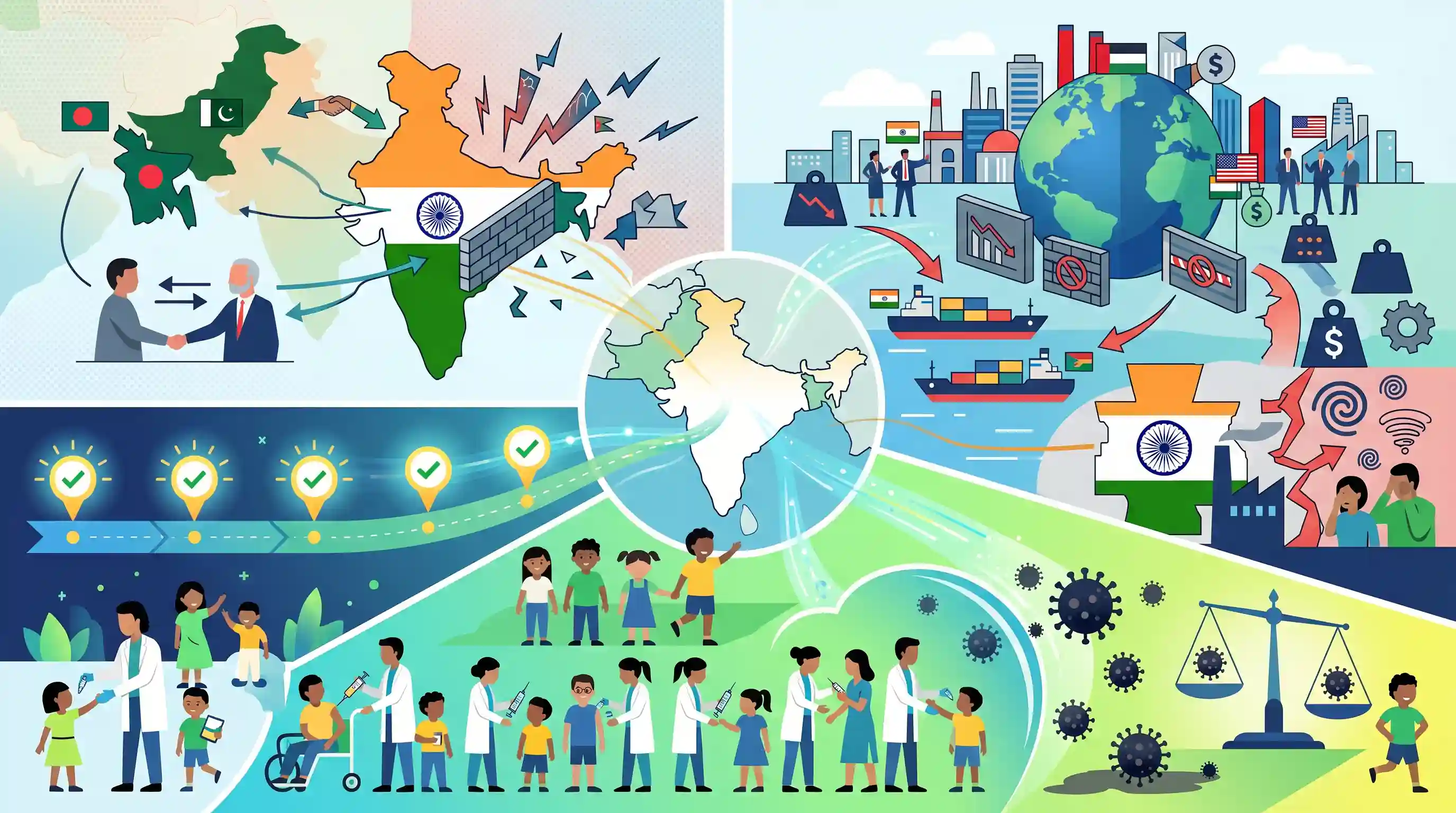
The article provides a strategic roundup of crucial developments affecting the Indian subcontinent. It highlights the diplomatic reset between Bangladesh and Pakistan following the ouster of the Sheikh Hasina government, a realignment that threatens to complicate India's regional influence and security calculus. Concurrently, developing nations are grappling with 'tariff anxiety' driven by the looming threat of intensified global trade protectionism and shifting US economic policies. Finally, the piece touches upon the enduring public health challenge of polio in the region, emphasizing that despite various milestones, consistent vaccination efforts remain imperative to eradicate the disease.
Key Points
- A strategic reset in Bangladesh-Pakistan relations is underway following the political transition in Dhaka, evidenced by the resumption of direct maritime links and enhanced diplomatic outreach.
- The warming of ties between Islamabad and Dhaka alters the South Asian geopolitical dynamic, posing fresh diplomatic and security challenges for India's 'Neighbourhood First' policy.
- Developing economies in the subcontinent are experiencing heightened 'tariff anxiety' due to fears of rising protectionism and impending US trade policies that could disrupt global supply chains.
- The region continues to face significant public health challenges, highlighted by recent milestones in polio eradication efforts in endemic areas like Pakistan, underscoring the critical need for sustained immunization drives.
Important Terms
Mission Indradhanush

A 2014 Indian health mission targeting unvaccinated or partially vaccinated children and pregnant women. It aims for 90% immunization coverage against 12 vaccine-preventable diseases to reduce childhood mortality.
UPSC context
GS Paper II (Health/Social Justice); tests flagship scheme implementation, child health outcomes, and Sustainable Development Goal 3 progress.
Universal Immunization Programme
India’s flagship health initiative (launched 1985) providing free vaccines to millions of children and pregnant women annually. It is central to India's public health successes, including polio eradication.
UPSC context
GS Paper II (Health); examines public health infrastructure, maternal-child health policies, and India’s disease eradication milestones.
SAARC
A regional grouping of eight South Asian nations established in 1985 to foster economic and regional integration. Its progress is frequently stalled by India-Pakistan bilateral tensions.
UPSC context
GS Paper II (International Relations); tests India’s Neighborhood First policy and regional cooperation challenges in South Asia.
World Health Organization (WHO)
The United Nations’ specialized health agency coordinating international public health. It leads global efforts like the Global Polio Eradication Initiative and sets international disease control standards.
UPSC context
GS Paper II (Global Institutions); tests the role of international agencies in health security and global governance.
World Trade Organization (WTO)
An international organization regulating global trade rules. It provides a forum for negotiating trade agreements and settling disputes, significantly influencing the economic policies of developing nations.
UPSC context
GS Paper II/III (Economy/IR); covers global trade governance and the impact of protectionism on India’s interests.
Prelims Trap
Wild Poliovirus (WPV) has been globally eradicated, leaving only vaccine-derived cases.
WPV Type 1 is not eradicated; it remains actively endemic in Pakistan and Afghanistan. Only WPV Types 2 and 3 have been certified as globally eradicated by the WHO.
Static Concepts Connected
What is the current global and Indian status of Wild Poliovirus (WPV) eradication?
- WPV Types: WPV Types 2 and 3 are globally eradicated. WPV Type 1 remains endemic in exactly two countries: Pakistan and Afghanistan.
- India's Status: India was certified polio-free in 2014 (last case in 2011). Sustained immunization remains critical to prevent cross-border viral importation.
- Vaccine-Derived Poliovirus (VDPV): Rare strains that mutate from the oral polio vaccine (OPV) in under-immunized populations, driving the global shift toward injectable IPV.
How do developing nations counter rising protectionism and tariff barriers?
- Bilateral FTAs: Negotiating bilateral Free Trade Agreements (FTAs) or CEPAs to secure preferential, zero-duty market access outside multilateral frameworks.
- China Plus One: Diversifying supply chains away from single manufacturing hubs (like China) to attract companies avoiding targeted Western tariffs.
- Rules of Origin: Enforcing strict domestic value-addition criteria in trade pacts to prevent third-country tariff evasion through route-shopping.
Cross-Topic Patterns
Bay of Bengal maritime security calculus
The resumption of Pakistan-Bangladesh maritime trade alters naval dynamics in the Bay of Bengal, directly intersecting with India's SAGAR vision and the strategic posture of the Andaman & Nicobar Command.
Protectionism driving bilateral FTAs
US protectionism and 'tariff anxiety' are accelerating the shift toward bilateral FTAs and 'China+1' strategies, directly contrasting with the stagnant, consensus-driven WTO multilateral framework.

Expect a 2026 GS-2 Mains question interlinking the Bangladesh-Pakistan maritime reset with India's 'Neighbourhood First' stress-tests.
Linked PYQs · 4
Linked PYQs · 4
- 2016MainsGS2
Increasing cross-border terrorist attacks in India and growing interference in the internal affairs of several member-states by Pakistan are not conducive for the future of SAARC (South Asian Association for Regional Cooperation)." Explain with suitable examples.
- 2025MainsGS3
What are the challenges before the Indian economy when the world is moving away from free trade and multilateralism to protectionism and bilateralism? How can these challenges be met?
- 2023MainsGS3
What are the direct and indirect subsidies provided to farm sector in India? Discuss the issues raised by the World Trade Organization (WTO) in relation to agricultural subsidies.
- 2016PrelimsGS1
'Mission Indradhanush' launched by the Government of India pertains to
