Bangladesh Political Transition and India Regional Diplomacy
Source:Indian Express ↗
Why It Matters
A regime change in Bangladesh profoundly impacts India's security (border management, insurgency), economic integration (connectivity projects), and broader regional strategy (BIMSTEC, countering Chinese influence). Understanding this transition is essential for GS2 International Relations.
Summary
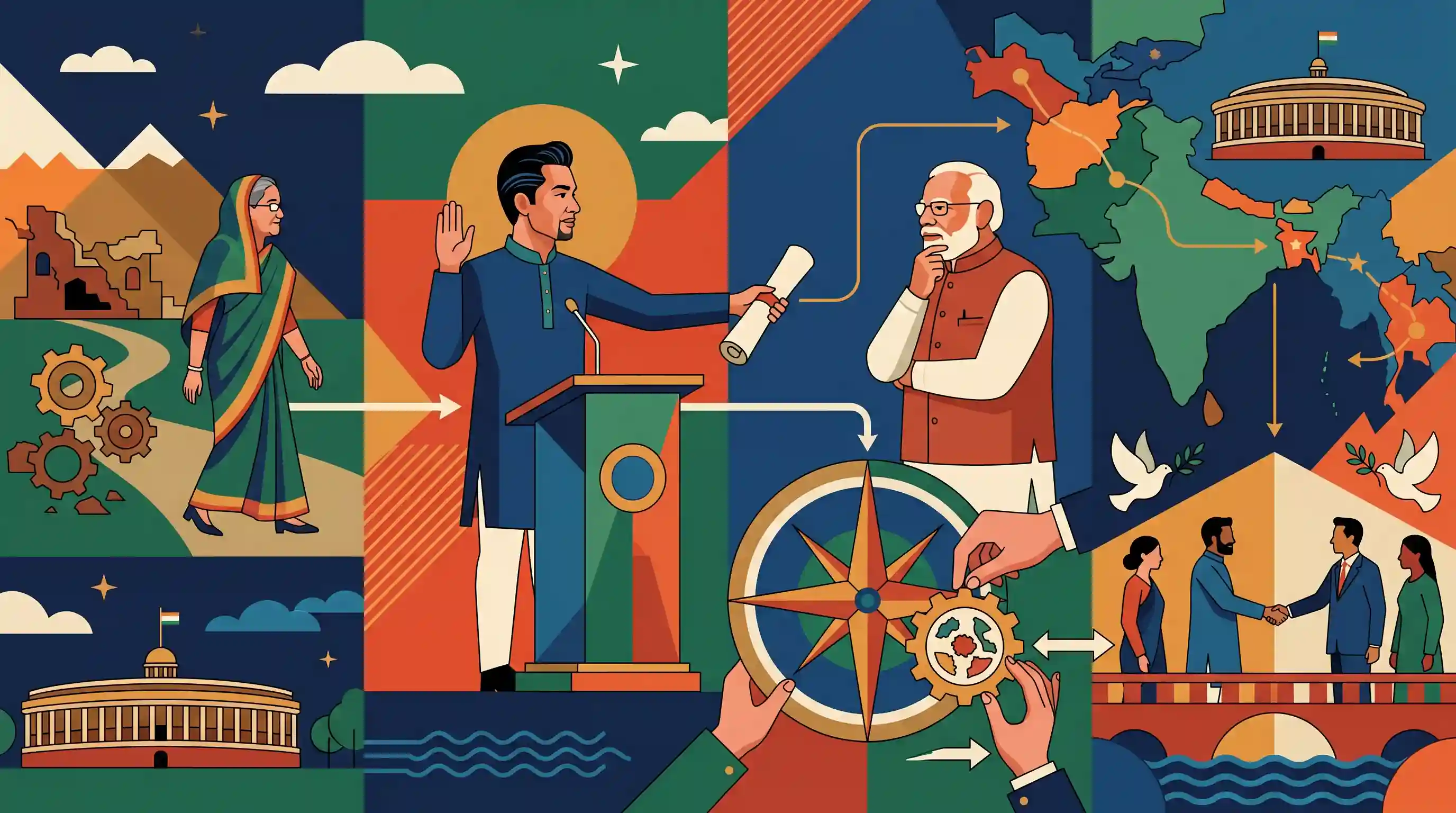
Bangladesh is expected to invite Indian PM Narendra Modi and other regional leaders to the swearing-in ceremony of Tarique Rahman, acting chairman of the Bangladesh Nationalist Party (BNP), on February 17. This gesture highlights a major political shift in Dhaka following the departure of Sheikh Hasina. For India, the invitation presents a crucial diplomatic opportunity to engage with the new administration, manage regional stability, and recalibrate its 'Neighborhood First' policy in the face of changing political dynamics in South Asia.
Key Points
- Bangladesh is preparing to invite Indian PM Narendra Modi and other regional leaders to the swearing-in ceremony of Tarique Rahman on February 17.
- The event signals a definitive political transition in Bangladesh, marking the rise of the BNP following the ouster of Sheikh Hasina and the Awami League.
- Inviting regional leaders mirrors earlier regional diplomatic overtures in South Asia and signifies the new regime's attempt to build diplomatic legitimacy and regional consensus.
- For India, navigating this transition is a critical test of its 'Neighborhood First' policy, requiring a reset in bilateral ties while safeguarding its security, trade, and border interests.
Important Terms
Neighborhood First Policy

India’s diplomatic strategy prioritizing immediate neighbors to foster regional stability, connectivity, and development. It emphasizes a consultative, non-reciprocal approach to improve security and counter external influences like China.
UPSC context
GS Paper-II (International Relations); focuses on India's strategic engagement with its periphery and managing regional stability vs. external powers.
Bangladesh Nationalist Party (BNP)
A major Bangladeshi political party, currently led by Tarique Rahman. Historically skeptical of India, it recently won a landslide victory, marking a shift from the long-standing Awami League administration.
UPSC context
GS Paper-II (Bilateral Relations); crucial for understanding shifts in Dhaka’s leadership and its impact on India’s security and border management.
BIMSTEC
A seven-member regional grouping connecting South and Southeast Asia via the Bay of Bengal. It serves as a key alternative to SAARC for India’s regional engagement and 'Act East' goals.
UPSC context
GS Paper-II (Regional Groupings); important for analyzing sub-regionalism as a vehicle for India’s maritime security and economic integration.
SAARC
Established in 1985, this eight-member intergovernmental organization aims to promote South Asian integration. It is currently largely dysfunctional due to persistent India-Pakistan geopolitical tensions.
UPSC context
GS Paper-II (Regional Groupings); tests knowledge of South Asian institutional failures and the impact of regional rivalries on cooperation.
Awami League
The political party formerly led by Sheikh Hasina, known for its pro-India stance and secular roots. It oversaw a period of deep bilateral cooperation before its 2024-25 removal from power.
UPSC context
GS Paper-II (Bilateral Relations); historical understanding of the party that shaped the 'Golden Chapter' of India-Bangladesh ties.
Prelims Trap
India shares its longest international land border with China, followed by Pakistan and Bangladesh.
India shares its *longest* international land border (4,096.7 km) with Bangladesh, not China or Pakistan. It is a highly porous border touching five Indian states.
Static Concepts Connected
What are the key geographical and political features of the India-Bangladesh border?
- Longest border: At 4,096.7 km, it is India's longest land border, determined originally by the Radcliffe Line during the 1947 partition.
- Bordering States: Five Indian states share this border: West Bengal, Assam, Meghalaya, Tripura, and Mizoram.
- 100th Amendment: The 2015 Land Boundary Agreement (LBA) resolved historical enclave disputes, exchanging territories to rationalize the porous and complex border.
Why has India strategically prioritized BIMSTEC over SAARC?
- Bypassing Pakistan: BIMSTEC excludes Pakistan, allowing India to pursue regional connectivity and economic integration without the persistent geopolitical deadlocks that stall SAARC.
- Act East Link: It acts as a strategic bridge between South Asia and Southeast Asia, aligning perfectly with India's 'Act East Policy'.
- Dhaka Headquarters: The BIMSTEC Secretariat is hosted in Dhaka, making Bangladesh a crucial geopolitical anchor for India's wider Bay of Bengal strategy.
Cross-Topic Patterns
Internal Security & Regime Change
Past BNP regimes allegedly sheltered Northeast insurgent groups. UPSC frequently links neighborhood political transitions directly to India's border management and internal security syllabus.
Infrastructure & Eastern Connectivity
The political shift tests strategic investments like the Akhaura-Agartala rail link and transit rights through Chattogram port, both vital for India's 'Act East' policy and Northeast development.

A 2026 Prelims multi-statement question will likely mix Bangladesh border states, the 100th CAA, and BIMSTEC membership mapping.
Linked PYQs · 4
Linked PYQs · 4
- 2022MainsGS2
Do you think that BIMSTEC is a parallel organisation like the SAARC ? What are the similarities and dissimilarities between the two ? How are Indian foreign policy objectives realized by forming this new organisation?
- 2011MainsGS2
Compared to the South Asian Free Trade Area (SAFTA), the Bay of Bengal Initiative for Multisectoral Technical and Economic Cooperation Free Trade Area (BIMSTEC FTA) seems to be more promising." Critically evaluate.
- 2016MainsGS2
Increasing cross-border terrorist attacks in India and growing interference in the internal affairs of several member-states by Pakistan are not conducive for the future of SAARC (South Asian Association for Regional Cooperation)." Explain with suitable examples.
- 2015MainsGS2
Project 'Mausam' is considered a unique foreign policy initiative of the Indian Government to improve relationship with its neighbours. Does the project have a strategic dimension? Discuss.
