Bangladesh July National Charter and Democratic Reforms
Source:Indian Express ↗
Why It Matters
Political instability and democratic transitions in neighboring countries directly impact India's 'Neighborhood First' policy, cross-border security (GS3), and regional connectivity. Understanding the internal political dynamics of Bangladesh, such as the 'July National Charter', provides crucial context for predicting future bilateral trajectories and managing border security challenges.
Summary
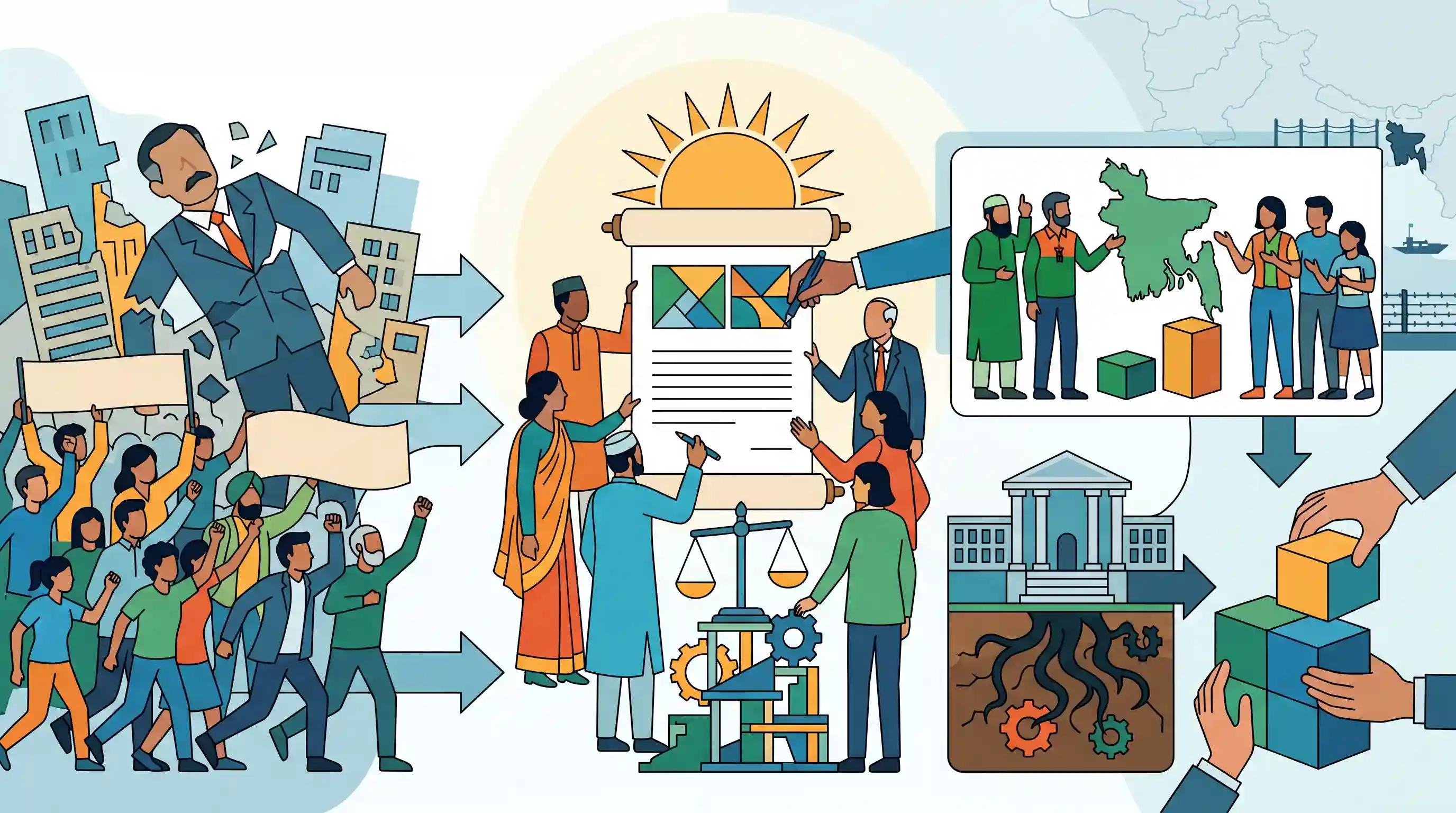
The article analyzes the political transition in Bangladesh following the student-led mass uprising in 2024 that ousted the Awami League government. It focuses on the "July National Charter," a broad consensus document backed by the Bangladesh Nationalist Party (BNP) and its acting chairman Tarique Rahman. The charter aims to institute sweeping democratic reforms to prevent future autocracies, overhaul biased state institutions, and establish structural checks and balances. However, executing this charter poses significant challenges, including forging consensus among diverse political factions—such as student leaders, the BNP, and Islamist groups—and dismantling deep-rooted institutional biases before fresh general elections can be held.
Key Points
- Bangladesh is navigating a fragile political transition following a student-led mass uprising in July/August 2024 that ousted Sheikh Hasina's Awami League government.
- Major political actors, including the BNP and its acting chairman Tarique Rahman, have endorsed the 'July National Charter', aimed at introducing deep democratic and institutional reforms to prevent future autocracy.
- The reforms focus on institutionalizing checks and balances, repairing state machinery, and overhauling constitutional mechanisms to avoid the concentration of power.
- Implementation faces severe challenges, such as building consensus among divergent groups (student leaders, traditional parties, and Islamist factions) and dismantling the deeply entrenched 'deep state' left behind by the previous regime.
- Ensuring stability and formalizing these reforms are critical prerequisites before Bangladesh can conduct fair and credible general elections.
Important Terms
July National Charter

A 2025 consensus document signed by the interim government and major parties to implement constitutional and institutional reforms following Bangladesh's 2024 student-led uprising.
UPSC context
GS-II: International Relations. Tests understanding of democratic transitions in neighboring countries and their impact on India’s regional stability.
31-point state reform agenda
A comprehensive framework proposed by the Bangladesh Nationalist Party (BNP) for structural state "repair," including prime ministerial term limits, judicial independence, and a bicameral legislature.
UPSC context
GS-II: Comparative Constitutions. Important for analyzing institutional checks and balances within South Asian democratic frameworks.
Bangladesh Nationalist Party (BNP)
A major center-right political party in Bangladesh, currently leading calls for a "government of national consensus" and a non-partisan caretaker election system.
UPSC context
GS-II: India and its Neighborhood. Critical for understanding the shift in power dynamics and its implications for India-Bangladesh bilateral ties.
Awami League
The formerly dominant center-left party led by Sheikh Hasina; it was ousted in 2024 and subsequently banned from political activities pending human rights investigations.
UPSC context
GS-II: India and its Neighborhood. Tests knowledge of political instability in the periphery and the challenges to India’s "Neighborhood First" policy.
Jamaat-e-Islami
Bangladesh's largest Islamist party, which re-emerged as a major political force post-2024 after being sidelined for over a decade by the previous regime.
UPSC context
GS-II: International Relations. Concerns the rise of religious-political groups in the neighborhood and potential security/radicalization risks for India.
Prelims Trap
The 'July National Charter' is a bilateral border management agreement between India and Bangladesh.
It is purely a domestic political reform blueprint in Bangladesh created post-uprising to institutionalize democratic checks and balances, not an international treaty.
Static Concepts Connected
Does the Indian Constitution prescribe term limits for the Prime Minister?
- No term limit: The Indian Constitution sets no maximum terms; a PM can serve indefinitely as long as they retain the majority confidence of the Lok Sabha.
- Global contrast: The US limits Presidents to two terms, and Bangladesh's proposed July Charter similarly seeks a strict two-term limit for its Prime Minister to prevent autocracy.
What is the strategic significance of the BBIN Motor Vehicles Agreement?
- Sub-regional connectivity: It aims to facilitate seamless passenger and cargo movement across Bangladesh, Bhutan, India, and Nepal, circumventing Pakistan-induced roadblocks within the broader SAARC framework.
- Crucial linchpin: With Bhutan temporarily opting out due to environmental concerns, Bangladesh's active participation is the linchpin for linking mainland India to the Northeast via transit routes.
Cross-Topic Patterns
Regime Change & Border Security
Political vacuums in Bangladesh directly impact India's GS3 internal security, elevating risks of illegal migration, cattle smuggling, and potential insurgent safe havens along the highly porous Indo-Bangladesh border.
Comparative Constitution: South Asia
Bangladesh's proposed transition to a bicameral legislature and PM term limits offers a vital comparative case study for GS2 questions on constitutionalism and democratic backsliding in South Asia.

Expect a GS2 mains question evaluating how domestic democratic transitions in the neighborhood impact India's sub-regional groupings like BBIN.
Linked PYQs · 3
Linked PYQs · 3
- 2022MainsGS2
India is an age-old friend of Sri Lanka.’ Discuss India's role in the recent crisis in Sri Lanka in the light of the preceding statement.
- 2020MainsGS3
Analyze internal security threats and transborder crimes along Myanmar, Bangladesh and Pakistan borders including Line of Control (LoC). Also discuss the role played by various security forces in this regard.
- 2022MainsGS2
Do you think that BIMSTEC is a parallel organisation like the SAARC ? What are the similarities and dissimilarities between the two ? How are Indian foreign policy objectives realized by forming this new organisation?
