Bangladesh International Crimes Tribunal Verdict and Extradition
Source:The Hindu ↗
Why It Matters
This event presents a critical case study in neighborhood diplomacy for India. The demand for the extradition of a former close ally and the underlying political instability in Bangladesh directly impact India's border security, geopolitical strategy, and the execution of its Neighborhood First policy.
Summary
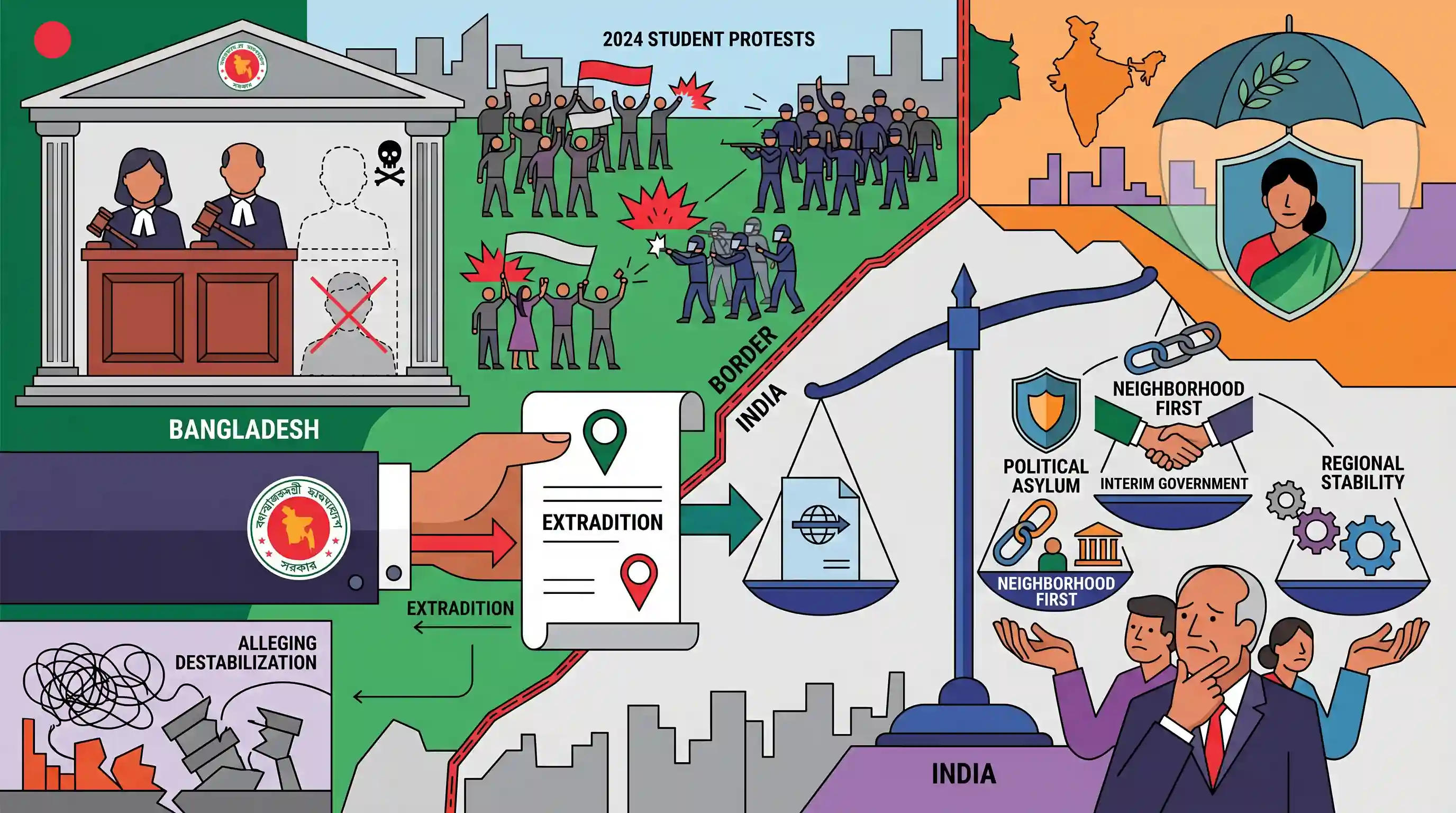
A special tribunal in Bangladesh has sentenced former Prime Minister Sheikh Hasina and former Home Minister Asaduzzaman Khan Kamal to death in absentia for crimes against humanity stemming from the violent crackdown on student protests in 2024. The verdict comes as Hasina resides in exile in India. Bangladesh has formally requested her extradition, labeling it an "obligatory responsibility" and alleging cross-border attempts to destabilize its internal security. This development creates a significant diplomatic predicament for India, testing its "Neighborhood First" policy as it balances legal extradition frameworks, the principle of political asylum, and the need to maintain stable relations with Bangladesh's interim government.
Key Points
- Bangladesh's International Crimes Tribunal-1 (ICT-1) sentenced former Prime Minister Sheikh Hasina and former Home Minister Asaduzzaman Khan Kamal to death in absentia.
- The convictions are for crimes against humanity committed during the state crackdown on a massive student uprising in July-August 2024.
- The interim government in Dhaka has officially requested India to extradite Sheikh Hasina, warning that granting asylum to convicts is an affront to justice.
- Bangladesh's Home Affairs Adviser alleged that attempts are being made from a neighboring country (hinting at India) to destabilize Bangladesh's security.
- The verdict has deepened the political divide in Bangladesh, with the Awami League rejecting it as politically motivated, while the BNP and Jamaat-e-Islami welcomed it.
Important Terms
India-Bangladesh Extradition Treaty

A 2013 bilateral agreement (amended 2016) facilitating the exchange of fugitives. It includes a 'political offense' exception that excludes crimes like murder, terrorism, and kidnapping.
UPSC context
GS Paper II (IR); tests knowledge of legal frameworks for bilateral security and extradition hurdles like the political offense exception.
International Crimes Tribunal-1 (ICT-1)
A Dhaka-based domestic special tribunal reconstituted in 2024 to prosecute genocide and crimes against humanity, specifically targeting leaders involved in the violent 'July Mass Uprising' crackdown.
UPSC context
GS Paper II; tests understanding of regional judicial mechanisms and their impact on India’s diplomatic relations with neighboring governments.
International Crimes (Tribunals) Act, 1973
Bangladesh’s statutory framework enabling the domestic prosecution of genocide, war crimes, and crimes against humanity, originally enacted to try local collaborators from the 1971 Liberation War.
UPSC context
GS Paper II (Neighborhood Policies); essential for analyzing the legal basis of trials affecting Indian-hosted exiles and bilateral trust.
Awami League
A major secular political party in Bangladesh, led by Sheikh Hasina, which spearheaded the 1971 independence movement and historically maintained deep strategic cooperation with India.
UPSC context
GS Paper II; tests knowledge of political actors in neighboring states and how party-to-party ties influence regional security.
Bangladesh Nationalist Party (BNP)
A major center-right political party in Bangladesh and the primary rival to the Awami League, often advocating for distinct nationalistic policies and skeptical of deep Indian influence.
UPSC context
GS Paper II; critical for assessing how shifts in neighboring political power affect India's 'Neighborhood First' policy objectives.
Jamaat-e-Islami
Bangladesh's largest Islamist party. It opposed the 1971 liberation and has been central to ICT trials, both as a target of past convictions and a current political force.
UPSC context
GS Paper II; tests knowledge of radicalism, religious-political groups, and their impact on South Asian regional stability and security.
Prelims Trap
Bangladesh's International Crimes Tribunal (ICT) is a UN-backed international court.
Despite its name, Bangladesh's International Crimes Tribunal (ICT) is a purely domestic special court set up under its national law, not a UN body.
Static Concepts Connected
What is the legal framework governing extradition in India?
- Nodal legislation: Regulated domestically by the Extradition Act, 1962, with the Ministry of External Affairs acting as the nodal agency.
- Dual criminality: The alleged offense must be punishable by a minimum of one year's imprisonment in both the requesting and requested nations.
- Political exception: Under Section 31, India can legally deny extradition if the offense is determined to be of a "political character."
What is India's stance on international refugee and asylum frameworks?
- Non-signatory: India is not a party to the 1951 UN Refugee Convention or its 1967 Protocol.
- No domestic law: India lacks a dedicated national refugee law, managing asylum seekers through ad-hoc executive discretion.
- Executive discretion: Foreigners, including political exiles, are managed under the Foreigners Act, 1946, and the Passport Act.
Cross-Topic Patterns
Extradition vs. Political Asylum
Hasina's case connects India's "Neighborhood First" policy directly to domestic executive discretion under the Foreigners Act, pitting bilateral treaty obligations against sovereign rights to grant political asylum.
Domestic vs. International Tribunals
Compares Bangladesh's ICT with actual UN-backed hybrid tribunals (like the Khmer Rouge Tribunal) or the ICC, highlighting how states use domestic courts for transitional justice without international oversight.

Expect a multi-statement question linking India's Extradition Act exceptions with its non-signatory status to the 1951 Refugee Convention.
Linked PYQs · 3
Linked PYQs · 3
- 2022MainsGS2
India is an age-old friend of Sri Lanka.’ Discuss India's role in the recent crisis in Sri Lanka in the light of the preceding statement.
- 2024MainsGS2
Discuss the geopolitical and geostrategic importance of Maldives for India with a focus on global trade and energy flows. Further also discuss how this relationship affects India's maritime security and regional stability amidst international competition ?
- 2015MainsGS2
Project 'Mausam' is considered a unique foreign policy initiative of the Indian Government to improve relationship with its neighbours. Does the project have a strategic dimension? Discuss.
