Sundarbans Conservation Bilateral Talks Scheduled in Bangladesh
Source:tbsnews ↗
Why It Matters
Highly relevant for WBCS aspirants due to its focus on the Sundarbans, a critical geographical and ecological feature shared by West Bengal and Bangladesh.
Summary
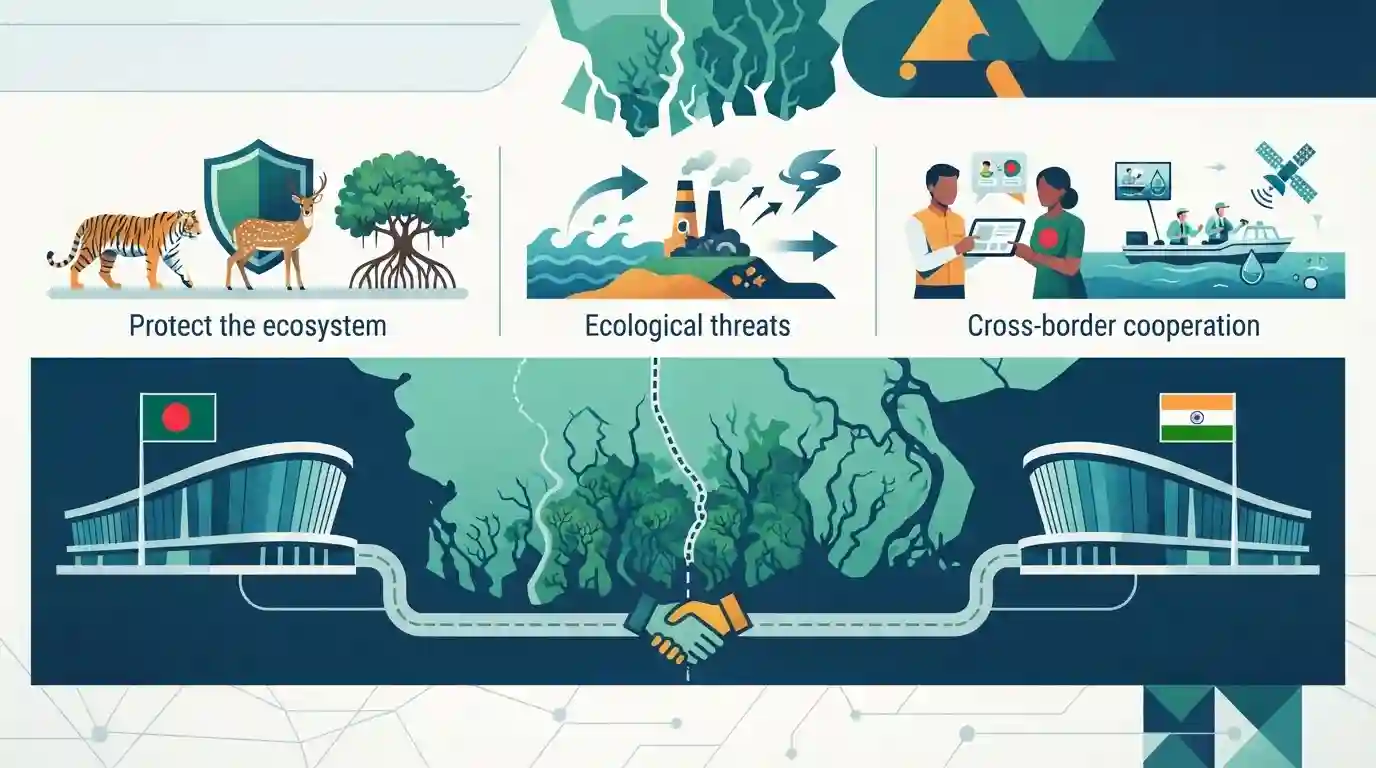
Bangladesh is scheduled to host upcoming bilateral conservation talks with India aimed at protecting the shared Sundarbans mangrove forest, addressing ecological threats, and enhancing cross-border environmental cooperation.
Key Points
- Bangladesh is set to host the next round of bilateral talks with India focusing on the conservation of the Sundarbans mangrove ecosystem.
- The discussions will center on joint management, biodiversity preservation, and tackling shared environmental challenges like climate change and pollution in the world's largest mangrove forest.
- Bilateral cooperation between India and Bangladesh is essential to protect the unique flora and fauna, including the Royal Bengal Tiger, across the deltaic region.
Important Terms
Sundarbans Mangrove Forest

The world's largest continuous tidal halophytic mangrove forest, spanning the Ganges-Brahmaputra-Meghna delta across India (40%) and Bangladesh (60%), noted for its rich biodiversity and the Royal Bengal Tiger.
UPSC context
Crucial for WBCS Paper III (Environment & Biodiversity) and Geography of West Bengal, testing knowledge of transboundary ecosystems, Ramsar sites, and climate resilience.
Joint Working Group on Sundarbans
A bilateral administrative body formed under a 2011 Memorandum of Understanding between India and Bangladesh to coordinate transboundary conservation, biodiversity protection, and management of the shared Sundarbans ecosystem.
UPSC context
Relevant for WBCS Paper II (Bilateral Relations and International Cooperation), evaluating institutional frameworks for joint ecological stewardship between India and Bangladesh.
Memorandum of Understanding (MoU) on Sundarbans Conservation
An international pact signed in 2011 by India and Bangladesh to address common environmental threats, promote scientific research, and preserve the ecological integrity of the shared Sundarbans delta.
UPSC context
Important for WBCS current affairs and polity, examining bilateral treaties, environmental diplomacy, and cross-border resource management.
Royal Bengal Tiger
The endangered apex predator (*Panthera tigris tigris*) native to the Indian subcontinent, with its largest remaining single contiguous population inhabiting the mangrove forests of the Indian and Bangladeshi Sundarbans.
UPSC context
Key topic for WBCS Environment & Ecology (Wildlife Conservation and Project Tiger), testing knowledge of endangered species and transboundary protocols.
Prelims Trap
The Sundarbans mangrove forest is a uniform UNESCO World Heritage Site with identical conservation and wetland designations across both India and Bangladesh.
Aspirants often assume the entire Sundarbans is a single administrative unit or has the same conservation status, ignoring that the Indian and Bangladeshi portions have distinct designations (e.g., Ramsar wetland on the Indian side).
Static Concepts Connected
What are the key ecological and geographical features of the Sundarbans in West Bengal?
- Deltaic Formation:: Formed at the deltaic confluence of the Ganges, Brahmaputra, and Meghna rivers flowing into the Bay of Bengal.
- Biodiversity:: Home to the endangered Royal Bengal Tiger and recognized globally as a UNESCO World Heritage Site.
- Ramsar Status:: The Indian Sundarbans was designated as a Ramsar Wetland of International Importance in January 2019.
Cross-Topic Patterns
Sundarbans Conservation + Transboundary River Management
India-Bangladesh transboundary conservation frameworks often overlap with river water-sharing treaties like the Ganges water treaty and joint basin management of the GBM river system.
Mangrove Ecosystems + Cyclone Disaster Mitigation
The Sundarbans mangrove belt acts as a critical natural green wall protecting coastal West Bengal and southwestern Bangladesh from severe cyclonic storms originating in the Bay of Bengal.

Expect questions on Ramsar sites in West Bengal or transboundary ecological cooperation frameworks between India and Bangladesh.
Linked PYQs · 2
Linked PYQs · 2
- 2019WBCS_PRELIMSGS1
Sundarban is declared as 'World Heritage Site' for
- 2012WBCS_PRELIMSGS1
'Sundarban' has been sited as a world heritage site due to its :
