Bangladesh Regime Transition and Implications for India Diplomacy
Source:Indian Express ↗
Why It Matters
Regime changes in neighboring countries directly impact India's regional geopolitical stability, cross-border security, and diplomatic strategy. Understanding the transition in Bangladesh is crucial for GS2 (India and its Neighborhood) and GS3 (Border Management).
Summary
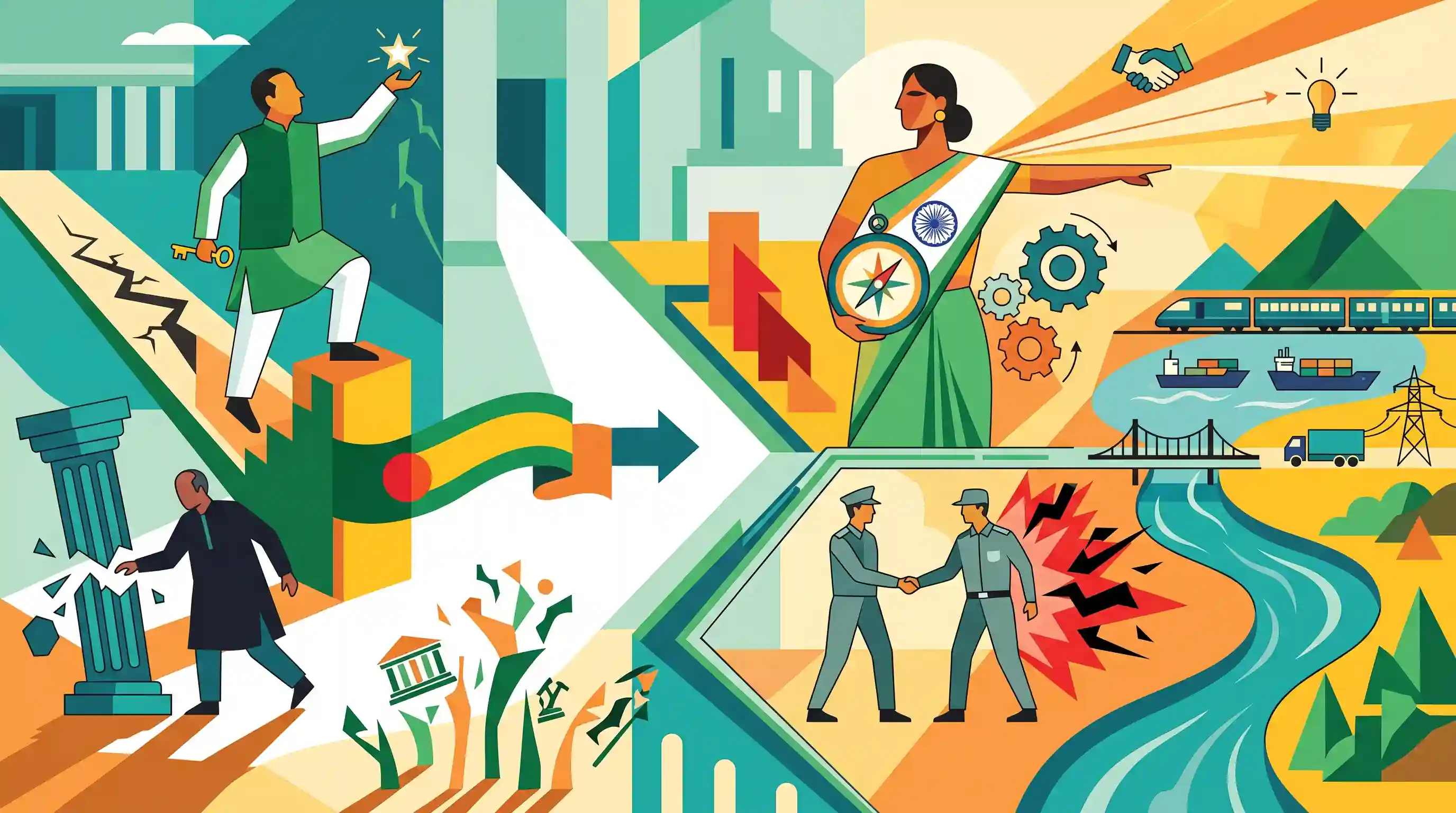
The article discusses the significant political transition in Bangladesh as the Bangladesh Nationalist Party (BNP) secures a mandate, paving the way for its leader, Tarique Rahman, to assume the Prime Minister's office after a 17-year exile. This victory marks a resounding call for change from the Bangladeshi public, following the earlier ouster of Sheikh Hasina and the tenure of an interim government. For Tarique Rahman, the immediate challenge will be consolidating democratic stability and addressing domestic governance. From a geopolitical perspective, this leadership change presents a critical test for India's 'Neighborhood First' policy. New Delhi must proactively adapt its diplomatic engagement with the BNP government to safeguard mutual interests, including border management, security cooperation against insurgencies, and regional connectivity in South Asia.
Key Points
- Tarique Rahman, leader of the Bangladesh Nationalist Party (BNP), is set to assume the Prime Minister's office, ending 17 years in exile following his party's victory in the recent general elections.
- The election results reflect a massive mandate for change among the Bangladeshi electorate, closing the chapter on the previous interim administration and the era of the Awami League.
- Rahman faces the immediate 'real test' of ensuring political stability, economic recovery, and restoring democratic governance in the country.
- The regime change forces India to recalibrate its 'Neighborhood First' policy, as New Delhi has historically shared deeper ties with the Awami League and must now navigate a new diplomatic equation with the BNP.
- Continued bilateral cooperation remains crucial for both nations to manage porous borders, prevent trans-border crime, and sustain regional connectivity initiatives in South Asia.
Important Terms
Neighborhood First Policy

A strategic foreign policy pillar prioritizing immediate neighbors to ensure regional stability, connectivity, and prosperity through consultative and sometimes non-reciprocal engagement.
UPSC context
GS Paper 2: International Relations; essential for understanding India’s regional diplomacy and strategic neighborhood management.
Bangladesh Nationalist Party (BNP)
A major center-right political party in Bangladesh, historically emphasizing nationalist sovereignty and often adopting a more skeptical or cautious stance toward Indian diplomatic and security initiatives.
UPSC context
GS Paper 2: India and its neighborhood; key actor influencing bilateral security and economic ties.
Awami League
A secular, center-left political party in Bangladesh that historically fostered deep strategic and security ties with India, particularly during the 15-year tenure of Sheikh Hasina.
UPSC context
GS Paper 2: International Relations; represents the traditional 'pro-India' political pole in Bangladeshi politics.
Tarique Rahman
The Prime Minister of Bangladesh and BNP Chairman who returned from 17 years in exile to lead his party to a landslide victory in 2026.
UPSC context
Current Affairs: Person in News; his leadership marks a paradigm shift in South Asian geopolitics.
Jamaat-e-Islami
The largest Islamist party in Bangladesh, which emerged as the main opposition in 2026; historically associated with more conservative and anti-India political positions.
UPSC context
GS Paper 3: Internal Security; its influence affects border stability and regional radicalization concerns.
Security Cooperation
The strategic partnership between India and Bangladesh to combat insurgency, cross-border terrorism, and organized crime, particularly affecting India's Northeast region.
UPSC context
GS Paper 3: Border management and security; a critical benchmark for the success of India-Bangladesh relations.
Prelims Trap
"The India-Bangladesh Friendship Pipeline transports crude oil from Assam to Bangladesh."
The pipeline transports refined petroleum (specifically high-speed diesel) from the Numaligarh Refinery, not unrefined crude oil. UPSC frequently swaps 'crude' with 'refined' to test precision.
Static Concepts Connected
Why has India strategically prioritized BIMSTEC over SAARC?
- Pakistan's obstruction: SAARC initiatives, such as the Motor Vehicles Agreement, repeatedly stalled due to Pakistan's vetoes. BIMSTEC bypasses this by excluding Pakistan.
- Act East alignment: BIMSTEC bridges South Asia and Southeast Asia, aligning perfectly with India's broader Act East Policy and Indo-Pacific strategy.
- Bay of Bengal centrality: It shifts the strategic focus to maritime security, blue economy, and connectivity in the geopolitically vital Bay of Bengal region.
What are the key internal security challenges along the India-Bangladesh border?
- Porous geography: Extensive riverine stretches (like the Brahmaputra) and dense forests make continuous physical fencing extremely difficult and maintenance-heavy.
- Organized crime: Rampant cattle smuggling, FICN (Fake Indian Currency Notes) circulation, and illegal migration facilitated by transnational crime syndicates.
- Insurgent sanctuaries: Historical risks of Indian insurgent groups (like ULFA) utilizing neighboring territory as safe havens and logistical hubs for arms procurement.
Cross-Topic Patterns
Northeast insurgency and neighborhood regimes
The historical Chittagong arms haul for ULFA demonstrates how internal security and insurgency management in India's Northeast are inextricably linked to the political regime in Dhaka.
Energy grids as diplomatic stabilizers
Despite political transitions, hard infrastructure like the Numaligarh Friendship Pipeline creates economic interdependence, acting as a geopolitical shock absorber that prevents bilateral ties from collapsing.

Bangladesh regime change + border management + SAARC revival dynamics will likely be a combined GS2/GS3 Mains question in 2026.
Linked PYQs · 3
Linked PYQs · 3
- 2022MainsGS2
Do you think that BIMSTEC is a parallel organisation like the SAARC ? What are the similarities and dissimilarities between the two ? How are Indian foreign policy objectives realized by forming this new organisation?
- 2016MainsGS2
Increasing cross-border terrorist attacks in India and growing interference in the internal affairs of several member-states by Pakistan are not conducive for the future of SAARC (South Asian Association for Regional Cooperation)." Explain with suitable examples.
- 2020MainsGS3
Analyze internal security threats and transborder crimes along Myanmar, Bangladesh and Pakistan borders including Line of Control (LoC). Also discuss the role played by various security forces in this regard.
