Bangladesh elections and security implications for India
Source:Indian Express ↗
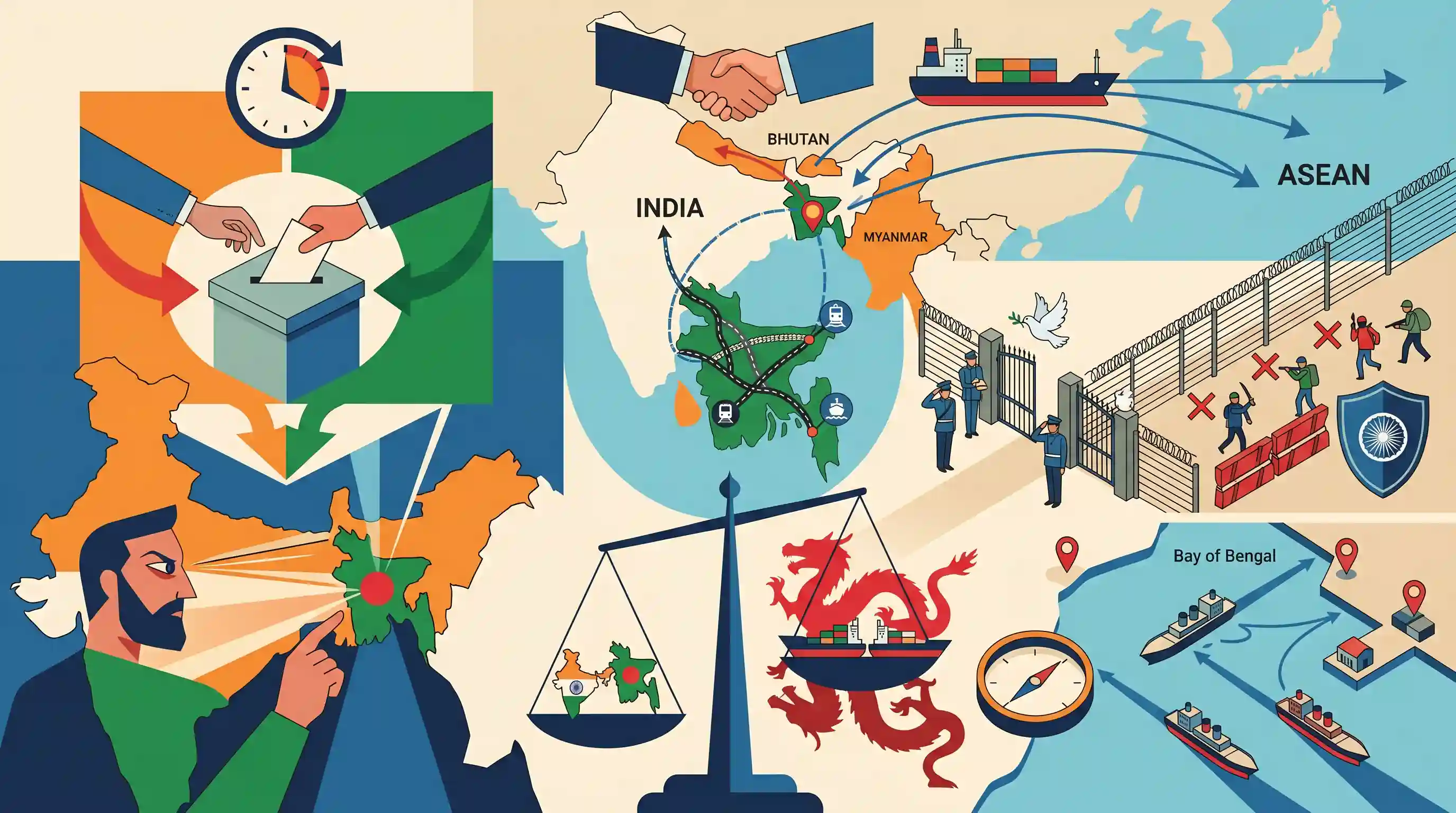
Why It Matters
Bangladesh is the cornerstone of India's 'Neighbourhood First' policy. Aspirants must understand how domestic political transitions in neighboring countries directly impact India's internal security (border management, insurgency, migration) and regional geopolitics (Chinese influence, regional connectivity).
Summary
The upcoming February 12 elections in Bangladesh signify a major political transition, offering a 'fresh start' for its democratic institutions and key political factions. For India, the outcome of these elections is of paramount importance due to deeply intertwined security, economic, and geopolitical interests. A stable and cooperative regime in Dhaka is essential for New Delhi to safeguard its 'Neighbourhood First' and 'Act East' policies, maintain crucial transit routes to the Northeast, and ensure effective border management against insurgent groups and illegal migration. Furthermore, the new government's foreign policy stance will directly impact the regional balance of power amid China's expanding influence in the Bay of Bengal.
Key Points
- The February 12 elections represent a critical democratic reset and a 'fresh start' for all major political parties in Bangladesh following a period of interim governance.
- A cooperative government in Dhaka is strategically vital for India to maintain regional stability, specifically to prevent anti-India insurgents from establishing cross-border safe havens that threaten Northeast India.
- The geopolitical orientation of the incoming administration will significantly impact India's efforts to balance China's growing infrastructure and economic footprint in South Asia.
- Sustained political stability is essential to protect critical transit and connectivity routes through Bangladesh, which act as economic lifelines for India's landlocked Northeastern states.
- The election outcome will dictate bilateral negotiations on sensitive friction points, including illegal trans-border migration, minority rights, and pending river water sharing treaties like the Teesta.
Important Terms
Neighbourhood First Policy

India’s foreign policy priority focusing on immediate neighbors to ensure regional stability, physical connectivity, and mutual prosperity through development assistance and non-reciprocal cooperation.
UPSC context
GS Paper II (International Relations). Key for questions on India's strategic management of its immediate periphery and regional leadership.
Act East Policy
An evolution of the 'Look East' policy, aimed at strengthening economic and security ties with Southeast and East Asia, viewing Bangladesh as a vital bridge.
UPSC context
GS Paper II (Bilateral & Regional Relations). Tests knowledge of India's sub-regional connectivity and countering China’s influence in the Indo-Pacific.
Teesta Water Sharing Agreement
A long-stalled treaty to regulate the waters of the Teesta River, crucial for northern Bangladesh's irrigation; blocked primarily by West Bengal's domestic political concerns.
UPSC context
GS Paper II (India-Bangladesh Relations). Focuses on transboundary water disputes and the role of federalism in foreign policy.
Bangladesh Nationalist Party (BNP)
A center-right political party in Bangladesh, led by Tarique Rahman in the 2026 transition, historically advocating a 'Bangladesh First' foreign policy stance.
UPSC context
GS Paper II (Effect of Politics of Developing Countries). Crucial for analyzing political shifts affecting India’s security and border management.
Awami League
The secular political party formerly led by Sheikh Hasina; historically pro-India, it dominated Bangladeshi politics for 15 years before the 2024 political upheaval.
UPSC context
GS Paper II (Bilateral Relations). Tests understanding of historical ties and the impact of regime changes on strategic partnerships.
BIMSTEC
A regional grouping of seven Bay of Bengal nations, serving as a primary platform for technical and economic cooperation and a substitute for the stalled SAARC.
UPSC context
GS Paper II (Regional Groupings). Important for topics on regional integration, maritime security, and neighborhood cooperation without Pakistan.
Prelims Trap
The Teesta river originates in West Bengal before entering Bangladesh.
Teesta originates from the Pahunri glacier in Sikkim, not West Bengal. It flows through West Bengal before joining the Brahmaputra in Bangladesh.
Static Concepts Connected
Which key treaties govern transboundary rivers between India and Bangladesh?
- Ganges Treaty: 1996 pact governing the dry-season water flow at the Farakka Barrage; valid for 30 years, making its upcoming 2026 renewal highly relevant.
- Teesta Impasse: A major stalled agreement over a Brahmaputra tributary, delayed due to opposition from West Bengal over dry-season deficits.
- Feni & Kushiyara: Recent agreements include the 2019 pact for Sabroom town (Tripura) and the 2022 Kushiyara MoU for border irrigation.
What are the major transit connectivity frameworks bypassing the Siliguri Corridor?
- Maitree Setu: A 1.9 km bridge over the Feni river connecting Sabroom in Tripura to Ramgarh in Bangladesh, granting access to Chattogram port.
- Akhaura-Agartala Link: Cross-border railway link facilitating significantly faster freight and passenger movement from mainland India to the Northeast via Bangladesh.
- PIWTT: Protocol on Inland Water Transit and Trade linking National Waterway 1 (Ganga) to National Waterway 2 (Brahmaputra) through Bangladeshi waters.
Cross-Topic Patterns
Act East + Border Security
India's connectivity projects bypassing the Siliguri Corridor rely entirely on Dhaka's cooperation, linking foreign policy directly to Internal Security in the Northeast.
Federalism + Treaty Powers
The Teesta stalemate acts as a recurring case study on how state politics (Water as a State List subject) constrain the Union's Article 253 treaty-making powers.

A GS-2 Mains question combining Bangladesh's political transition with Northeast insurgency and the 'Act East' policy is highly likely.
Linked PYQs · 4
Linked PYQs · 4
- 2019MainsGS3
Cross-border movement of insurgents is only one of the several security challenges facing the policing of the border in North-East India. Examine the various challenges currently emanating across the India-Myanmar border. Also, discuss the steps to counter the challenges.
- 2014MainsGS3
How does illegal transborder migration pose a threat to India's security? Discuss the strategies to curb this, bringing out the factors which give impetus to such migration.
- 2022MainsGS2
Do you think that BIMSTEC is a parallel organisation like the SAARC ? What are the similarities and dissimilarities between the two ? How are Indian foreign policy objectives realized by forming this new organisation?
- 2016MainsGS2
Increasing cross-border terrorist attacks in India and growing interference in the internal affairs of several member-states by Pakistan are not conducive for the future of SAARC (South Asian Association for Regional Cooperation)." Explain with suitable examples.
