Diaspora voting rights introduced in upcoming elections
Source:The Hindu ↗
Why It Matters
The expansion of voting rights to the diaspora in a neighboring country offers an excellent comparative lens for India's own ongoing discussions regarding NRI voting rights (e.g., Electronically Transmitted Postal Ballot System). Additionally, the democratic transition and constitutional reforms in Bangladesh following a period of political crisis hold significant implications for regional stability in South Asia.
Summary
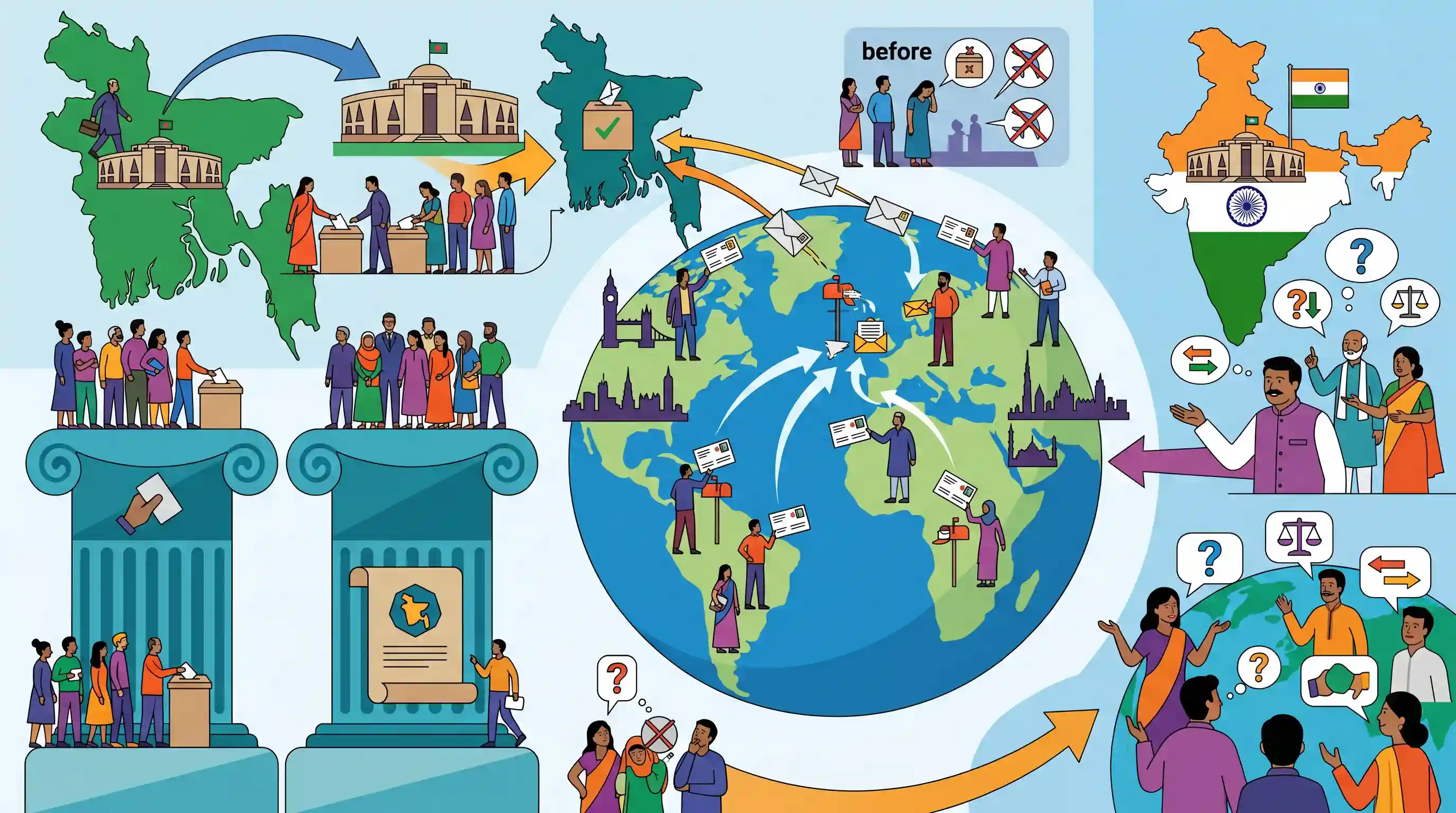
Bangladesh is set to hold its 13th national parliamentary elections and a simultaneous referendum on constitutional reforms on February 12, 2026, following a major political upheaval that ousted former Prime Minister Sheikh Hasina. Over 127 million voters are eligible, but a standout electoral reform is the extension of postal voting rights to the approximately 15 million Bangladeshi expatriates. Previously largely disenfranchised unless they traveled home, the diaspora will now be able to register and vote from their host countries. This development provides a crucial comparative perspective for India, which frequently debates expanding voting mechanisms for its own Non-Resident Indians (NRIs).
Key Points
- Bangladesh is tentatively scheduled to hold its 13th national parliamentary elections on February 12, 2026, marking the first election since the ouster of Sheikh Hasina in August 2024.
- A referendum will be held alongside the election to gauge public support for constitutional reforms aimed at reinforcing democratic institutions.
- In a major electoral reform, the Bangladesh Election Commission is introducing postal voting for its roughly 15 million expatriate citizens, who previously could only vote if physically present in the country.
- Expatriate Bangladeshis will also be allowed to register as voters directly from their host countries via embassies and missions.
- Over 127 million citizens are eligible to vote, with basic qualifications including being a citizen, 18 years of age, a resident of an electoral area, and not declared to be of unsound mind.
Important Terms
Bangladesh Election Commission (BEC)

A constitutional body responsible for conducting and overseeing national elections in Bangladesh. It manages voter registration, polling procedures, and recently implemented major reforms like overseas postal voting for the diaspora.
UPSC context
GS Paper II: Governance/Elections. Tests knowledge of constitutional bodies and comparative electoral management in South Asian democracies.
Awami League
Founded in 1949, this major party led Bangladesh's independence movement. Under Sheikh Hasina, it dominated politics for 15 years until being ousted and suspended in 2024-2025 amid widespread civil unrest.
UPSC context
GS Paper II: International Relations. Essential for understanding political stability in the neighborhood and India’s strategic bilateral partnerships.
Constitution of Bangladesh
The fundamental law of Bangladesh, adopted in 1972. It is currently undergoing significant revision via the 2026 referendum to introduce a bicameral legislature and restore the caretaker government system.
UPSC context
GS Paper II: Comparative Constitutions. Relevant for analyzing democratic transitions and constitutional frameworks in neighboring sovereign states.
Postal Voting (Electoral Reform)
An electoral process allowing voters to submit ballots by mail. Bangladesh’s 2026 reform extended this facility to its 15 million expatriates, a move frequently compared to India's NRI voting debates.
UPSC context
GS Paper II: Electoral Reforms. Important for comparative analysis of diaspora political participation and voting rights for NRIs.
Jatiya Party
A centrist political party founded in 1986 by former President Hussain Muhammad Ershad. It remains a key parliamentary actor, though currently fractured into various factions following the 2024 political shift.
UPSC context
GS Paper II: India and its Neighborhood. Tests understanding of the internal political dynamics and party systems of a key regional neighbor.
Prelims Trap
"NRIs can currently cast their votes from abroad through the Electronically Transmitted Postal Ballot System (ETPBS)."
ETPBS is currently restricted to Service Voters. Despite Election Commission proposals, NRIs must still be physically present in their Indian constituency to cast a vote.
Static Concepts Connected
What is the current voting mechanism for Non-Resident Indians (NRIs)?
- Registration: NRIs holding Indian passports can register as overseas electors using Form 6A under the Representation of the People Act, 1950.
- In-person requirement: They must be physically present at their registered Indian polling booth to vote. Neither postal ballots nor online voting is permitted for NRIs.
- Service Voters exception: Currently, only Service Voters (e.g., Armed Forces personnel) and their spouses are eligible for Electronically Transmitted Postal Ballots (ETPBS) and proxy voting.
How do direct democracy tools like Referendums function?
- Referendum: A referendum is a direct vote by the electorate on a specific political question, legislation, or constitutional reform, binding or advisory in nature.
- Indian context: The Indian Constitution relies entirely on representative democracy for amendments (Article 368) and lacks any provision for holding a national referendum.
- Other tools: Other direct democracy tools include Initiative (citizens proposing laws), Recall (removing elected officials), and Plebiscite (resolving disputes).
Cross-Topic Patterns
Comparative Constitutional Schemes
UPSC frequently tests constitutional comparisons. Bangladesh's use of a national referendum for constitutional reform contrasts sharply with India's purely representative parliamentary amendment process under Article 368.
Diaspora Voting & Remittance Leverage
Engaging the diaspora via remote voting (like Bangladesh's new postal system) enhances political ties, which often translates to sustained remittance flows and sovereign investments from expatriates.

Expect a 2026 Prelims question mixing ETPBS eligibility for NRIs with constitutional provisions for universal adult suffrage (Article 326).
Linked PYQs · 3
Linked PYQs · 3
- 2024MainsGS2
Examine the need for electoral reforms as suggested by various committees with particular reference to "one nation one election" principle.
- 2017MainsGS2
To enhance the quality of democracy in India the Election Commission of India has proposed electoral reforms in 2016. What are the suggested reforms and how far are they significant to make democracy successful?
- 2017PrelimsGS1
Right to vote and to be elected in India is a
