Bangladesh Prepares for 13th Parliamentary Elections in 2026
Source:The Hindu ↗
Why It Matters
A stable and democratic transition in Bangladesh is crucial for India's 'Neighbourhood First' policy. Regime changes in neighboring countries heavily influence India's border management, cross-border trade, and the security dynamics of the Northeastern states.
Summary
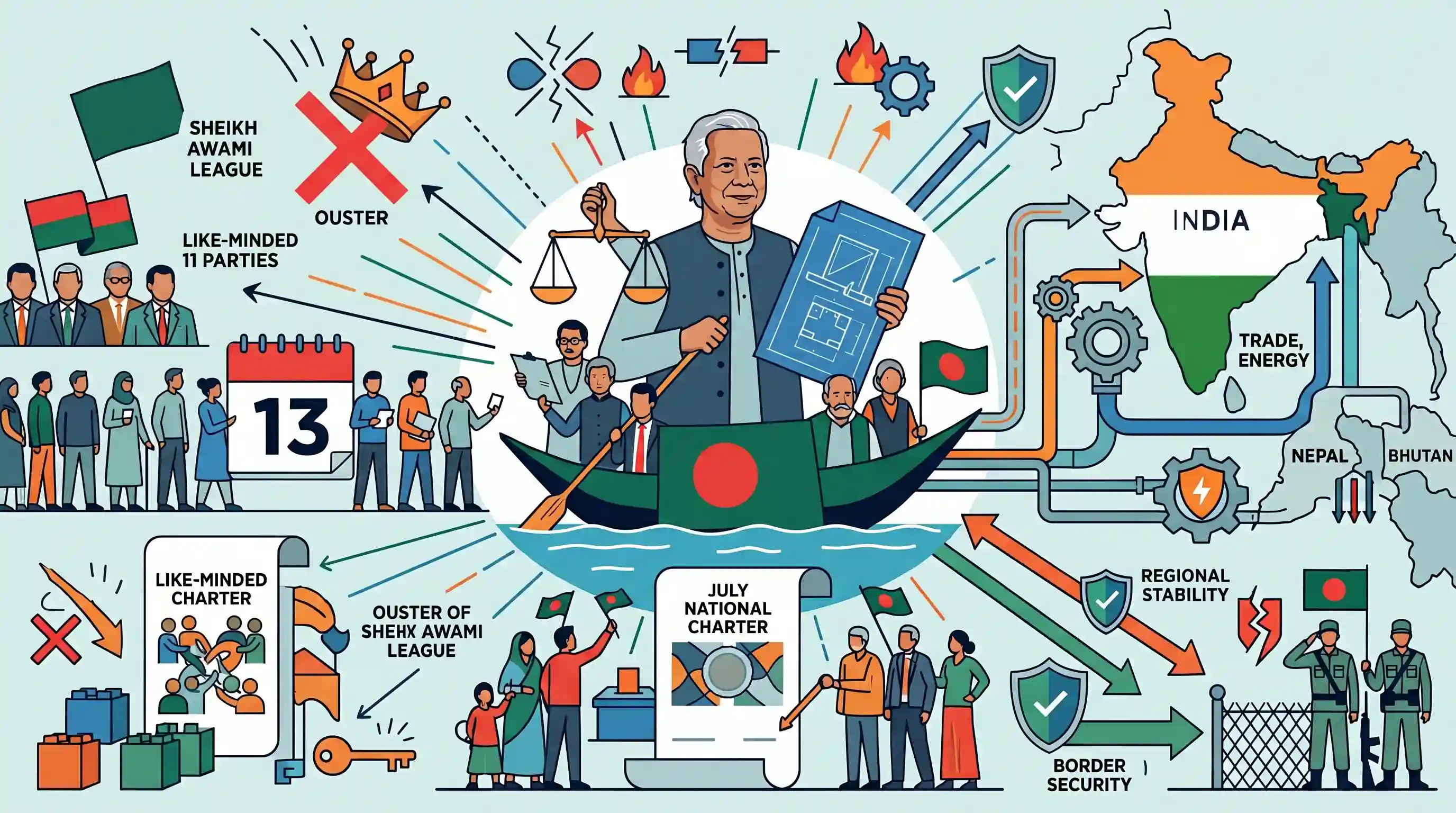
Bangladesh is scheduled to hold its 13th Parliamentary elections on February 12, 2026, marking a critical step toward restoring electoral democracy following the ouster of Sheikh Hasina in August 2024. Overseen by the interim government under Muhammad Yunus, the election will also include a simultaneous referendum on the 'July National Charter' to enact key constitutional reforms. With the Awami League barred from contesting, the primary battle lies between the Bangladesh Nationalist Party (BNP) and the Like-minded 11 Parties alliance. The outcome of this transition is highly significant for regional stability and India's strategic interests in South Asia.
Key Points
- Bangladesh's 13th Parliamentary elections are scheduled for February 12, 2026, the first since the ouster of Sheikh Hasina in August 2024.
- The elections are being overseen by the interim government led by Muhammad Yunus.
- A referendum on the 'July National Charter', aimed at introducing critical constitutional reforms, will be held concurrently with the polls.
- With the Awami League barred from participating, the primary electoral contest is between the BNP and the Jamaat-e-Islami-led Like-minded 11 Parties alliance.
Important Terms
July National Charter

A reform document with ~80 proposals seeking to reshape Bangladesh's governance. It includes prime ministerial term limits, judicial independence, and an upper house, approved via a 2026 national referendum.
UPSC context
GS-II: International Relations/Comparative Constitutions. Tests understanding of democratic transitions and constitutional reforms in India's immediate neighborhood.
Awami League
The political party formerly led by Sheikh Hasina, ousted in 2024. It was barred from the 2026 elections by the interim government due to its deregistration and leader trials.
UPSC context
GS-II: India and its Neighborhood. Critical for analyzing the impact of domestic political vacuum on India-Bangladesh bilateral relations.
Bangladesh Nationalist Party (BNP)
A major center-right party in Bangladesh, led by Tarique Rahman. It secured a two-thirds majority in the 2026 elections, ending 17 years in the political wilderness.
UPSC context
GS-II: International Relations. Essential for assessing future diplomatic engagement and security cooperation under a new regime in Dhaka.
Like-minded 11 Parties Alliance
An Islamist electoral coalition led by Jamaat-e-Islami, formed after the 2024 uprising. It emerged as the primary opposition to the BNP in the 2026 parliament.
UPSC context
GS-II: Effect of Policies and Politics of Developing Countries. Relevant for understanding coalition dynamics and the rise of religious-political forces.
National Citizen Party (NCP)
A youth-led political party formed in February 2025 by leaders of the student uprising. It focuses on reformism and pluralism, winning its first parliamentary seats in 2026.
UPSC context
GS-II: International Relations; Governance. Tests knowledge of Gen Z-led movements and their transition from protests to formal institutional politics.
Jamaat-e-Islami (Bangladesh)
A prominent Islamist party in Bangladesh. Previously deregistered, it was reinstated following the 2024 uprising and led the major 11-party opposition alliance in 2026.
UPSC context
GS-III: Security Challenges in Border Areas. Important for evaluating the influence of religious-political groups on regional stability and cross-border security.
Prelims Trap
"The 'July National Charter' is a bilateral agreement between India and Bangladesh to resolve the Teesta river dispute."
It is actually a domestic constitutional reform document in Bangladesh, slated for a national referendum to overhaul its governance structure.
Static Concepts Connected
What are the core features and challenges of the Indo-Bangladesh border?
- Length & States: India's longest land border (4,096 km), touching West Bengal, Assam, Meghalaya, Tripura, and Mizoram.
- Terrain Challenges: Highly porous, densely populated, and features shifting riverine boundaries, making complete physical fencing nearly impossible.
- Security Threats: Illegal immigration, cattle smuggling, FICN (Fake Indian Currency Notes) trafficking, and potential safe havens for insurgents.
How does Bangladesh facilitate India's North-East connectivity architecture?
- Port Access: Agreements allowing India to use Chattogram and Mongla ports to transport goods to landlocked NE states like Tripura.
- Inland Waterways: The Protocol on Inland Water Transit and Trade (PIWT&T) connects National Waterway 1 (Ganga) to NW-2 (Brahmaputra) via Bangladesh.
- Rail Links: Projects like the Akhaura-Agartala cross-border rail link restore pre-1965 connectivity and significantly reduce transport costs.
Cross-Topic Patterns
Regime change & North-East internal security
Non-Awami League regimes in Dhaka have historically correlated with increased cross-border safe havens for North-East Indian insurgent groups like ULFA, directly bridging GS-2 diplomacy with GS-3 internal security.
Comparative Constitutionalism in South Asia
Bangladesh's 'July National Charter' referendum provides a comparative constitutionalism case study for GS-2, echoing Nepal's turbulent transition and constitution-drafting process in the 2010s.

Expect a 2026 Mains GS-2 question evaluating how Bangladesh's political transition impacts India's Act East connectivity and NE security.
Linked PYQs · 3
Linked PYQs · 3
- 2022MainsGS2
India is an age-old friend of Sri Lanka.’ Discuss India's role in the recent crisis in Sri Lanka in the light of the preceding statement.
- 2020MainsGS3
Analyze internal security threats and transborder crimes along Myanmar, Bangladesh and Pakistan borders including Line of Control (LoC). Also discuss the role played by various security forces in this regard.
- 2016MainsGS2
Increasing cross-border terrorist attacks in India and growing interference in the internal affairs of several member-states by Pakistan are not conducive for the future of SAARC (South Asian Association for Regional Cooperation)." Explain with suitable examples.
