India Bangladesh Bilateral Ties Post Bangladesh Regime Transition
Source:Indian Express ↗
Why It Matters
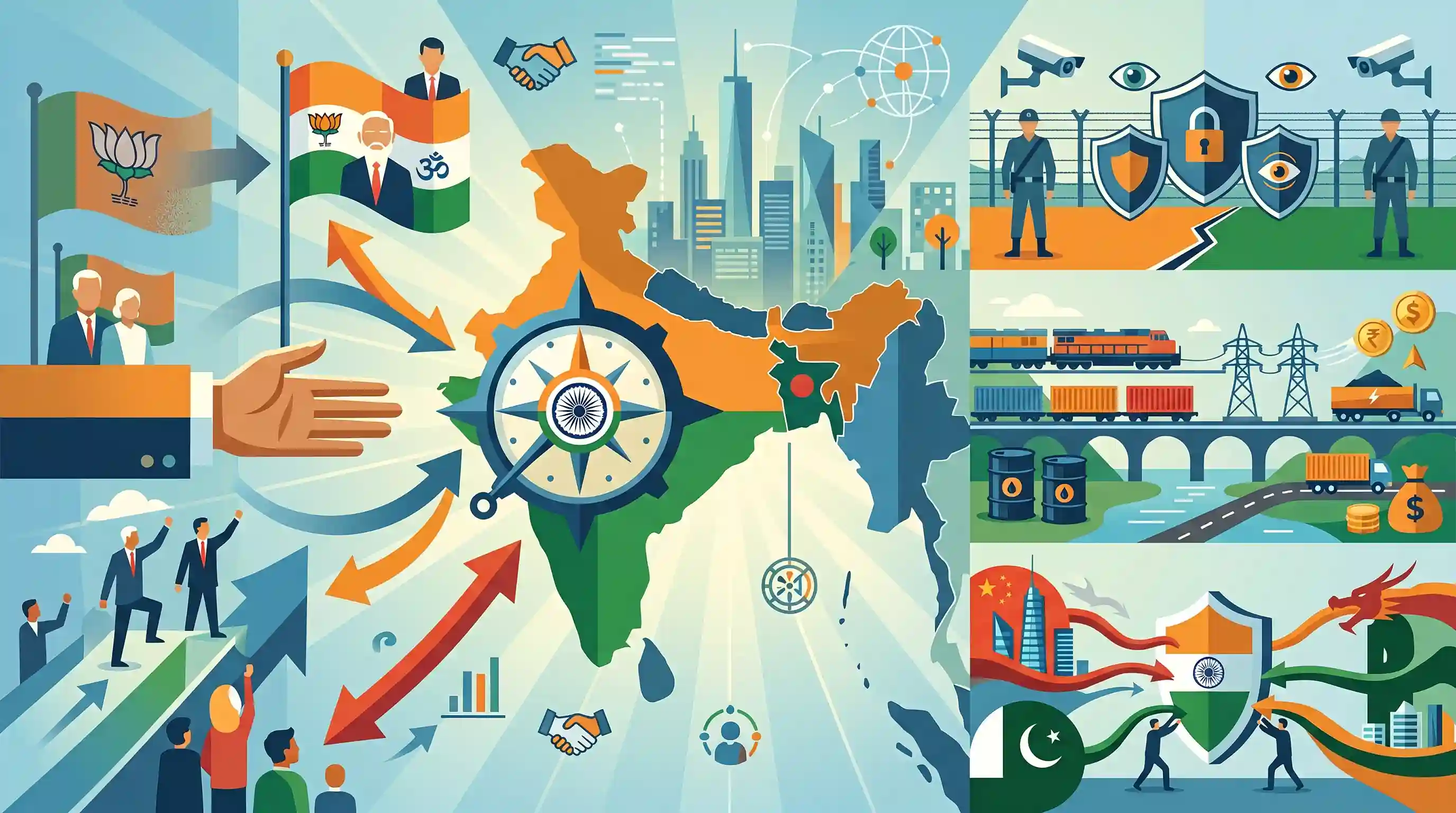
Bangladesh is central to India's 'Neighborhood First' policy and is crucial for the internal security and economic integration of India's Northeast. Regime changes in Dhaka require swift diplomatic recalibration by Indian policymakers to protect strategic, economic, and security interests from external adversarial influences.
Summary
The article examines the geopolitical and diplomatic implications of the Bangladesh Nationalist Party's (BNP) resurgence and the decline of Sheikh Hasina's Awami League. It urges New Delhi to pivot from its historical reliance on the Awami League and adopt a pragmatic approach to engage with the new BNP-led political reality in Dhaka. Highlighting the tenets of India's 'Neighborhood First' policy, the author argues that establishing robust ties with leaders like Tarique Rehman is essential for safeguarding India's strategic interests. Key focus areas include maintaining strict security protocols at the border, ensuring the continuity of economic and transit projects, and preventing regional rivals like China and Pakistan from expanding their influence in Bangladesh.
Key Points
- Political Transition in Dhaka: The BNP's resurgence and Sheikh Hasina's decline mark a significant shift, necessitating a diplomatic reset by India after years of backing the Awami League.
- Pragmatic Engagement: India is advised to adopt practical diplomacy aligned with its 'Neighborhood First' policy by establishing direct channels with the BNP leadership, including Tarique Rehman.
- Security Red Lines: Preventing the reactivation of anti-India insurgent camps and managing border security remain paramount concerns for New Delhi in the new regime.
- Geopolitical Balancing: Active engagement is necessary to prevent rival powers like China and Pakistan from filling the strategic vacuum in Bangladesh.
- Economic Continuity: Bilateral ties must focus on sustaining existing connectivity, transit corridors, and energy projects that are crucial to both nations' economic interests.
Important Terms
Neighborhood First Policy

India's core foreign policy priority that focuses on building stable, cordial, and mutually beneficial relationships with immediate neighbors through economic connectivity, security cooperation, and infrastructure development.
UPSC context
GS Paper 2: International Relations; essential for understanding India’s regional diplomacy, stability, and efforts to counterbalance external influences like China.
Bangladesh Nationalist Party (BNP)
A major center-right political party in Bangladesh, currently led by Tarique Rahman, which has historically maintained a nationalist stance often perceived as more skeptical toward India.
UPSC context
GS Paper 2: India and its neighborhood; tests knowledge of political transitions in neighboring countries and their impact on India’s security.
Awami League
A major secular, center-left political party in Bangladesh that led the 1971 Liberation War and historically maintains deep, friendly ties with India.
UPSC context
GS Paper 2: Bilateral relations; significant for historical context of India-Bangladesh ties and the 1971 war legacy.
Siliguri Corridor
A narrow 22-km wide stretch of land in West Bengal that connects mainland India to its eight northeastern states, making it strategically vital for national security.
UPSC context
GS Paper 3: Internal Security; tests understanding of geographical vulnerabilities and the strategic importance of transit through Bangladesh.
Land Boundary Agreement (LBA)
A historic 2015 treaty between India and Bangladesh that resolved long-standing border disputes by exchanging enclaves and simplifying the 4,096-km international boundary.
UPSC context
GS Paper 2: Bilateral agreements; a milestone in resolving territorial disputes and enhancing cross-border cooperation.
Transit and Trans-shipment
The movement of goods or passengers from one part of a country to another through the territory of a foreign country (e.g., Indian goods through Bangladesh).
UPSC context
GS Paper 3: Infrastructure and Connectivity; vital for economic development of the Northeast and reducing logistics costs in regional trade.
Prelims Trap
"Bangladesh shares its international land boundary with exactly four Indian states."
Aspirants often forget Mizoram. Bangladesh actually borders five Indian states: West Bengal, Assam, Meghalaya, Tripura, and Mizoram.
Static Concepts Connected
What are the strategic connectivity links between India and Bangladesh?
- Rail Links: Akhaura-Agartala and Haldibari-Chilahati lines bypass the Siliguri Corridor, vital for integrating Northeast India.
- Inland Waterways: The Protocol on Inland Water Transit and Trade (PIWTT) enables cargo movement using interconnected riverine routes like the Brahmaputra.
- Port Transit: India negotiated transit access to Chattogram and Mongla ports to efficiently supply its landlocked Northeastern states.
What makes the Indo-Bangladesh border vulnerable to security threats?
- Riverine Terrain: Highly porous, shifting river courses and dense populations right up to the zero-line make physical fencing impossible in several stretches.
- Transnational Crime: The border remains a primary hub for cattle smuggling, narcotics, arms trafficking, and Fake Indian Currency Notes (FICN).
- Insurgent Havens: Political transitions historically alter the security matrix, occasionally allowing anti-India elements to establish cross-border camps.
Cross-Topic Patterns
Regime Change & Northeast Security
Dhaka's political shifts directly impact GS3 internal security; historically, non-Awami regimes provided safe havens to insurgent groups like ULFA and NDFB.
BIMSTEC vs SAARC Paralysis
With SAARC stalled by Pakistan, an adversarial or Beijing-leaning Dhaka could leverage its BIMSTEC secretariat position to disrupt India's alternative regional integration efforts.
China's Strategic Encirclement
The BNP's return opens a potential vacuum for Beijing to expand its infrastructure footprint (e.g., Teesta river management), directly challenging India's 'Neighbourhood First' policy.

Bangladesh regime change + China's regional footprint + Northeast internal security is a prime multi-dimensional GS2/GS3 prompt for 2026.
Linked PYQs · 3
Linked PYQs · 3
- 2022MainsGS2
Do you think that BIMSTEC is a parallel organisation like the SAARC ? What are the similarities and dissimilarities between the two ? How are Indian foreign policy objectives realized by forming this new organisation?
- 2022MainsGS2
India is an age-old friend of Sri Lanka.’ Discuss India's role in the recent crisis in Sri Lanka in the light of the preceding statement.
- 2024MainsGS2
Discuss the geopolitical and geostrategic importance of Maldives for India with a focus on global trade and energy flows. Further also discuss how this relationship affects India's maritime security and regional stability amidst international competition ?
