New Bangladesh leadership demands extradition testing India ties
Source:Indian Express ↗
Why It Matters
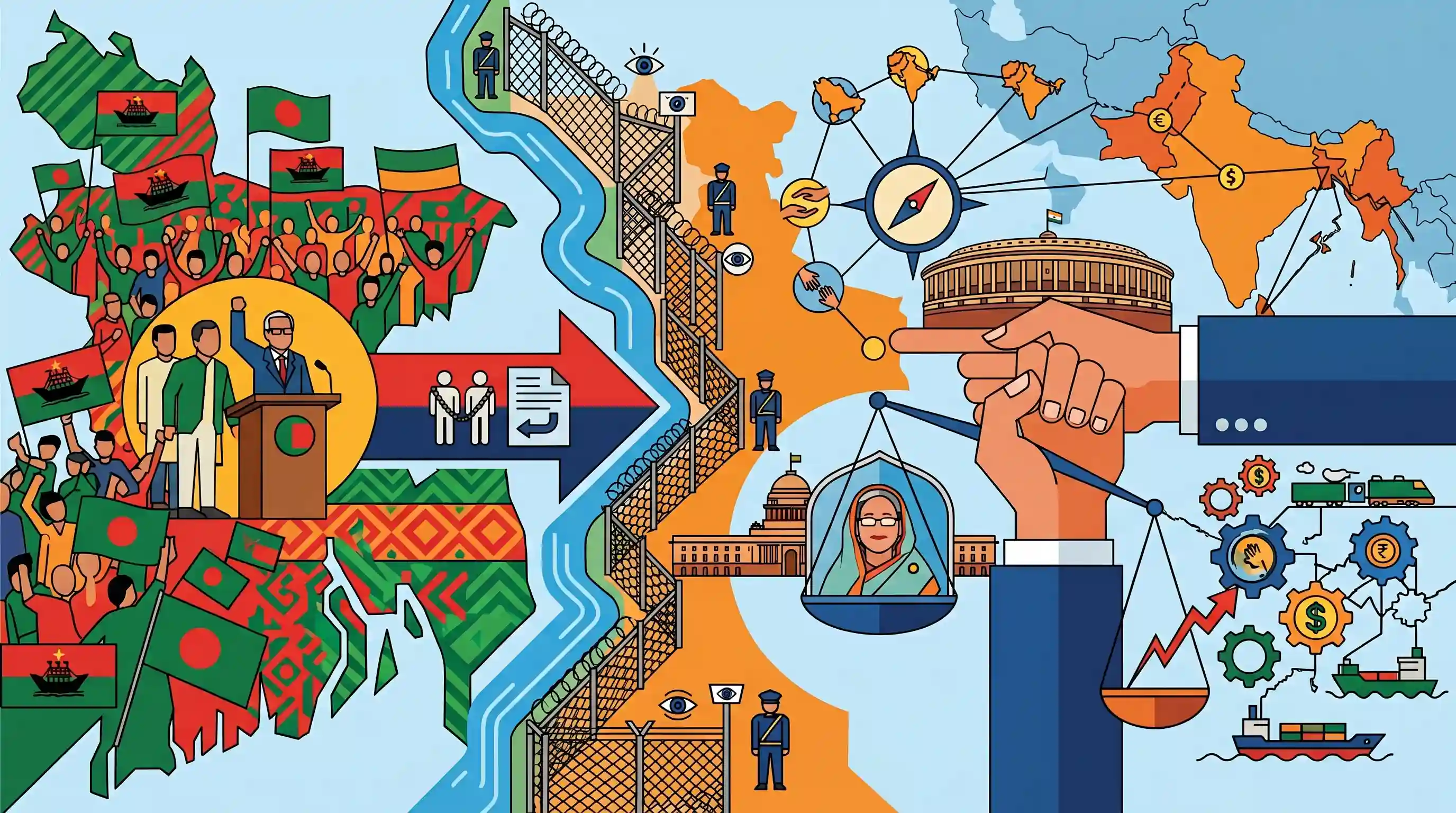
The diplomatic standoff over Sheikh Hasina's extradition tests India's foreign policy adaptability and pragmatism when navigating sudden regime changes in its immediate neighborhood. It highlights the delicate balance between honoring political loyalties and securing national interests related to border stability, trade, and regional security.
Summary
Following a historic election victory in Bangladesh, the Bangladesh Nationalist Party (BNP) has demanded the extradition of former Prime Minister Sheikh Hasina, who is currently in exile in New Delhi. This development forces India into a high-stakes diplomatic dilemma: balancing its long-standing alliance and offer of asylum to Hasina with the need to establish functional, pragmatic bilateral relations with the newly elected BNP government in Dhaka. The scenario underscores the geopolitical complexities of India's 'Neighbourhood First' policy, the challenges of political instability in South Asia, and potential ripple effects on cross-border security and economic cooperation.
Key Points
- The Bangladesh Nationalist Party (BNP) secured a historic victory in the Bangladesh elections, marking a significant regime change.
- Former Prime Minister Sheikh Hasina is currently living in exile in New Delhi.
- The newly elected BNP government is demanding the extradition of Sheikh Hasina from India, triggering a high-stakes diplomatic standoff.
- This situation places India in a diplomatic dilemma, forcing it to balance the protection of a long-standing ally with the necessity of forging working bilateral ties with the new administration in Dhaka.
- The political shift in Bangladesh carries broader implications for India-Bangladesh border security, regional stability in South Asia, and cross-border trade.
Important Terms
India-Bangladesh Extradition Treaty

A bilateral agreement (signed 2013, amended 2016) facilitating the transfer of individuals accused or convicted of crimes punishable by at least one year, simplified to require only a warrant for arrest.
UPSC context
GS Paper II: Bilateral agreements and judicial cooperation. Tests understanding of legal frameworks governing cross-border fugitives.
Neighbourhood First Policy
India's diplomatic strategy prioritizing immediate neighbors to ensure regional stability, connectivity, and economic integration through consultative and often non-reciprocal engagement.
UPSC context
GS Paper II: Foreign Policy. Central to India's regional strategy and balancing external influences in South Asia.
Bangladesh Nationalist Party (BNP)
A major center-right political party in Bangladesh that traditionally emphasizes national sovereignty and has recently demanded the extradition of former PM Sheikh Hasina from India.
UPSC context
GS Paper II: Regional politics. Tests impact of neighboring regime changes on India's strategic interests.
Awami League
A secular, center-left party that led the 1971 independence struggle; it maintained a decade-long strategic alliance with India under Sheikh Hasina before her 2024 ouster.
UPSC context
GS Paper II: International Relations. Essential for understanding historical and ideological foundations of India-Bangladesh ties.
Political Asylum
Protection granted by a state to a foreign citizen on its territory against pursuit by another state, often for political reasons.
UPSC context
GS Paper II: International Law. Relevant to sovereignty and diplomatic friction involving high-profile political exiles.
Prelims Trap
"The existence of an Extradition Treaty makes it mandatory for India to deport fugitive leaders requested by Dhaka."
The treaty (Article 6) and the Indian Extradition Act explicitly allow India to refuse extradition if the offense is deemed to be of a 'political nature'. Extradition is never purely automatic.
Static Concepts Connected
How is extradition governed in India, and what are the key exceptions?
- Legal Framework: Governed primarily by the Indian Extradition Act, 1962, which sets the domestic legal framework for surrendering fugitives.
- Political Exception: Under Section 31(1), the Indian government can legally refuse to surrender a fugitive if the requested offense is of a 'political character'.
- Treaty Requirement: While treaties facilitate the process, extradition can still occur without a formal treaty through special bilateral arrangements under the Act.
What are the key geographical features of the India-Bangladesh border?
- Longest Border: At 4,096.7 km, it is the longest land boundary India shares with any neighboring country.
- Bordering States: It touches five Indian states: West Bengal, Assam, Meghalaya, Tripura, and Mizoram. (A common trap includes Sikkim or Manipur).
- Security Force: The border is exclusively guarded by the Border Security Force (BSF) as the designated border guarding force.
Cross-Topic Patterns
Regime change & North-East internal security
A hostile or unstable regime in Dhaka historically correlates with spikes in illegal migration and safe havens for North-East insurgent groups, directly linking international diplomacy to India's internal security management.
Asylum vs. Neighbourhood First diplomacy
India's handling of Hasina mirrors historical asylum dilemmas (e.g., the Dalai Lama), balancing domestic legal doctrines of 'political offense' exceptions against the pragmatic need to secure regional trade and borders.

Expect a 2026 Prelims statement mixing the 'political offense' exception in the Extradition Act with India-Bangladesh border geography.
Linked PYQs · 2
Linked PYQs · 2
- 2022MainsGS2
India is an age-old friend of Sri Lanka.’ Discuss India's role in the recent crisis in Sri Lanka in the light of the preceding statement.
- 2014MainsGS3
How does illegal transborder migration pose a threat to India's security? Discuss the strategies to curb this, bringing out the factors which give impetus to such migration.
