BNP secures landslide victory in Bangladesh general elections
Source:Indian Express ↗
Why It Matters
A regime change in Bangladesh, a critical strategic neighbor to India, directly affects India's internal security (especially in the North-East), regional trade, and strategic footprint in South Asia. Balancing diplomatic engagement with border security becomes a pressing challenge given the historical context between the BNP and New Delhi.
Summary
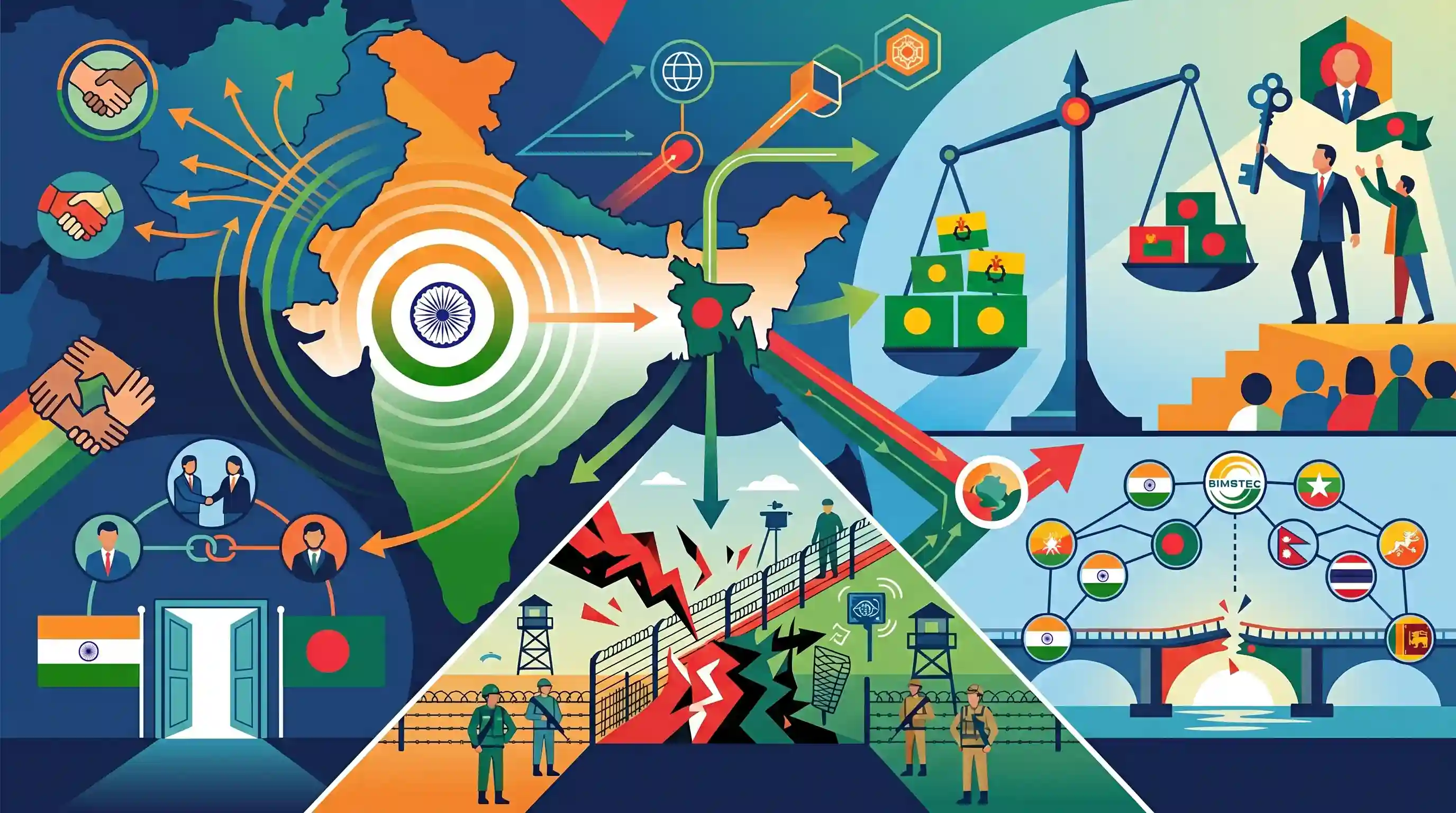
The Bangladesh Nationalist Party (BNP) has secured a landslide victory in the 2026 Bangladesh elections, with acting chairman Tarique Rahman tipped to take over as Prime Minister. This shift in power comes after years of Awami League dominance and signifies a major geopolitical transition in South Asia. Given the historical complexities between the BNP and the Indian establishment, the election results could significantly shape India's 'Neighbourhood First' policy, border security management, and regional integration initiatives like BIMSTEC.
Key Points
- The Bangladesh Nationalist Party (BNP) achieved a landslide victory in the 2026 national elections in Bangladesh.
- Tarique Rahman is widely expected to assume the role of Prime Minister, leading the new government.
- The outcome marks a fundamental regime change in Dhaka, concluding the long-standing dominance of the Awami League.
- For India, the BNP's victory necessitates recalibrating bilateral ties, emphasizing border management, and addressing shared security and trade concerns.
- A smooth democratic transition in Bangladesh is crucial for overall stability, trade connectivity, and counter-terrorism cooperation in South Asia.
Important Terms
Neighbourhood First Policy

A core pillar of Indian foreign policy prioritizing stable, cooperative, and interconnected relations with immediate neighbors through consultative, non-reciprocal assistance and multi-sectoral connectivity projects.
UPSC context
GS Paper 2 (International Relations). Tests knowledge of regional diplomacy, security management, and countering external influence in South Asia.
BIMSTEC
A 7-member regional organization (including India and Bangladesh) bridging South and Southeast Asia around the Bay of Bengal for technical and economic cooperation.
UPSC context
GS Paper 2 (Regional Groupings). Key for studying sub-regional integration and India's 'Act East' policy.
Bangladesh Nationalist Party (BNP)
A center-right political party in Bangladesh founded by Ziaur Rahman. It historically champions an 'independence first' ideology and has had complex, sometimes strained relations with the Indian establishment.
UPSC context
GS Paper 2 (India and its Neighbourhood). Tests understanding of internal political shifts in neighboring states and bilateral security recalibration.
Awami League
A secular, center-left party in Bangladesh that led the 1971 independence movement. Historically maintaining close ties with India, its long tenure (2009-2024) saw significant bilateral security and infrastructure cooperation.
UPSC context
GS Paper 2 (India-Bangladesh Relations). Important for analyzing historical ties, secular politics, and the impact of regime changes on India.
Tarique Rahman
The acting chairman of the BNP and son of Ziaur Rahman. His 2026 electoral victory marks a return from exile and a major shift in Bangladesh's political trajectory.
UPSC context
GS Paper 2 (International Relations). Relevant for tracking key political figures in neighboring states who influence regional stability and India's security.
Prelims Trap
Dhaka hosts the SAARC Secretariat, making Bangladesh's regime change critical.
Kathmandu hosts the SAARC Secretariat, while Dhaka hosts the BIMSTEC Secretariat. UPSC frequently swaps regional headquarters to test foundational IR knowledge.
Static Concepts Connected
What are the primary border security challenges along the India-Bangladesh boundary?
- Longest boundary: India shares its longest land border (4,096.7 km) with Bangladesh, touching five states: West Bengal, Assam, Meghalaya, Tripura, and Mizoram.
- Riverine terrain: Large stretches are porous, riverine, and prone to seasonal flooding, making continuous physical fencing and strict border enforcement highly complex.
- Transborder crime: The border sees high incidences of cattle smuggling, human trafficking, illegal migration, and fake currency circulation.
- Insurgent havens: Historical security concerns exist regarding Northeast Indian insurgent groups utilizing porous borders to maintain safe havens.
How does BIMSTEC differentiate itself structurally and strategically from SAARC?
- Geopolitical exclusion: BIMSTEC excludes Pakistan, allowing India to pursue regional connectivity without the bilateral roadblocks that have historically paralyzed SAARC.
- Bridging regions: It acts as a strategic bridge between South Asia and Southeast Asia, aligning perfectly with India's 'Act East' policy.
- Sector-driven: Unlike SAARC's broad political mandate, BIMSTEC focuses on specific developmental sectors like technology, transport, and energy connectivity.
Cross-Topic Patterns
Internal Security + Foreign Policy
Past BNP tenures saw increased cross-border movement of Northeast insurgent groups (ULFA, NDFB). Regime changes here directly intertwine India's internal border management with its foreign diplomacy.
Economic Geography + Trade Transit
A new regime may review regional connectivity initiatives, bringing frameworks like the BBIN Motor Vehicles Agreement and the Protocol on Inland Water Transit and Trade (PIWTT) back into focus.

Expect a multi-statement question linking India-BD border management, historical transit treaties, and BIMSTEC's secretariat in Dhaka.
Linked PYQs · 2
Linked PYQs · 2
- 2020MainsGS3
Analyze internal security threats and transborder crimes along Myanmar, Bangladesh and Pakistan borders including Line of Control (LoC). Also discuss the role played by various security forces in this regard.
- 2025PrelimsGS1
Consider the following statements in respect of BIMSTEC : I. It is a regional organization consisting of seven member States till January 2025. II. It came into existence with the signing of the Dhaka Declaration, 1999. III. Bangladesh, India, Sri Lanka, Thailand and Nepal are founding member States of BIMSTEC. IV. In BIMSTEC, the subsector of 'tourism' is being led by India. Which of the statements given above is/are correct?
