Bangladesh Political Transition and Regional Geopolitical Shifts
Source:Indian Express ↗
Why It Matters
Regime change in Bangladesh directly impacts India's strategic interests, particularly concerning cross-border security, counter-terrorism, and regional connectivity in the Northeast. Understanding these geopolitical shifts is essential for analyzing India's foreign policy challenges.
Summary
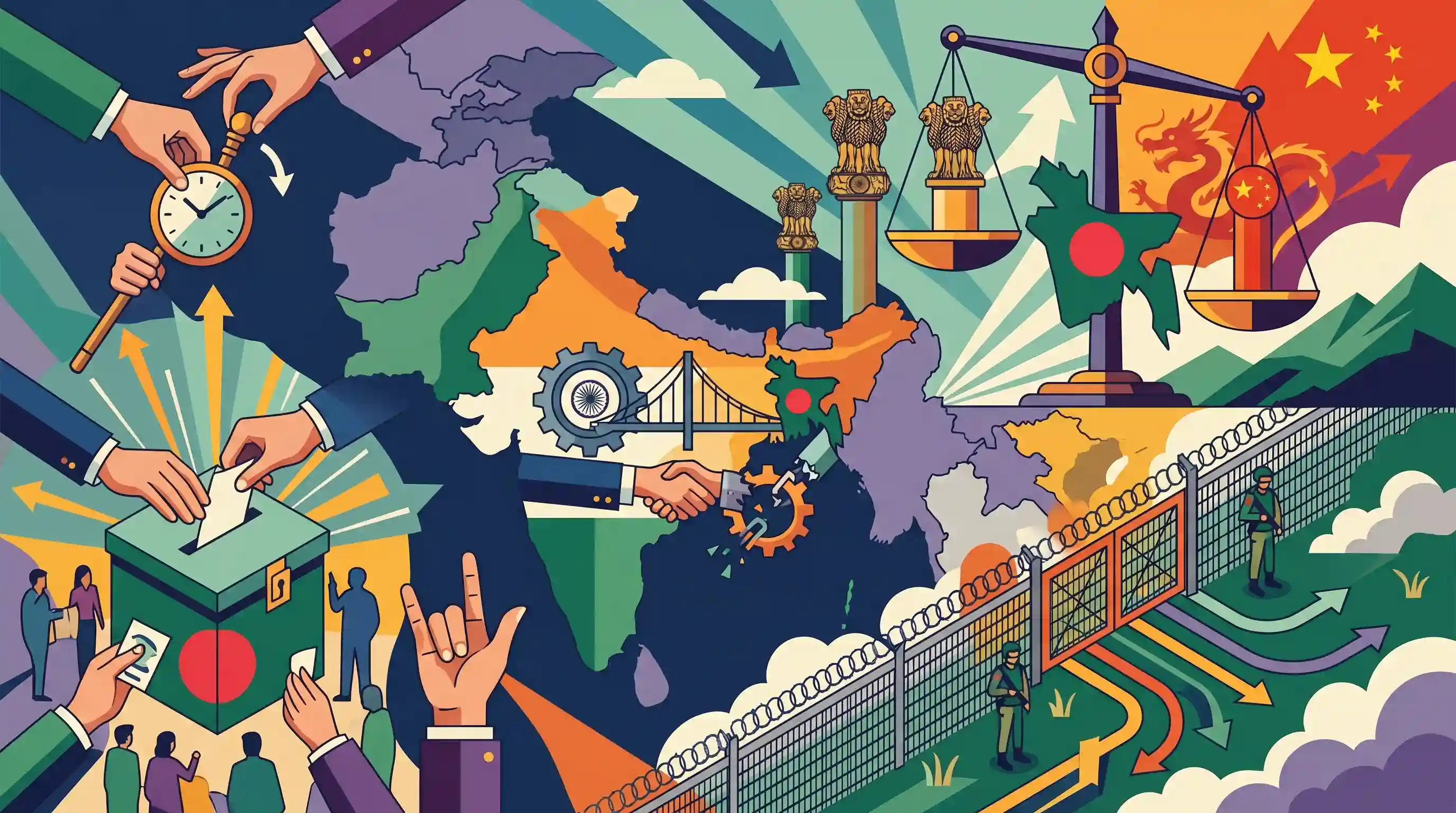
The 2026 general elections in Bangladesh represent a watershed moment in South Asian geopolitics, bringing an end to the interim government led by Muhammad Yunus. As voting concludes, key political figures like BNP's Tarique Rahman are asserting conditions for accepting the results, signaling a dramatic shift in the nation's political landscape. This transition holds profound implications for India, as a potential departure from previously friendly regimes could challenge bilateral ties, complicate border management, and alter the regional balance of power amidst growing Chinese influence.
Key Points
- The 2026 Bangladesh elections mark a crucial democratic transition following the tenure of the interim government led by Muhammad Yunus.
- BNP leader Tarique Rahman has set specific conditions for accepting the election results, heralding what he terms the 'Birthday of a New Bangladesh'.
- The political transition is expected to trigger significant geopolitical shifts in South Asia, particularly concerning the strategic balance between India, China, and Western powers.
- For India, a potential BNP-led government poses renewed diplomatic and security challenges, requiring recalibration of its 'Neighborhood First' policy and border management strategies.
Important Terms
Bangladesh Nationalist Party (BNP)

A major centre-right political party in Bangladesh, founded in 1978. It advocates for "Bangladeshi Nationalism" and returned to power in the 2026 elections under Tarique Rahman's leadership.
UPSC context
GS Paper 2 (International Relations). Essential for understanding shifts in India-Bangladesh ties, security cooperation, and regional geopolitical alignments.
Muhammad Yunus
Nobel laureate and economist who served as the Chief Adviser of the interim government (2024–2026), tasked with state reforms and overseeing the transition to democratic elections.
UPSC context
GS Paper 2. Represents the transitional leadership that navigated Bangladesh through its 2024 political crisis and 2026 electoral return.
Tarique Rahman
The Prime Minister of Bangladesh (sworn in 2026) and Chairman of the BNP. He returned from 17 years of exile to lead the party following the 2024 uprising.
UPSC context
GS Paper 2. His leadership marks a significant shift from the Awami League era, affecting bilateral security and economic agreements.
July Charter
A reform framework signed in 2025 during the interim administration, focused on curtailing Prime Ministerial powers and institutionalizing neutral caretaker governments for fair elections.
UPSC context
GS Paper 2 (Governance/International Relations). Significant for analyzing constitutional reforms and democratic stability in India's immediate neighborhood.
Neighborhood First Policy
A core Indian foreign policy pillar prioritizing relations with neighboring countries to ensure regional stability, connectivity, and collective growth.
UPSC context
GS Paper 2. The primary framework for India's engagement with Bangladesh, testing India's adaptability to regime changes.
Belt and Road Initiative (BRI)
A multi-billion dollar global infrastructure development strategy by China, which has significantly increased its economic and strategic footprint in Bangladesh through ports and energy projects.
UPSC context
GS Paper 2. A major factor in the regional balance of power, challenging India's traditional influence in South Asia.
Prelims Trap
CIBMS (Comprehensive Integrated Border Management System) is exclusively deployed along the India-Pakistan border.
CIBMS is also actively deployed along the India-Bangladesh border (e.g., project BOLD-QIT in Assam's Dhubri) to secure highly porous and riverine stretches.
Static Concepts Connected
What are the geographical features and security measures of the India-Bangladesh border?
- Longest land border: India shares 4,096.7 km (its longest) with five states: West Bengal, Assam, Meghalaya, Tripura, and Mizoram.
- Riverine challenges: Over 900 km of the border is riverine, making physical fencing difficult and facilitating illegal migration.
- Technological solutions: India deploys CIBMS and BOLD-QIT (Border Electronically Dominated QRT Interception Technique) for continuous digital surveillance.
How is Bangladesh strategically critical for India's connectivity to the Northeast?
- Siliguri Corridor alternative: Transit rights through Bangladesh significantly reduce logistical dependency on the narrow and vulnerable Siliguri Corridor.
- Port access: Agreements allowing India to use Chattogram and Mongla ports ensure faster transit of goods to Tripura and Assam.
- Key infrastructure: Projects like the Akhaura-Agartala rail link and Maitri Setu bridge integrate NE India with global trade routes.
Cross-Topic Patterns
Regime Change and Northeast Insurgency
Historically, non-Awami regimes in Dhaka have tolerated safe havens for Northeast insurgent groups. A political shift directly impacts India's internal security and border management strategies in the Northeast.
Debt-Trap Diplomacy vs Act East Policy
A BNP-led government might accelerate Chinese BRI projects like the Teesta river management or port expansions, directly challenging India's regional maritime security and 'Neighborhood First' policy.

Expect a multi-statement Prelims question in 2026 mixing CIBMS border tech, Bangladesh-bordering states, and transit pacts (Maitri Setu).
Linked PYQs · 2
Linked PYQs · 2
- 2016MainsGS3
Border management is a complex task due to difficult terrain and hostile relations with some countries. Elucidate the challenges and strategies for effective border management.
- 2014MainsGS3
How does illegal transborder migration pose a threat to India's security? Discuss the strategies to curb this, bringing out the factors which give impetus to such migration.
