Gen Z Voters Influence Bangladesh Elections and Regional Ties
Source:Indian Express ↗
Why It Matters
A potential change in the political regime of Bangladesh—one of India's most crucial and strategically located neighbors—directly impacts cross-border security, trade relations, and overall regional stability. Understanding the political influence of youth dynamics and extremist elements in neighboring democracies provides essential context for India's foreign policy and internal security challenges.
Summary
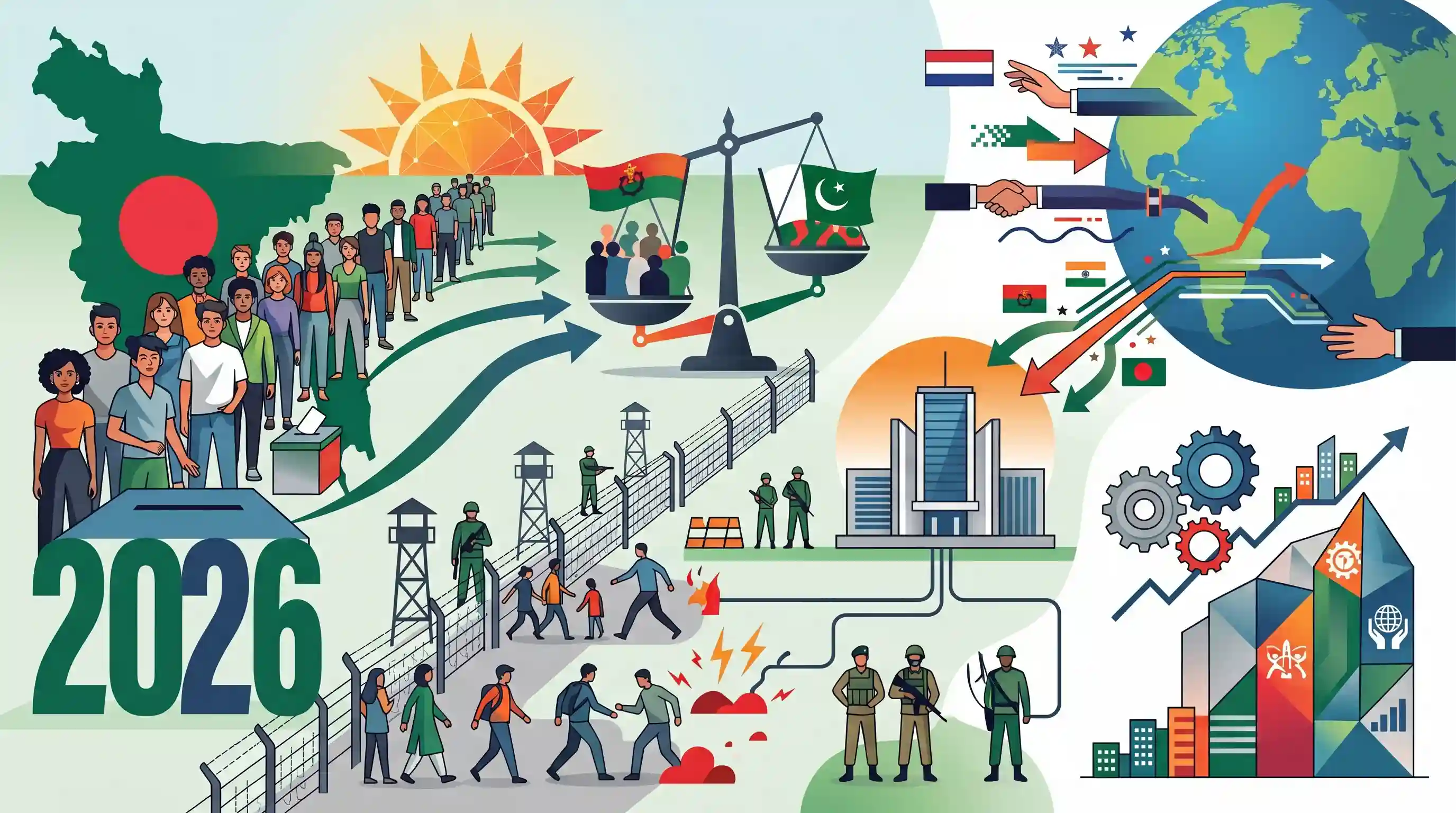
The 2026 Bangladesh elections represent a critical turning point in the country's post-Sheikh Hasina political landscape, emerging as one of the most competitive polls in recent years. Central to this transition are Gen Z voters, whose demographic heft will shape the intense electoral battle between the Bangladesh Nationalist Party (BNP) and a resurgent Jamaat-e-Islami. For India, these shifts hold profound geopolitical significance. The potential rise of different political ideologies in the neighborhood directly impacts India's "Neighbourhood First" policy, border management, and regional security. The involvement of young voters in redefining Bangladesh's democratic process also offers lessons in political participation and demographic impact, while requiring New Delhi to carefully recalibrate its diplomatic and security strategies along the shared border.
Key Points
- The 2026 Bangladesh elections are anticipated to be highly competitive, marking a significant transition in the post-Sheikh Hasina era.
- Gen Z and youth voters will play a pivotal role in shaping the political landscape and electoral outcomes in the country.
- The elections highlight a major contestation between the Bangladesh Nationalist Party (BNP) and the surging Jamaat-e-Islami.
- The evolving political dynamics in Bangladesh have critical implications for India-Bangladesh bilateral relations, regional stability, and border management.
- A potential shift towards religious fundamentalism or a change in regime could impact cross-border security, emphasizing the need for robust Indian diplomacy.
Important Terms
Bangladesh Nationalist Party (BNP)

A major center-right political party in Bangladesh founded in 1978. It emphasizes Bangladeshi nationalism and has historically maintained a complex, often strained, relationship with India over security and transit issues.
UPSC context
GS Paper II (International Relations); focuses on bilateral ties and political stability in India's neighborhood.
Jamaat-e-Islami
Bangladesh's largest Islamist political party. It holds a conservative religious ideology and is historically controversial for its opposition to the 1971 Liberation War, impacting regional security and secularism.
UPSC context
GS Paper II & III; relevant for studying regional security, extremism, and diplomatic challenges in South Asia.
Neighbourhood First Policy
India's foreign policy priority of strengthening ties with immediate neighbors. It focuses on regional stability, connectivity, and prosperity through a consultative and often non-reciprocal approach to development.
UPSC context
GS Paper II (Foreign Policy); central to India's strategic interests and countering external influence in the region.
Demographic Dividend
Economic growth potential resulting from a shift in population age structure, specifically when the working-age population (15-64) is larger than the non-working-age share.
UPSC context
GS Paper I & III; evaluates social issues, economic growth, and the role of youth in national development.
Border Management
The coordinated strategy to secure national boundaries. For India-Bangladesh, it involves tackling illegal migration, smuggling, and managing porous riverine terrain through physical and technological surveillance.
UPSC context
GS Paper III (Internal Security); tests knowledge of border security challenges and management of international boundaries.
Prelims Trap
"The 4,096 km India-Bangladesh border is fully fenced and secured."
While the Land Boundary Agreement resolved demarcation issues, vast riverine and porous stretches remain unfenced, making the border vulnerable to infiltration during political instability.
Static Concepts Connected
What are the key internal security challenges along the India-Bangladesh border?
- Riverine stretches: Vast portions of the border run through rivers and chars, making continuous physical fencing impossible and aiding illegal migration.
- Insurgent safe havens: Political instability or a regime change in Dhaka raises the historical risk of Northeast militant groups finding renewed shelter.
- Transborder crime: Dense cross-border ethnic ties and weak enforcement facilitate cattle smuggling, human trafficking, and the circulation of counterfeit currency.
What are the core principles of India's Gujral Doctrine regarding its neighbors?
- Non-reciprocity: India must offer concessions unilaterally without expecting equal returns from smaller neighbors like Bangladesh, Nepal, and Bhutan.
- Mutual non-interference: South Asian nations should not interfere in each other's internal affairs or allow their territory to be used against another.
Cross-Topic Patterns
Siliguri Corridor vulnerability
A hostile or unstable regime in Dhaka directly threatens India's strategic "Chicken's Neck," bridging GS-2 (IR) with GS-3 (Internal Security) concerns regarding the potential isolation of the Northeast.
Digital youth mobilizations
The leaderless Gen Z uprisings in Bangladesh mirror recent protests in Sri Lanka and Kenya, tying GS-1 demographic dividend concepts to GS-2 democratic transitions and institutional accountability.

Mains 2026 will likely test the impact of Bangladesh's political transition on India's Northeast security and border management strategies.
Linked PYQs · 3
Linked PYQs · 3
- 2020MainsGS3
Analyze internal security threats and transborder crimes along Myanmar, Bangladesh and Pakistan borders including Line of Control (LoC). Also discuss the role played by various security forces in this regard.
- 2022MainsGS2
Do you think that BIMSTEC is a parallel organisation like the SAARC ? What are the similarities and dissimilarities between the two ? How are Indian foreign policy objectives realized by forming this new organisation?
- 2016MainsGS2
Demographic Dividend in India will remain only theoretical unless our manpower becomes more educated, aware, skilled and creative." What measures have been taken by the government to enhance the capacity of our population to be more productive and employable?
