Rooppur Nuclear Plant Integration and South Asian Energy Security
Source:The Hindu ↗
Why It Matters
This development provides a key case study for South Asian energy security, infrastructure cooperation with global powers like Russia, and the transition toward low-carbon energy sources in India's immediate neighborhood.
Summary
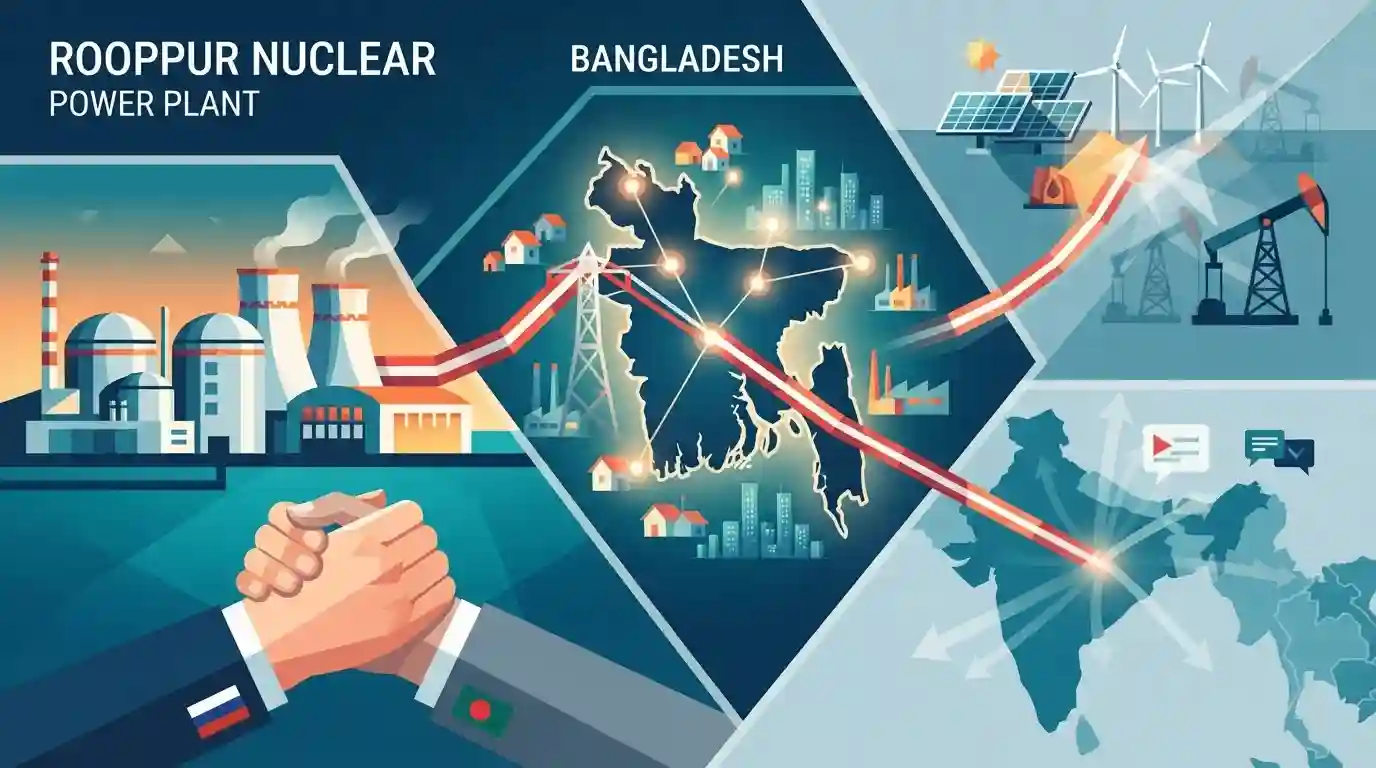
Bangladesh has connected its first nuclear power plant, the Rooppur Nuclear Power Plant built with Russian collaboration, to its national grid. This landmark infrastructure project aims to bolster the country's energy security and reduce reliance on fossil fuels, carrying regional and strategic significance for South Asia's energy landscape.
Key Points
- Bangladesh has successfully connected its first nuclear power plant, the Rooppur Nuclear Power Plant, to its national grid.
- The project has been constructed with technical and financial assistance from Russia (Rosatom).
- The development marks a significant milestone in Bangladesh's transition toward cleaner and diversified energy sources.
- It highlights regional energy developments in South Asia and cooperation involving external global powers like Russia.
Important Terms
Rosatom

State-owned Russian nuclear energy corporation that builds and operates nuclear power plants globally, supplying technology, engineering assistance, and fuel, such as for Bangladesh's Rooppur project.
UPSC context
Relevant for GS Paper II (International Relations) and GS Paper III (Energy Security & Technology Infrastructure, exploring strategic partnerships in South Asia).
International Atomic Energy Agency
The global intergovernmental agency operating under the UN system that seeks to promote the peaceful use of nuclear energy and inhibit its military use through international safeguards.
UPSC context
Relevant for GS Paper II (International Organizations) and GS Paper III (Nuclear Non-Proliferation, Global Security, and Peaceful Uses of Atomic Energy).
Prelims Trap
The Rooppur Nuclear Power Plant was constructed entirely through a trilateral joint venture between Bangladesh, India, and Russia.
Aspirants often assume India is a partner in constructing the Rooppur plant; however, it is entirely built with Russian (Rosatom) assistance, with India only cooperating on specialized training and technical exchange.
Static Concepts Connected
What are the key safety features and international oversight mechanisms associated with civil nuclear energy?
- IAEA Oversight: Operates under the safety standards and regular peer reviews of the International Atomic Energy Agency (IAEA), including OSART missions.
- Passive Safety: Modern plants utilize Gen III+ designs featuring passive safety systems that do not require external power or operator intervention to prevent meltdowns.
- India Context: India is not a signatory to the NPT but operates its civil nuclear facilities under specific IAEA safeguards agreements following the 2008 NSG waiver.
Cross-Topic Patterns
Nuclear Diplomacy and South Asian Regional Dynamics
The construction of Rooppur through Russian state credit illustrates how strategic energy infrastructure projects intersect with debt diplomacy, sanctions compliance, and regional geopolitical balancing in South Asia.
Clean Energy Transitions vs Nuclear Non-Proliferation
South Asian states are increasingly turning to advanced nuclear technology to meet net-zero targets, contrasting sharply with western phase-out trends and testing non-proliferation norms.

Rooppur NPP + Rosatom + IAEA oversight likely to be tested in a multi-statement prelims question on nuclear energy milestones.
Linked PYQs · 3
Linked PYQs · 3
- 2019PrelimsGS1
Recently, India signed a deal known as 'Action Plan for Prioritization and Implementation of Cooperation Areas in the Nuclear Field' with which of the following countries?
- 2020PrelimsGS1
In India, why are some nuclear reactors kept under "IAEA Safeguards" while others are not?
- 2025MainsGS2
"Energy security constitutes the dominant kingpin of India's foreign policy, and is linked with India's overarching influence in Middle Eastern countries.” How would you integrate energy security with India's foreign policy trajectories in the coming years?
