Rohingya Refugee Crisis and Regional Security Implications
Source:The Hindu ↗
Why It Matters
The displacement of Rohingya refugees and the ongoing civil conflict in Myanmar directly impact regional stability in South Asia. For India, this poses significant border management, internal security, and humanitarian policy challenges, directly relevant to GS2 (International Relations) and GS3 (Internal Security).
Summary
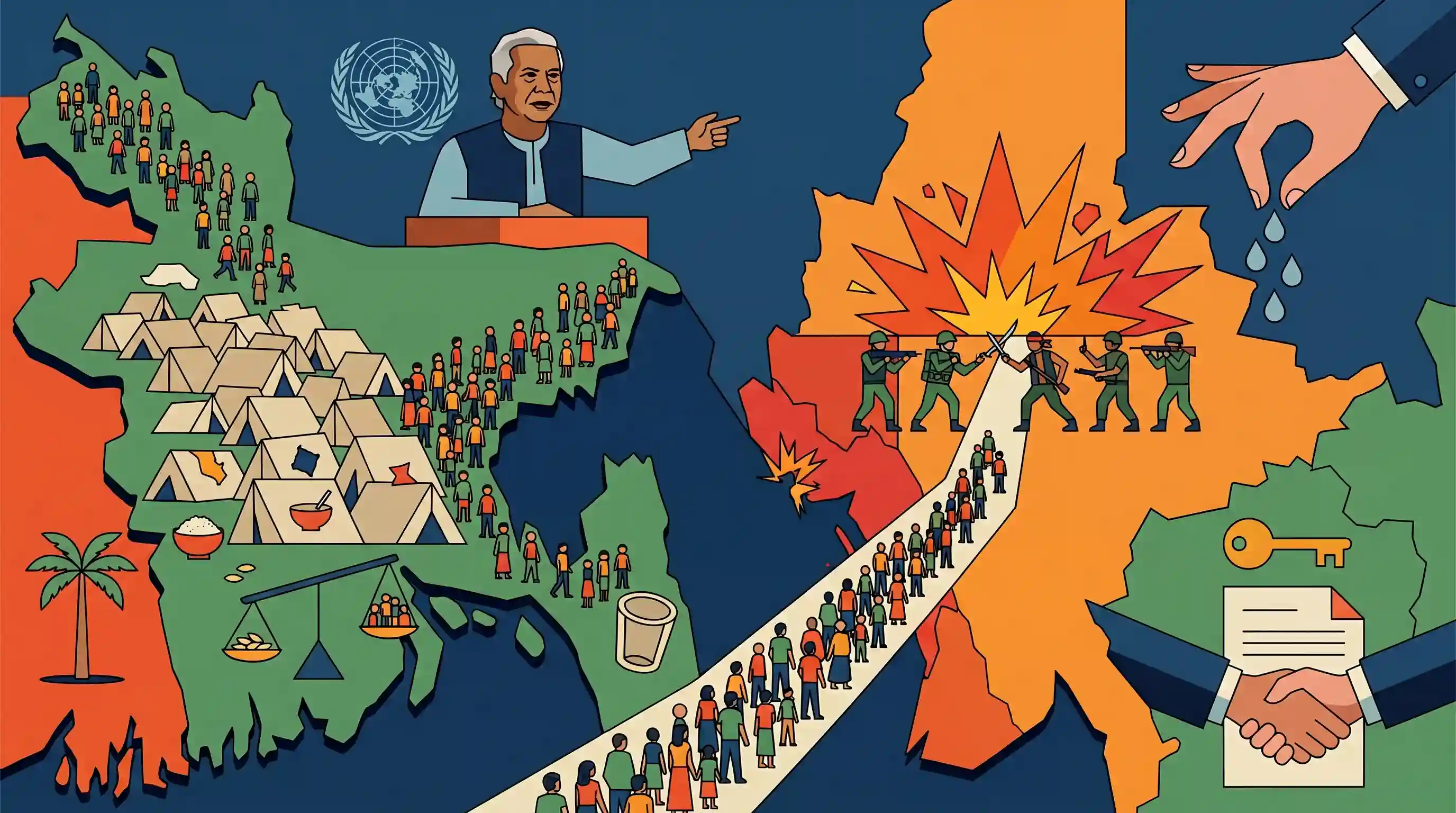
Bangladesh's interim leader Muhammad Yunus issued a stark warning at the UN General Assembly regarding the escalating Rohingya aid crisis. Hosting over 1.3 million refugees, Bangladesh is grappling with severe aid shortages that have reduced food rations to $6 per person monthly. The situation is further destabilized by renewed fighting in Myanmar's Rakhine state between military junta forces and the Arakan Army. Yunus called for immediate international intervention to avert a humanitarian disaster and stressed the necessity of a political solution that secures citizenship and equal rights for the Rohingya within Myanmar.
Key Points
- Bangladesh is currently hosting 1.3 million Rohingya refugees who fled the 2017 military crackdown in Myanmar, placing immense strain on the nation's resources.
- International aid for the refugees is shrinking alarmingly, leading to food rations being cut to a mere $6 per person per month.
- Intensified clashes in Myanmar's Rakhine state between junta forces and the Arakan Army threaten to trigger further mass displacement.
- Bangladesh's interim leader, Muhammad Yunus, emphasized the urgent need for a political settlement in Myanmar that guarantees equal rights and citizenship for the Rohingya minority.
Important Terms
Rohingya

A predominantly Muslim ethnic minority from Myanmar's Rakhine State, denied citizenship under the 1982 law and described as one of the world's most persecuted communities.
UPSC context
GS Paper II (International Relations) and Paper III (Internal Security). Tests knowledge of refugee crises and human rights.
UN General Assembly (UNGA)
The main policy-making organ of the UN where all 193 member states have equal representation; it adopts resolutions on global crises, including the Rohingya humanitarian situation.
UPSC context
GS Paper II (Important International Institutions). Relevant for understanding global governance and multilateral diplomacy in crisis management.
Arakan Army (AA)
A powerful ethnic armed organization in Myanmar’s Rakhine State seeking greater autonomy; it is currently a major belligerent against the military junta.
UPSC context
GS Paper II (India and its neighborhood) and Paper III (Security challenges). Impacts border stability and regional connectivity projects.
Rakhine State
A coastal state in western Myanmar, home to the Rohingya and the primary site of conflict between the military and ethnic armed groups.
UPSC context
GS Paper II (Geography-based International Relations). Crucial for mapping conflicts and India's Kaladan Multi-Modal Transit Transport Project.
1982 Citizenship Law (Myanmar)
Myanmar's legislation that effectively stripped the Rohingya of citizenship by recognizing only 135 "national races," excluding them as "illegal immigrants" from Bangladesh.
UPSC context
GS Paper II (International Relations). Identifies the legal root cause of statelessness and the ensuing refugee crisis.
United Nations (UN)
The primary intergovernmental organization responsible for maintaining international peace; its agencies (UNHCR, WFP) provide critical aid to over 1.3 million Rohingya refugees.
UPSC context
GS Paper II (International Institutions). Tests understanding of global humanitarian architecture and the effectiveness of international intervention.
Prelims Trap
India is a signatory to the 1951 UN Refugee Convention and legally bound to provide asylum.
India is NOT a signatory to the 1951 Convention or its 1967 Protocol. It lacks specific refugee legislation; asylum seekers are governed by the Foreigners Act, 1946.
Static Concepts Connected
What is the legal status and framework governing refugees in India?
- No domestic law: India lacks specific refugee legislation; asylum seekers are legally classified and detained as 'illegal migrants' under the Foreigners Act, 1946 and Passport Act, 1920.
- UN Conventions: India is not a party to the 1951 UN Refugee Convention or its 1967 Protocol, despite hosting large refugee populations.
- Non-refoulement: Constitutional courts have periodically read the customary international law principle of non-refoulement into Article 21 (Right to Life), though national security can override it.
How does the geography of Rakhine State impact India's strategic interests?
- Geographic location: It is a coastal state on the Bay of Bengal bordering Bangladesh, geographically isolated from central Myanmar by the Arakan Mountains.
- Kaladan Project: Sittwe port in Rakhine is the critical maritime gateway for the Kaladan Multi-Modal Transit Transport Project linking Kolkata to Mizoram.
- Security threat: The Arakan Army's control over strategic towns like Paletwa in Rakhine threatens the operationalization of India's infrastructure investments and border stability.
Cross-Topic Patterns
Myanmar civil war & FMR suspension
Clashes between the junta and Arakan Army directly threaten India's Northeast security, prompting the suspension of the Indo-Myanmar Free Movement Regime (FMR) and a push for border fencing.
Global aid fatigue & host burden
Drastic cuts in UN rations ($6/month) reflect global aid diversion, forcing host developing nations like Bangladesh to bear unsustainable economic burdens and raising regional instability.

Expect a 2026 Prelims question integrating India's Foreigners Act, Article 21 (non-refoulement), and the 1951 UN Refugee Convention.
Linked PYQs · 2
Linked PYQs · 2
- 2019MainsGS3
Cross-border movement of insurgents is only one of the several security challenges facing the policing of the border in North-East India. Examine the various challenges currently emanating across the India-Myanmar border. Also, discuss the steps to counter the challenges.
- 2023PrelimsGS1
Consider the following pairs: Area of conflict mentioned in news Country where it is located 1. Donbas : Syria 2. Kachin : Ethiopia 3. Tigray : North Yemen How many of the above pairs are correctly matched?
