International Crimes Tribunal Proceedings and Internal Security
Source:The Hindu ↗
Why It Matters
The political volatility in Bangladesh directly impacts India's internal security, border management, and its 'Neighborhood First' policy. The ongoing International Crimes Tribunal (ICT) proceedings against Sheikh Hasina, who currently resides in India, pose a complex diplomatic challenge for New Delhi regarding potential extradition requests and maintaining stable relations with the new Bangladeshi establishment.
Summary
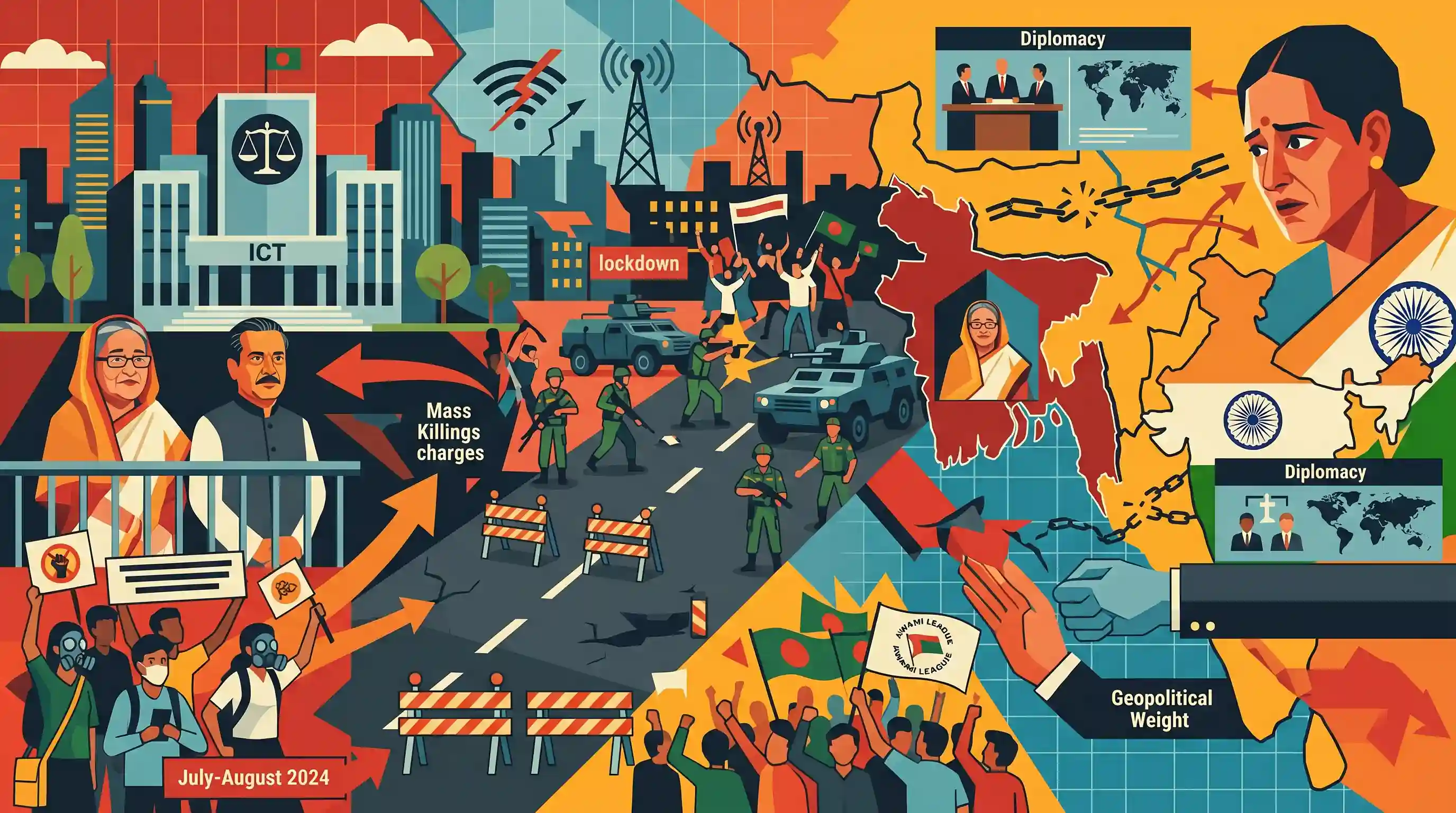
Bangladesh has heightened security in Dhaka ahead of a highly anticipated verdict by the International Crimes Tribunal (ICT) concerning deposed Prime Minister Sheikh Hasina and her former Home Minister Asaduzzaman Khan Kamal. They face charges of mass killings and attempted murder related to the July-August 2024 student-led protests that ultimately ousted Hasina's government. Hasina's party, the Awami League, has called for a 'complete lockdown' in protest, leading to internet restrictions, clashes, and heavy deployment of security forces including the Border Guard Bangladesh (BGB). The domestic turmoil and the legal actions against a leader currently sheltered in India carry significant geopolitical weight for India's neighborhood diplomacy.
Key Points
- The Bangladesh International Crimes Tribunal (ICT) is preparing to deliver its verdict on deposed PM Sheikh Hasina and her former Home Minister over alleged mass killings during the July-August 2024 student protests.
- In response to the impending verdict, the Awami League (AL) announced a 'complete lockdown' demanding Hasina's return, leading to heightened tensions and sporadic violence across Dhaka.
- Bangladesh authorities have significantly intensified security measures, deploying the BGB and armed police, and restricting mobile internet access to messaging apps like Telegram to prevent coordination of unrest.
- The tribunal's proceedings and verdict carry significant diplomatic implications for India, where Hasina is currently taking refuge, potentially complicating the bilateral relationship and raising future extradition challenges.
Important Terms
International Crimes Tribunal (ICT)

A domestic special court in Bangladesh established under a 1973 Act. It prosecutes genocide, war crimes, and crimes against humanity, originally targeting 1971 war criminals and recently expanded to trial 2024 protest-related killings.
UPSC context
GS II/International Relations; tests knowledge of transitional justice and legal proceedings against political figures in neighboring states.
Awami League (AL)
A major political party that led Bangladesh's independence. Traditionally pro-India, it governed from 2009 until its 2024 ouster. It represents secular nationalism but currently faces legal bans and allegations of authoritarianism.
UPSC context
GS II/Bilateral Relations; tests understanding of ideological shifts and political stability in India’s critical eastern neighbor.
Anti-Discrimination Students Movement
A student-led activist platform formed in 2024. Initially demanding civil service quota reforms, it spearheaded the 'July Revolution' mass uprising that ended Sheikh Hasina's 15-year rule and facilitated the current interim government.
UPSC context
GS II/Polity and Governance; tests understanding of grassroots pro-democracy movements and their impact on regional geopolitics.
Border Guard Bangladesh (BGB)
A paramilitary force responsible for Bangladesh's border security and anti-smuggling operations. It serves as the primary counterpart to India's Border Security Force (BSF) in managing the 4,096 km shared boundary.
UPSC context
GS III/Internal Security; tests awareness of border management challenges and inter-agency cooperation on the Indo-Bangladesh border.
Rapid Action Battalion (RAB)
An elite paramilitary unit of the Bangladesh Police known for anti-terrorism operations. It is controversial due to international sanctions and widespread allegations of extrajudicial killings and human rights abuses.
UPSC context
GS II/Global Issues; tests awareness of security-related human rights challenges and the geopolitical impact of international sanctions.
Prelims Trap
"The International Crimes Tribunal (ICT) trying Hasina is a UN-backed international court."
Despite its name, the ICT is a domestic special court of Bangladesh established under a 1973 national law (originally for 1971 war crimes), not a UN body.
Static Concepts Connected
How does the India-Bangladesh Extradition Treaty (2013) function?
- Dual Criminality: Extradition is only permitted if the offence is punishable in both countries with at least one year of imprisonment.
- Political Exemption Limits: While 'political offences' are protected, serious crimes like murder, terrorism, and crimes against humanity are explicitly excluded from this exemption.
- Evidentiary Standard: A 2016 amendment allows extradition based simply on a valid arrest warrant from a competent court, removing the need to produce full evidence first.
Cross-Topic Patterns
Bangladesh turmoil & Northeast security
Domestic unrest directly tests the 2011 Coordinated Border Management Plan (CBMP) between BSF and BGB, elevating risks of illegal migration and insurgent spillover into India's Northeast.
Extradition law & Political Asylum
The demand to extradite a former head of state links neighborhood diplomacy with the legal mechanics of India's Extradition Act (1962) and the customary international law of non-refoulement.

Prelims 2026 will likely test the 'political offence' exceptions in India's extradition treaties amidst South Asian regime changes.
Linked PYQs · 2
Linked PYQs · 2
- 2022MainsGS2
India is an age-old friend of Sri Lanka.’ Discuss India's role in the recent crisis in Sri Lanka in the light of the preceding statement.
- 2024MainsGS2
Discuss the geopolitical and geostrategic importance of Maldives for India with a focus on global trade and energy flows. Further also discuss how this relationship affects India's maritime security and regional stability amidst international competition ?
