Democratic transition risks and political bans in Bangladesh
Source:Indian Express ↗
Why It Matters
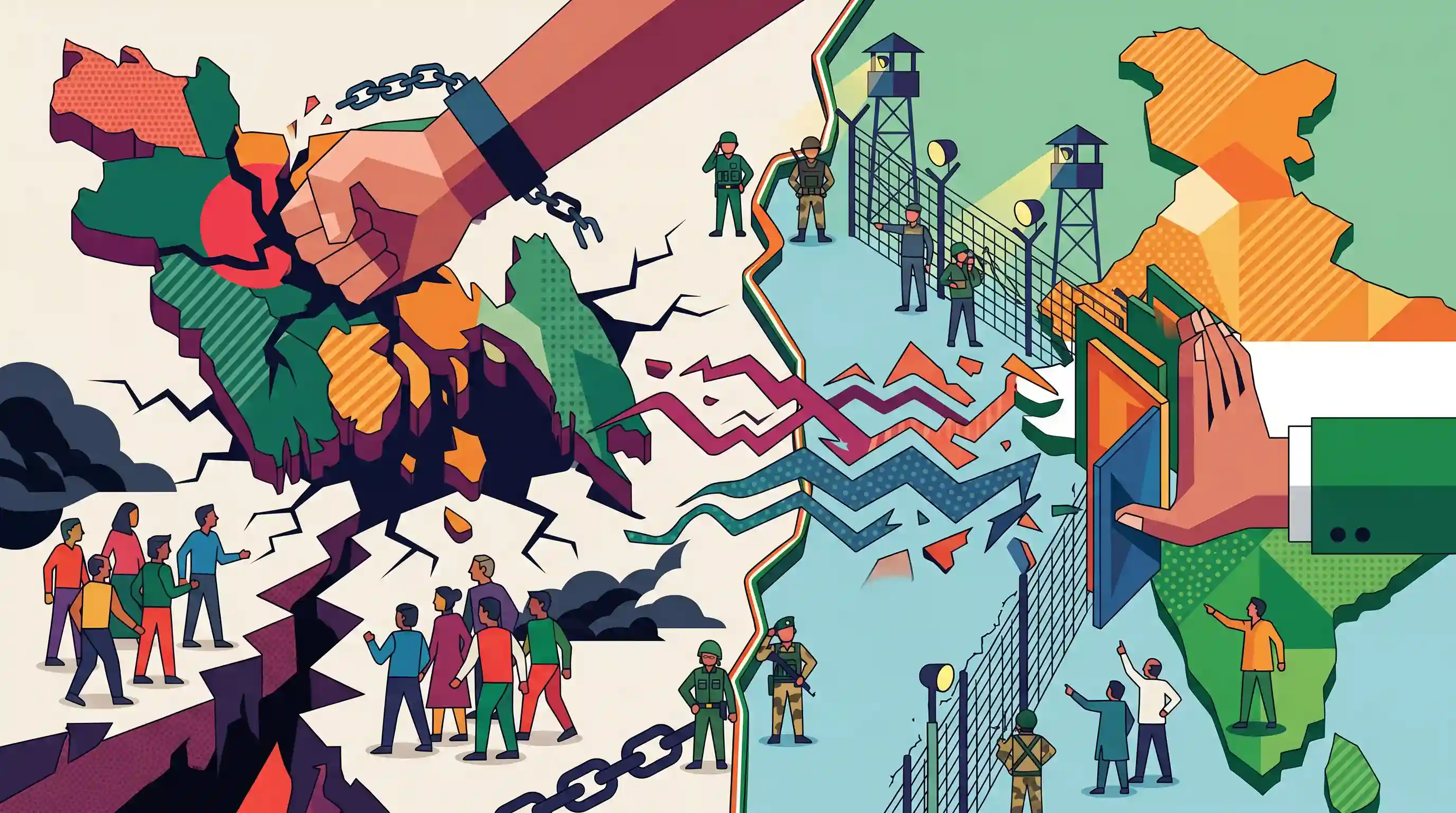
Political instability in Bangladesh directly affects India's "Neighbourhood First" policy, regional security, and border management. Understanding democratic transitions and the role of political parties in neighbouring countries is essential for analysing geopolitical challenges in South Asia.
Summary
The article examines the potential ban on the Awami League (AL) in Bangladesh following the ouster of Sheikh Hasina. It argues that banning a major political party undermines democratic pluralism, political freedom, and inclusive governance. Such a move risks alienating a large section of the population, polarizing society, and exacerbating political instability. For a successful democratic transition, the interim government should prioritize institutional reform and reconciliation over political retribution. A fractured polity in Bangladesh presents broader security and geopolitical challenges for South Asia, particularly impacting India's border management and neighbourhood diplomacy.
Key Points
- The proposed ban on the Awami League following Sheikh Hasina's ouster poses a significant threat to democratic pluralism and political freedom in Bangladesh.
- Banning a major political party with deep historical roots could alienate millions of supporters, leading to severe societal polarization and unrest.
- The article argues that democratic transitions require institutional reform, inclusive elections, and reconciliation rather than political retribution.
- A fractured and unstable polity in Bangladesh has direct implications for India's regional security, border management, and its Neighbourhood First policy.
Important Terms
Neighbourhood First Policy

India's core foreign policy framework prioritizing immediate neighbors through enhanced connectivity, trade, and development assistance, guided by principles like non-reciprocity and regional stability.
UPSC context
GS Paper II (International Relations); tests understanding of India's strategic priorities and regional leadership in South Asia.
Awami League
Major secular political party in Bangladesh, founded by Sheikh Mujibur Rahman; historically India's most trusted partner, its 2024 ouster ended 15 years of continuous rule.
UPSC context
GS Paper II (India and its Neighborhood); critical for analyzing bilateral security, counter-terrorism, and political stability in South Asia.
Interim Government of Bangladesh
The temporary administration led by Muhammad Yunus formed in August 2024 to restore order and oversee fundamental reforms following the resignation of Sheikh Hasina.
UPSC context
GS Paper II (International Relations/Governance); concerns political transitions, democratic restoration, and India's diplomatic recalibration during neighborhood crises.
Democratic Pluralism
A political philosophy where power is dispersed among diverse, competing interest groups rather than concentrated in a single party, ensuring inclusive governance and minority protection.
UPSC context
GS Paper II (Polity and Governance); relevant for discussions on party systems, electoral democracy, and inclusive political processes.
Doctrine of Necessity
A legal principle used to justify extra-constitutional actions (like forming an interim government) during crises to maintain state continuity and public order when regular laws fail.
UPSC context
GS Paper II (Constitution and Polity); tests knowledge of legal justifications for unconventional political transitions in parliamentary systems.
Border Management
The coordinated security and administrative control of international boundaries to prevent illegal migration, smuggling, and insurgency while facilitating legitimate trade and movement.
UPSC context
GS Paper III (Internal Security); vital for the India-Bangladesh border, which is India's longest and prone to security vulnerabilities.
Prelims Trap
"The Election Commission of India has explicit statutory power to ban or deregister a political party."
In India, the Election Commission has the power to register parties but generally lacks the statutory power to deregister them under the RPA 1951.
Static Concepts Connected
What are the key geographical and security challenges of the Indo-Bangladesh border?
- Riverine terrain: Over 1,116 km of the border is riverine (e.g., Brahmaputra), making physical fencing extremely difficult and facilitating smuggling.
- Population density: Dense habitation extends right up to the zero line, complicating border guarding and the detection of illegal migrants.
- Strategic choke point: Effective border management is vital to protect the highly vulnerable 22-km wide Siliguri Corridor from transborder threats.
How does Bangladesh fit into India's 'Act East' and 'Neighbourhood First' policies?
- Transit access: Bangladesh provides essential multi-modal transit routes (like Chattogram port access) linking mainland India to the landlocked Northeast.
- Insurgency management: A stable, cooperative regime in Dhaka is crucial for denying safe havens to North-East Indian insurgent groups.
Cross-Topic Patterns
Regime change and North-East security
A political vacuum in Dhaka historically correlates with increased activity of insurgent groups in India's Northeast, exploiting weakened intelligence sharing and porous borders.
Democratic backsliding in the Global South
Banning major political factions echoes instability seen in Pakistan and Myanmar, highlighting how political retribution stalls institutional democratic consolidation in neighboring states.

Expect a 2026 Mains question linking Bangladesh's democratic backsliding directly to India's border security and Act East transit projects.
Linked PYQs · 2
Linked PYQs · 2
- 2020MainsGS3
Analyze internal security threats and transborder crimes along Myanmar, Bangladesh and Pakistan borders including Line of Control (LoC). Also discuss the role played by various security forces in this regard.
- 2016MainsGS2
The Indian party system is passing through a phase of transition which looks to be full of contradictions and paradoxes." Discuss.
