Bihar Minister Nishant Kumar Meets Union Minister Lalan Singh
Source:biharandjharkhand ↗
Why It Matters
This event highlights key developments in Bihar's executive leadership and state-level political transitions. Understanding these dynamics is essential for studying state politics, the functioning of state legislatures (including the Bihar Legislative Council), and federal party structures.
Summary
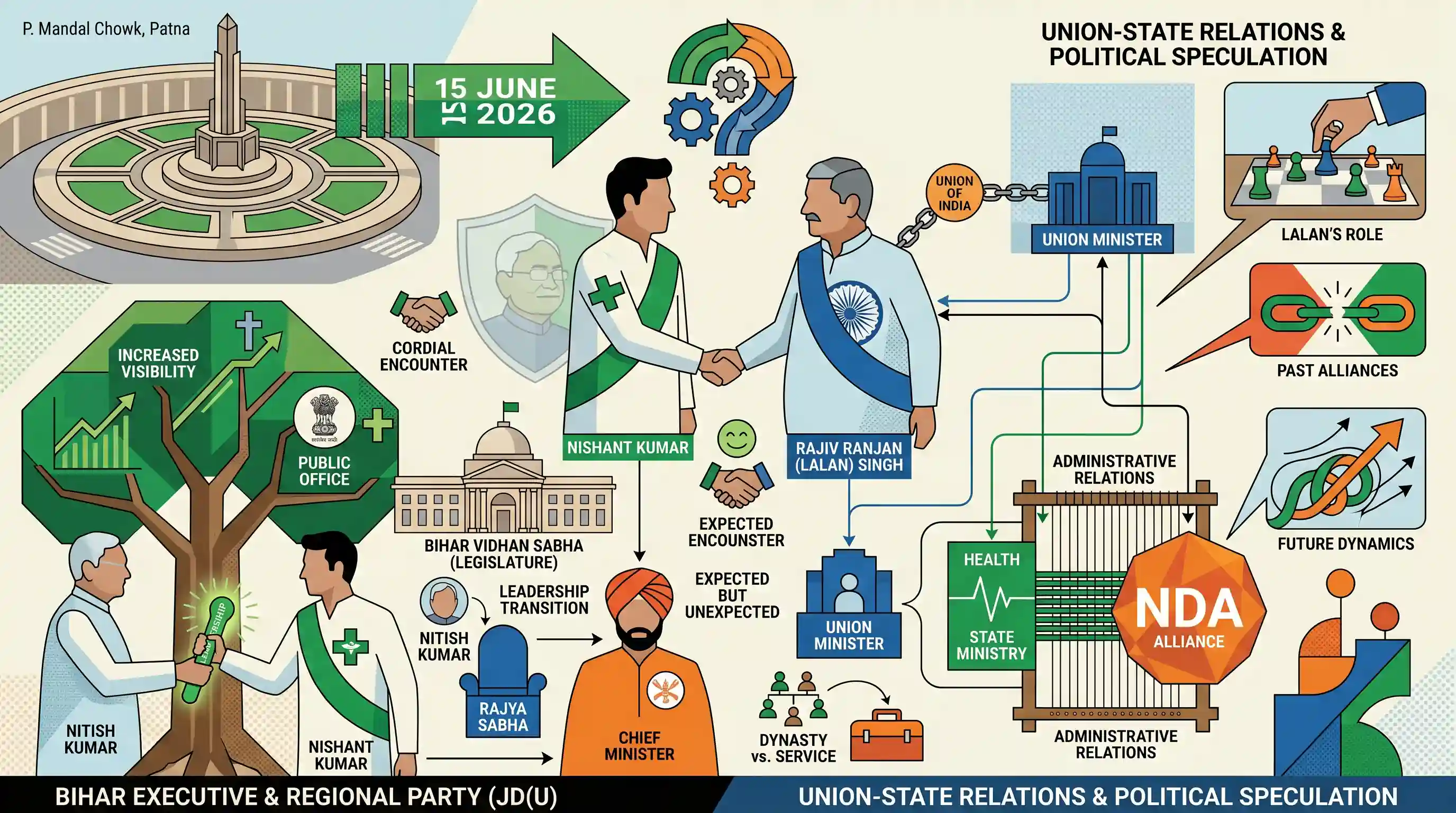
On June 15, 2026, Bihar Health Minister Nishant Kumar and Union Minister Rajiv Ranjan (Lalan) Singh had an unexpected encounter at P. Mandal Chowk in Patna. The brief, cordial interaction has sparked political speculation in the state, particularly because Nishant Kumar has recently seen increased public visibility and is the son of former Bihar Chief Minister Nitish Kumar, with whom Lalan Singh shares a close political association.
Key Points
- An unexpected chance encounter occurred at P. Mandal Chowk in Patna between Bihar's Health Minister, Nishant Kumar, and Union Minister Rajiv Ranjan Singh (popularly known as Lalan Singh).
- The meeting was warm and cordial, with Nishant Kumar greeting and taking blessings from Rajiv Ranjan Singh, a senior leader of the Janata Dal (United) and a close associate of former Bihar Chief Minister Nitish Kumar.
- Nishant Kumar's growing public visibility, increasing participation in social, religious, and public programmes, and his political remarks have fueled intense speculation regarding his future political path.
- Political observers are linking these developments to broader changes and discussions within Bihar's political landscape, including recent appointments and Legislative Council developments.
Important Terms
Janata Dal (United)

A prominent regional socialist political party in India, primarily based in Bihar. Formed in 2003 through mergers, it has played a key role in both state governance and national coalition politics.
UPSC context
GS Paper II (Polity & Governance) — Tests understanding of regional political parties, coalition politics, and state-level leadership transitions.
State Executive
The constitutional body responsible for administering state laws. It consists of the Governor, the Chief Minister, the Council of Ministers, and the Advocate General of the State under Articles 153 to 167 of the Indian Constitution.
UPSC context
GS Paper II (Polity) — Evaluates constitutional roles, division of powers, executive functions, and the working of state ministries.
Regional Political Parties
Political organizations operating primarily within a limited geographical area or state, articulating regional, linguistic, or cultural interests. They act as crucial players in federalism and national coalition politics.
UPSC context
GS Paper II (Polity) — Analyzes multi-party systems, federal dynamics, coalition governance, and democratic decentralization.
Union-State Administrative Relations
The constitutional framework (Articles 256–263) governing administrative interactions between the central government and states. It empowers the Union to issue directions to state administrative machinery to ensure compliance with federal laws.
UPSC context
GS Paper II (Polity) — Key for federalism questions, Centre-State relations, and cooperative federalism mechanisms.
Indo-Asian News Service
A private Indian news agency established in 1986. It provides independent news, views, and strategic analysis from India and South Asia across multiple media platforms to subscribers worldwide.
UPSC context
GS Paper II & III — Relevant to media ownership, press freedom, communication networks, and regional news dissemination.
Prelims Trap
Creation or abolition of a State Legislative Council requires a constitutional amendment passed under Article 368.
Parliament creates or abolishes a State Legislative Council through an ordinary bill (simple majority). Article 169(3) explicitly states this is not a constitutional amendment under Article 368.
Static Concepts Connected
What is the constitutional process to create or abolish a Legislative Council (Vidhan Parishad)?
- Assembly Resolution: Under Article 169, the State Legislative Assembly must first pass a resolution demanding creation or abolition.
- Special Majority: The resolution must be passed by a special majority: a majority of the total membership and 2/3rds of members present and voting.
- Parliamentary Approval: Parliament can then approve the creation or abolition via an ordinary law passed by a simple majority, without needing a constitutional amendment.
How did the Government of India Act 1935 introduce bicameralism at the provincial level?
- Provincial Autonomy: The Act granted provincial autonomy and replaced dyarchy with responsible government in the provinces.
- Bicameral Provinces: It established bicameral legislatures in 6 out of 11 provinces, namely Bengal, Bombay, Madras, Bihar, Assam, and the United Provinces.
- Legislative Structure: The houses were divided into a Legislative Assembly (lower house) and a Legislative Council (upper house, as a permanent body).
Cross-Topic Patterns
State Bicameralism vs. Constitutional Utility
The ongoing utility debate of Legislative Councils as either checks on hasty legislation or mere political rehabilitation backdoors for unelected leaders.
GOI Act 1935 legacy in federalism
How provincial structures under the 1935 Act laid the administrative blueprint for post-independence federal architecture and state boundaries.

Constitutional provisions of Article 169 and 171 paired with historical roots in the GOI Act 1935 are high-yield areas for Polity MCQs.
Linked PYQs · 3
Linked PYQs · 3
- 2024-IBPSC_PRELIMSGS1
Under the Government of India Act 1935, who was the first elected Chairman of Bihar Legislative Council ?
- 2022BPSC_PRELIMSGS1
In which year was the first sitting of the Bihar Legislative Council convened?
- 2024-IBPSC_PRELIMSGS1
Which of the following Acts converted Unicameral Legislature of Bihar into Bicameral : Bihar Legislative Assembly and Bihar Legislative Council?
