Structural flaws and judicial scrutiny in electoral roll revision
Source:The Hindu ↗
Why It Matters
The integrity of electoral rolls is fundamental to the functioning of a democracy. Addressing structural defects in voter verification processes is crucial to prevent the disenfranchisement of vulnerable populations and to uphold the constitutional right to vote.
Summary
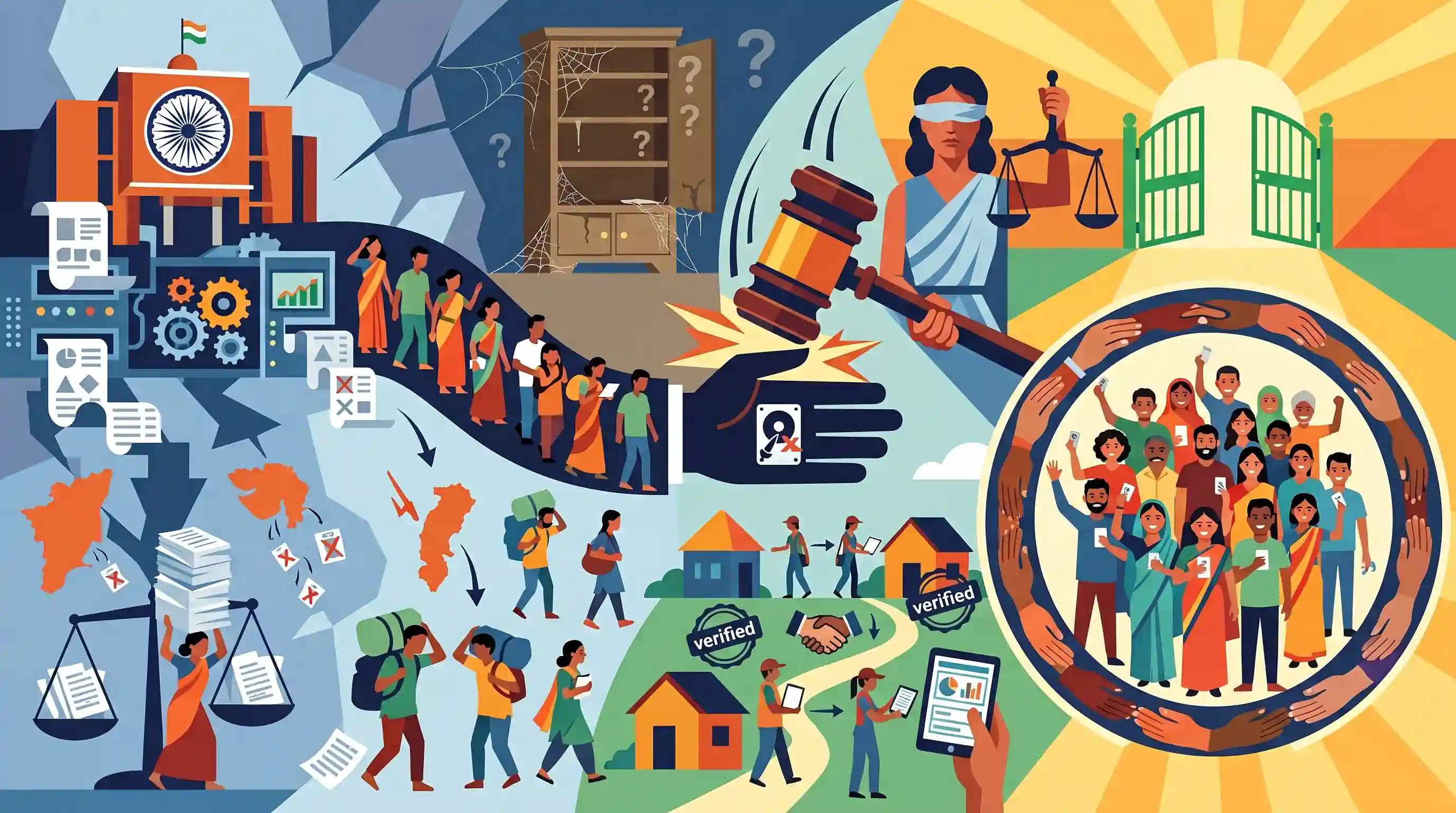
The article critiques the Election Commission of India's (ECI) Special Intensive Revision (SIR) of electoral rolls, highlighting structural defects that disproportionately disenfranchise female and migrant voters. With significant deletions reported across states like Tamil Nadu, Gujarat, and Chhattisgarh, the burden of proving voter eligibility has unfairly shifted onto citizens. The absence of updated Census data further complicates baseline assessments. While the Supreme Court has intervened in specific cases like West Bengal, the article argues for comprehensive judicial review to mandate a robust, household-by-household physical verification process, thereby safeguarding the constitutional right to universal adult franchise.
Key Points
- The ECI's Special Intensive Revision (SIR) process has led to an abnormally high number of deletions from electoral rolls, disproportionately affecting women and migrant workers.
- The SIR process suffers from structural defects by shifting the burden of proving eligibility onto the electors, rather than relying on proactive verification by the state.
- Delays in conducting the Census have deprived the ECI of accurate, up-to-date baseline demographic data to properly assess the electorate.
- The Supreme Court had to intervene in West Bengal by appointing judicial officers to oversee legal verification, highlighting the inadequacy of the ECI's implementation.
- The article advocates for a comprehensive judicial review to mandate a rigorous, household-by-household physical verification process to protect universal adult franchise.
Important Terms
Special Intensive Revision (SIR)

A comprehensive door-to-door verification drive by the Election Commission to update electoral rolls by removing deceased, shifted, or duplicate voters, usually conducted under Section 21(3) of the Representation of the People Act, 1950.
UPSC context
GS Paper II: Statutory bodies and electoral reforms; focuses on procedural fairness and constitutional mandates.
Election Commission of India (ECI)
A constitutional body established under Article 324, responsible for the superintendence, direction, and control of all elections to Parliament, State Legislatures, and the offices of President and Vice-President.
UPSC context
GS Paper II: Constitutional bodies; tests powers, functions, and challenges to institutional independence.
Representation of the People Act (RPA)
A legal framework comprising two acts: the 1950 Act, which governs seat allocation and electoral roll preparation, and the 1951 Act, which regulates the actual conduct of elections.
UPSC context
GS Paper II: Salient features of the RPA; essential for understanding India\'s electoral legislative structure.
Judicial Review
The power of the judiciary to examine the constitutionality of legislative and executive actions, ensuring they comply with the Basic Structure and Fundamental Rights (Articles 13, 32, 226).
UPSC context
GS Paper II: Judiciary; crucial for evaluating the balance of power and protection of democratic rights.
Universal Adult Franchise
The constitutional right (Article 326) granted to every citizen of India, aged 18 or older, to vote in elections without discrimination based on race, caste, religion, or gender.
UPSC context
GS Paper II: Fundamental principles of Indian Democracy; tests understanding of voting rights and inclusivity.
Prelims Trap
"The Right to Vote in India is merely a statutory right created under the Representation of the People Act."
UPSC frequently tests this. The right to vote is a Constitutional Right guaranteed under Article 326 (Universal Adult Suffrage), even though its exercise is regulated by statutory laws like the RPA.
Static Concepts Connected
Which constitutional articles govern electoral rolls and voting rights?
- Article 324: Vests the superintendence, direction, and control of the preparation of electoral rolls in the Election Commission of India.
- Article 325: Mandates one general electoral roll per territorial constituency, explicitly prohibiting exclusion based on religion, race, caste, or sex.
- Article 326: Establishes Universal Adult Suffrage, making the right to vote in Lok Sabha and State Assembly elections a Constitutional Right.
How does the RPA 1950 fundamentally differ from the RPA 1951?
- RPA 1950: Focuses on the foundational groundwork: preparation and revision of electoral rolls, delimitation of constituencies, and allocation of legislative seats.
- RPA 1951: Regulates the actual conduct of elections, qualifications/disqualifications of candidates, corrupt practices, and the resolution of electoral disputes.
Cross-Topic Patterns
Census Delay & Governance Deficits
The multi-year Census delay not only hampers PDS welfare targeting (due to outdated demographic denominators) but also degrades electoral roll accuracy, leading to arbitrary voter deletions and disenfranchisement.
Internal Migration & Political Exclusion
Migrant workers face structural exclusion from voting due to documentation burdens. This closely links to the ECI’s recent, debated proposals to introduce Remote Electronic Voting Machines (RVMs) for domestic migrants.

Expect a 2026 prelims question contrasting Article 325/326 constitutional rights with RPA 1950 statutory procedures for electoral rolls.
Linked PYQs · 4
Linked PYQs · 4
- 2017MainsGS2
To enhance the quality of democracy in India the Election Commission of India has proposed electoral reforms in 2016. What are the suggested reforms and how far are they significant to make democracy successful?
- 2022MainsGS2
Discuss the role of the Election Commission of India in the light of the evolution of the Model Code of Conduct.
- 2017PrelimsGS1
Right to vote and to be elected in India is a
- 2024MainsGS2
Examine the need for electoral reforms as suggested by various committees with particular reference to "one nation one election" principle.
