Bamboo Flowering and Ecological Crisis in Forest Ecosystems
Source:The Hindu ↗
આ શા માટે મહત્વનું છે
The article highlights a lesser-discussed ecological phenomenon—bamboo mass flowering and die-off—and its cascading effects on forest ecosystems, food webs, rodent dynamics, and human-wildlife conflicts, which is crucial for biodiversity conservation and forest management questions in GS3.
સારાંશ
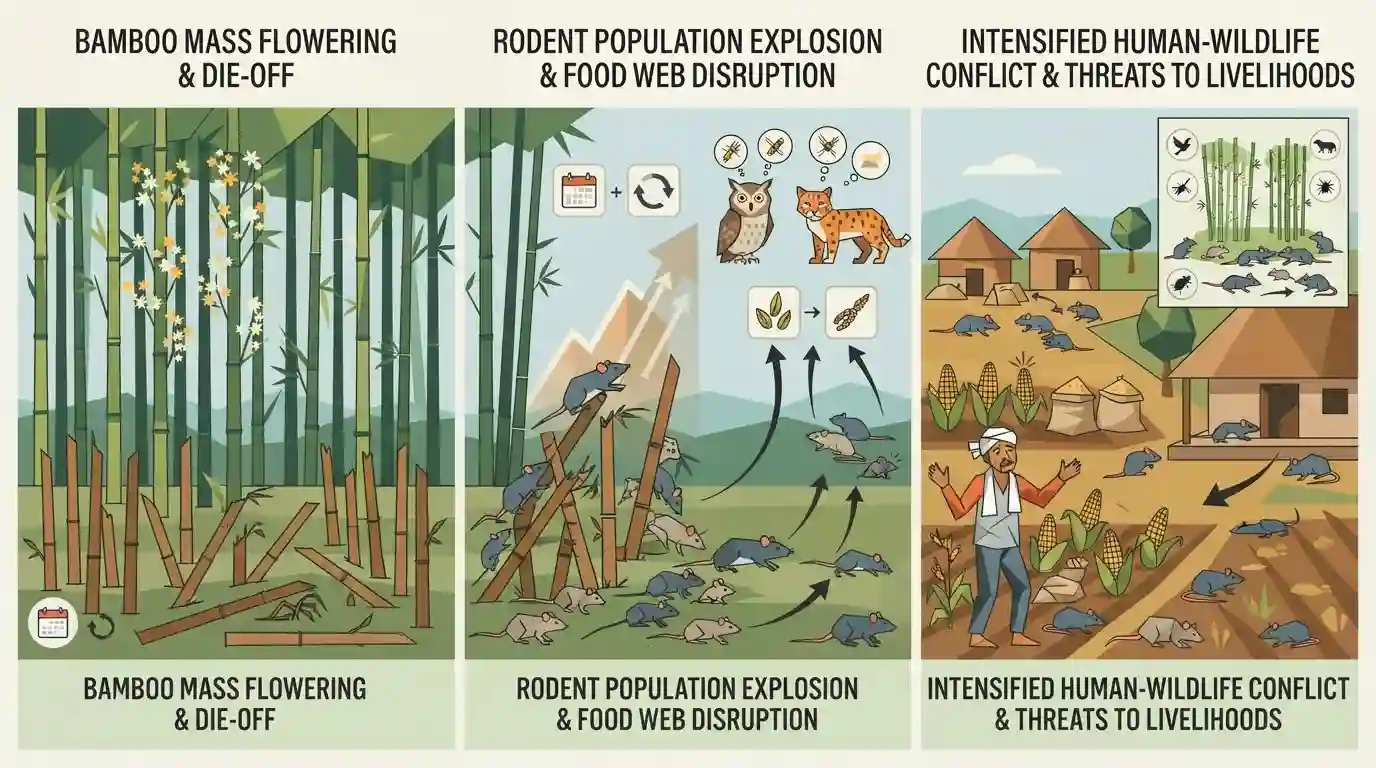
Recent studies warn that bamboo mass flowering and subsequent die-offs can trigger massive ecological crises, including rodent population explosions, disruption of forest food webs, and intensified human-wildlife conflicts, posing threats to biodiversity and local livelihoods.
મુખ્ય મુદ્દા
- Bamboo mass flowering and synchronized die-offs can trigger severe ecological crises, rodent population explosions, and heightened human-wildlife conflict.
- Mass flowering events in bamboo forests alter forest microclimates and food web dynamics, temporarily boosting rodent numbers which subsequently raid nearby agricultural fields.
- The ecological disruption impacts indigenous forest biodiversity and traditional livelihoods dependent on bamboo ecosystems.
- Proactive management strategies and continuous ecological monitoring are required to mitigate the fallout of bamboo die-offs on local communities and wildlife.
પ્રિલિમ્સ ટ્રેપ
Mass bamboo flowering provides an abundant continuous food source for all forest herbivores and indigenous fauna.
Aspirants often assume mass flowering benefits herbivores uniformly; however, it causes acute starvation because most bamboo species die synchronously and seeds are rapidly depleted by rodents, followed by long regeneration gaps.
સંલગ્ન સ્થિર ખ્યાલો
What are the ecological characteristics and management implications of bamboo mass flowering and die-offs?
- Gregarious Flowering: Monocarpic nature: Most bamboo species are monocarpic, meaning they flower once in a synchronized gregarious event over decades or centuries and then entirely die off.
- Historical Famine: Mautam phenomenon: Associated with Melocanna baccifera in Northeast India, historically linked to severe famines due to rodent explosions feeding on fallen bamboo seeds.
- Rodent Explosions: Trophic cascades: Sudden seed gluts cause exponential rodent population growth, which upon seed exhaustion migrate to devastate surrounding agricultural crops and granaries.
આંતર-વિષય પેટર્ન
Bamboo Die-offs + Human-Wildlife Conflict
Mass bamboo die-offs remove key dry-season forage for Asian elephants, pushing herds into agrarian landscapes and escalating man-animal friction in forest fringe areas.
Ecological Succession + Invasive Alien Species
Sudden canopy loss after bamboo die-off accelerates the invasion of alien weed species like Mikania micrantha, threatening indigenous forest biodiversity and regeneration.

Bamboo flowering cycles (like Mautam) and their cascading trophic impact on rodent booms and elephant conflict will likely feature in prelims.
સંલગ્ન PYQ · 3
સંલગ્ન PYQ · 3
- 2017PrelimsGS1
From the ecological point of view, which one of the following assumes importance in being a good link between the Eastern Ghats and the Western Ghats?
- 2011PrelimsGS1
Three of the following criteria have contributed to the recognition of Western Ghats-Sri Lanka and Indo-Burma regions as hotspots of biodiversity: 1. Species richness 2. Vegetation density 3. Endemism 4. Ethno-botanical importance 5. Threat perception 6. Adaptation of flora and fauna to warm and humid conditions Which three of the above are correct criteria in this context?
- 2023PrelimsGS1
Consider the following statements: 1. Amarkantak Hills are at the confluence of Vindhya and Sahyadri Ranges. 2. Biligirirangan Hills constitute the easternmost part of Satpura Range. 3. Seshachalam Hills constitute the southernmost part of Western Ghats. How many of the statements given above are correct?
