India Macroeconomic Policy Amid Global Trade Fragmentation
Source:Indian Express ↗
Why It Matters
Provides a crucial analytical framework for GS3 Economy questions dealing with how India should position its domestic fiscal policy and industrial strategy in response to global trade fragmentation and rising protectionism.
Summary
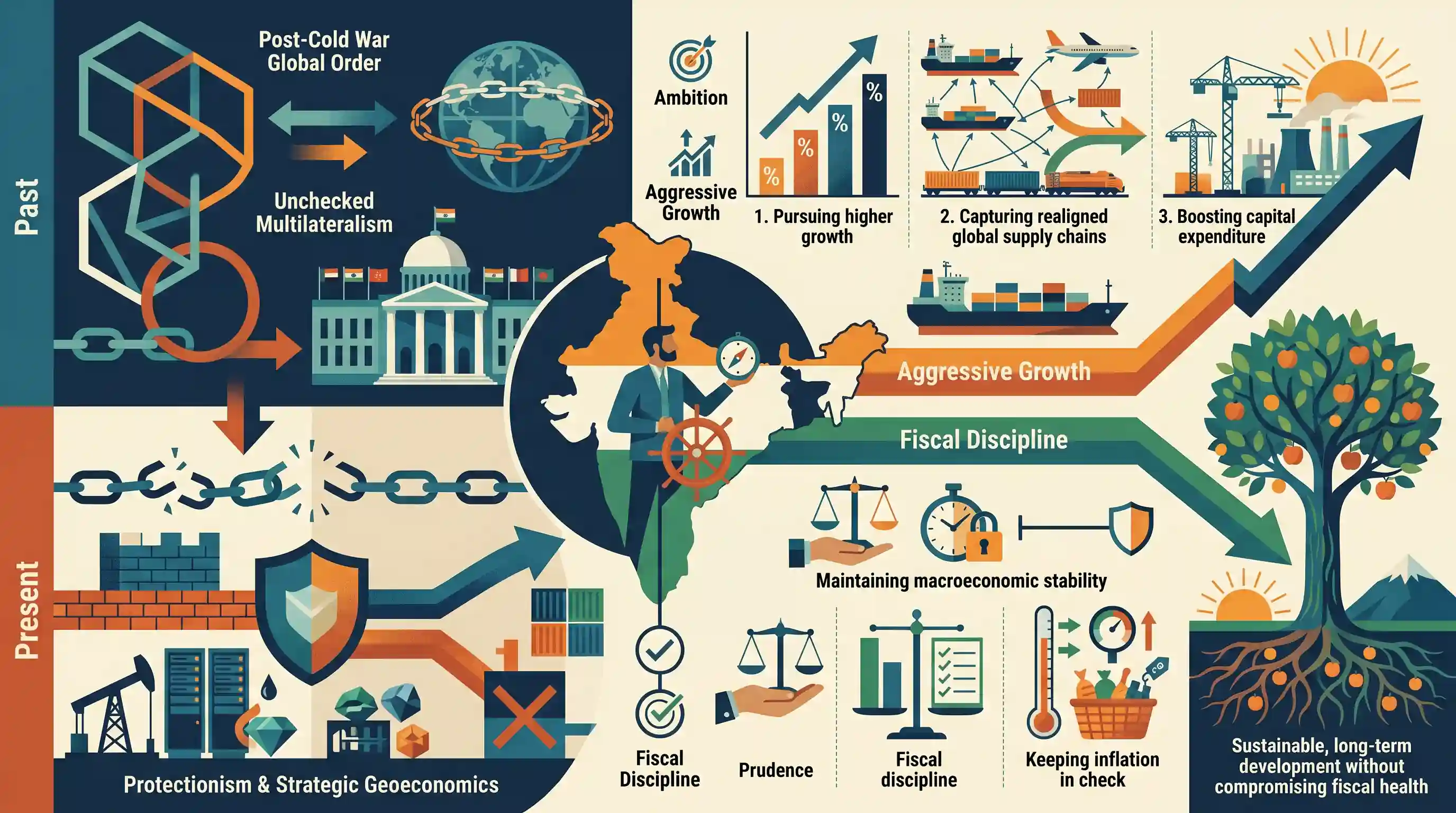
As the post-Cold War global economic order transitions away from unchecked multilateralism toward protectionism and strategic geoeconomics, India faces a critical juncture. The article highlights the necessity for policymakers to balance "ambition" — aggressively pursuing higher growth, capturing realigned global supply chains, and boosting capital expenditure — with "prudence," which entails maintaining macroeconomic stability, fiscal discipline, and keeping inflation in check. Navigating this new global paradigm requires a nuanced economic strategy that ensures sustainable, long-term development without compromising the nation's fiscal health.
Key Points
- The global economic order is undergoing a structural transition from multilateral free trade to a fragmented system characterized by protectionism and geoeconomics.
- In the face of these changing global paradigms, India is presented with opportunities to capitalize on supply chain realignments, such as the China+1 strategy.
- Policymakers must navigate these shifts by balancing an ambitious growth strategy—focused on infrastructure expansion and manufacturing—with strict fiscal prudence.
- A well-calibrated approach that maintains macroeconomic stability, controls inflation, and manages fiscal deficits is essential to sustainably achieve India's long-term economic ambitions.
Prelims Trap
An increase in government capital expenditure invariably leads to the 'crowding out' of private sector investment.
Aspirants mechanically link all government borrowing to 'crowding out'. However, targeted capital expenditure in infrastructure often 'crowds in' private investment by reducing logistics costs.
Static Concepts Connected
How does Capital Expenditure differ from Revenue Expenditure in macroeconomic impact?
- Asset Creation: Capital expenditure creates productive assets or reduces liabilities, whereas revenue expenditure does neither.
- Multiplier Effect: Capex has a significantly higher macroeconomic multiplier effect, fostering long-term capital formation and sustainable growth.
- Budget Examples: Capex includes infrastructure spending and loan repayments; revenue expenditure covers daily running costs like salaries, subsidies, and interest payments.
What is the 'Escape Clause' under the Fiscal Responsibility and Budget Management (FRBM) Act?
- Flexibility Mechanism: A legal mechanism allowing the Central Government to deviate from the fiscal deficit target by up to 0.5% of GDP in a year.
- Trigger Conditions: It can be invoked during national security crises, structural reforms, natural calamities, or a severe decline in real output growth.
- Balancing Prudence: It provides a rules-based framework to balance strict fiscal prudence with necessary state intervention during external economic shocks.
Cross-Topic Patterns
Bilateral FTAs replacing multilateralism
The shift away from WTO-led multilateral free trade correlates with India's aggressive pursuit of bilateral FTAs (UAE, Australia, EFTA) and its strategic withdrawal from mega-blocs like RCEP.
Supply Chain Resilience Initiative (SCRI)
The geoeconomic pivot from 'efficiency' to 'resilience' ties directly into the India-Japan-Australia Supply Chain Resilience Initiative (SCRI), aiming to reduce dependency on China for critical imports.

Expect a GS3 Mains question evaluating how India balances fiscal consolidation (FRBM) with Capex-led growth amid global supply chain shifts.
Linked PYQs · 3
Linked PYQs · 3
- 2025MainsGS3
What are the challenges before the Indian economy when the world is moving away from free trade and multilateralism to protectionism and bilateralism? How can these challenges be met?
- 2018MainsGS3
How would the recent phenomena of protectionism and currency manipulations in world trade affect macroeconomic stability of India?
- 2025MainsGS3
Explain how the Fiscal Health Index (FHI) can be used as a tool for assessing the fiscal performance of states in India. In what way would it encourage the states to adopt prudent and sustainable fiscal policies?
