Deep Sea Mineral Exploration and Marine Environmental Stewardship
Source:The Hindu ↗
हे का महत्त्वाचे आहे
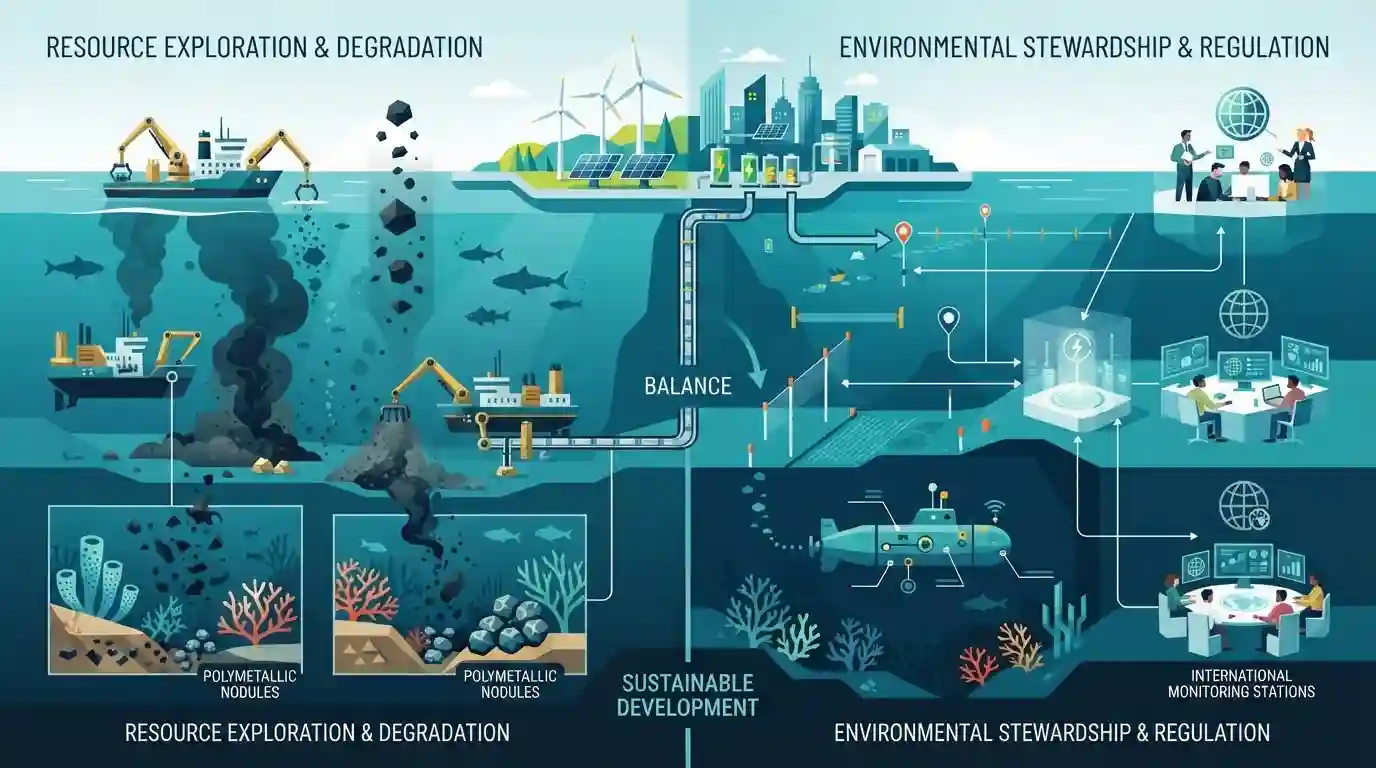
With India pursuing its Deep Ocean Mission and engaging with the International Seabed Authority for polymetallic nodule exploration, understanding the trade-off between marine resource extraction and ecological preservation is crucial for GS3 Environment and Economy syllabi.
सारांश
The article discusses the delicate balance required between exploring deep-sea mineral resources and maintaining environmental stewardship. As nations look to the seabed for critical minerals to fuel clean energy technologies, concerns over severe ecological disruptions to fragile marine ecosystems have intensified. The piece emphasizes the importance of robust regulatory frameworks, scientific governance, and international cooperation through bodies like the International Seabed Authority to mitigate environmental degradation.
मुख्य मुद्दे
- Deep-sea discovery and exploration offer vital mineral resources (such as polymetallic nodules) necessary for the green transition and high-tech industries.
- Commercial seabed mining threatens fragile, unexplored marine ecosystems, benthic biodiversity, and long-term ocean health through sediment plumes and habitat destruction.
- Balancing resource extraction with environmental stewardship requires robust regulatory frameworks, precautionary approaches, and strict oversight by bodies like the International Seabed Authority (ISA).
- India's Deep Ocean Mission must integrate rigorous scientific baseline studies and environmental impact assessments to ensure sustainable exploration.
महत्त्वाच्या संज्ञा
International Seabed Authority (ISA)

An autonomous international organization established under UNCLOS to organize, regulate, and control all mineral-related activities in the international seabed area beyond national jurisdiction while protecting the marine environment.
UPSC context
UPSC Prelims/Mains: Important international institutions, marine governance, and global commons. Tests understanding of resource regulation and environmental conservation.
United Nations Convention on the Law of the Sea (UNCLOS)
An international treaty that establishes a legal framework for all marine and maritime activities, defining rights and responsibilities of nations regarding use of the world's oceans and protection of marine resources.
UPSC context
UPSC Prelims/Mains (GS Paper II/III): International conventions, law of the sea, geopolitical rights, and maritime security.
Deep Ocean Mission
India's flagship initiative launched by the Ministry of Earth Sciences to develop deep-sea technologies, explore marine mineral resources like polymetallic nodules, and support the blue economy.
UPSC context
UPSC Prelims/Mains (GS Paper III): Science & Technology, resource mobilization, and India's strategic initiatives in ocean exploration and sustainable development.
संबंधित स्थिर संकल्पना
What are the primary maritime zones and jurisdictional powers defined under UNCLOS?
- Territorial Sea: Extends up to 12 nautical miles from the baseline; coastal states exercise full sovereignty.
- Exclusive Economic Zone: Extends up to 200 nautical miles; coastal states have sovereign rights for exploring and exploiting natural resources.
- The Area: Areas beyond national jurisdiction; designated as the 'common heritage of mankind' administered by the ISA.
आंतर-विषय नमुने
Deep-Sea Minerals & National Tech Missions
Deep Ocean Mission joins PM Gati Shakti and National Quantum Mission to test India's high-tech resource security frameworks.
Global Commons & International Law
The ISA's 'common heritage of mankind' principle directly parallels global commons debates in Antarctica and outer space treaties.

Expect a multi-statement prelims question pairing UNCLOS jurisdictional mandates with ISA exploitation rules and India's CIOB site.
संबंधित PYQ · 2
संबंधित PYQ · 2
- 2021PrelimsGS1
Consider the following statements : 1. The Global Ocean Commission grants licences for seabed exploration and mining in international waters. 2. India has received licences for seabed mineral exploration in international waters. 3. 'Rare earth minerals' are present on seafloor in international waters. Which of the statements given above are correct?
- 2025MainsGS3
Mineral resources are fundamental to the country's economy and these are exploited by mining. Why is mining considered an environmental hazard? Explain the remedial measures required to reduce the environmental hazard due to mining.
