US Pakistan Trade Agreement Tariffs and Regional Energy Dynamics
Source:The Hindu ↗
Why It Matters
The development showcases the aggressive restructuring of global trade under the US administration via targeted tariffs and bilateral deals. For UPSC aspirants, understanding US-Pakistan economic alignments, potential energy exploration in the region, and the shift towards protectionist US trade policies is vital for analyzing the changing geopolitical landscape in India's neighborhood.
Summary
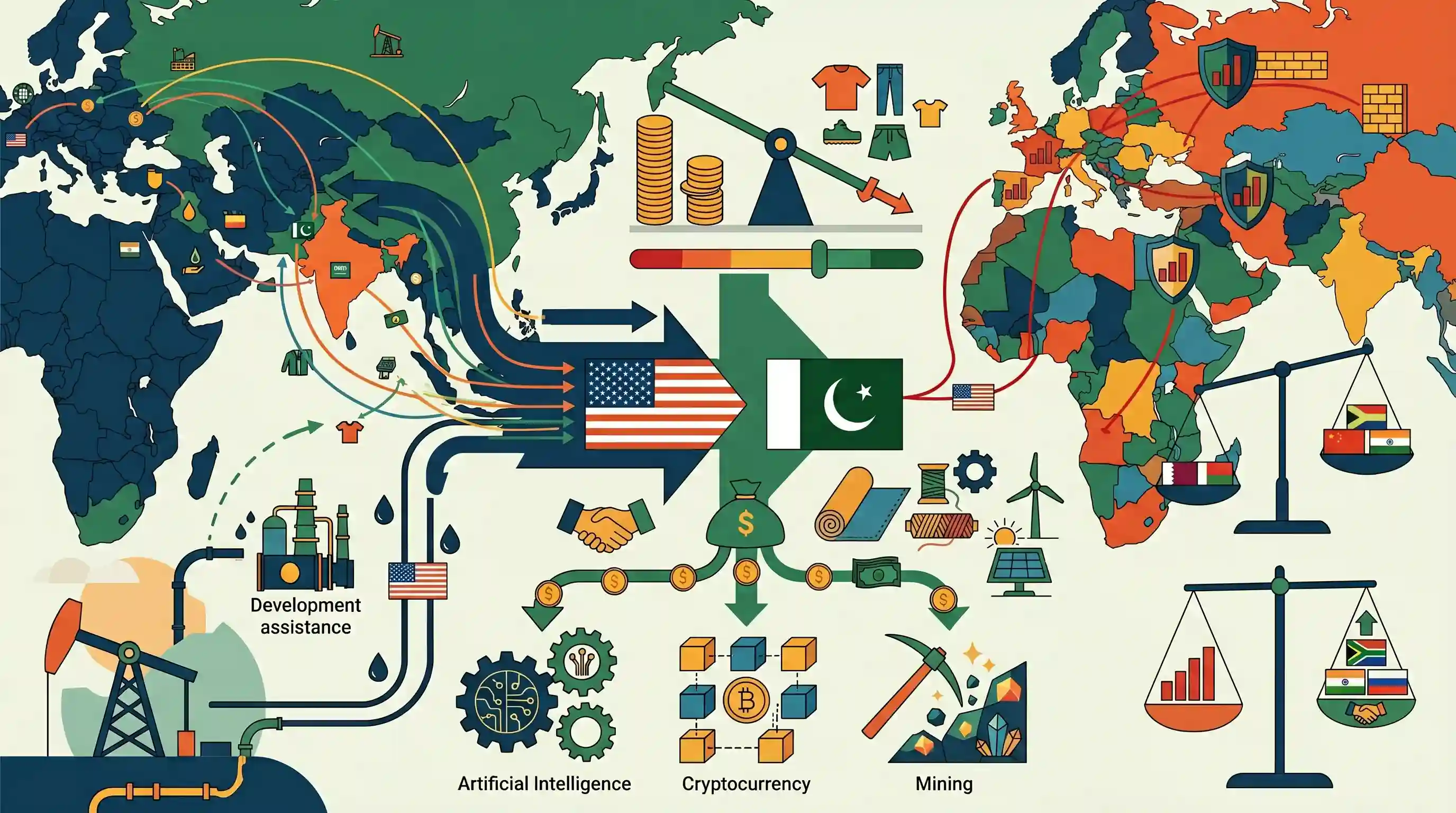
The United States and Pakistan have finalized a new trade deal imposing a 19% tariff on Pakistani exports, a reduction from the 29% initially proposed by President Donald Trump. Pakistan’s government welcomed the agreement as a strategic deepening of economic ties that will sustain the competitiveness of its critical textile sector. The deal is marked by Trump's promise of US assistance in developing 'massive oil reserves' in Pakistan, a country that traditionally relies on West Asian oil imports. Furthermore, it paves the way for US foreign direct investment into emerging Pakistani sectors like artificial intelligence, cryptocurrency, and mining. This bilateral agreement unfolds alongside a broader US trade policy pivot, highlighted by new, aggressive tariffs imposed on over 60 other nations.
Key Points
- The US and Pakistan concluded a new trade deal that sets a 19% tariff on Pakistani exports, reduced from a previously proposed 29%.
- Pakistan hailed the tariff rate as balanced and forward-looking, noting it keeps its key sectors, like textiles, competitive in the US market compared to other Asian nations.
- President Trump stated the US would help Pakistan develop its 'massive oil reserves,' although Pakistan currently imports oil from West Asia and has no major tapped reserves.
- The agreement signals deepening economic ties with potential US investments in artificial intelligence, cryptocurrency, mining, and energy sectors in Pakistan.
- Concurrently, the US administration imposed new tariffs on over 60 countries, ranging from 10% to 40%, reflecting a broader protectionist shift in US trade policy.
Important Terms
US-Pakistan Trade Deal (2026)

A 2026 bilateral agreement reducing U.S. tariffs on Pakistani exports to 19% from a proposed 29%, while facilitating U.S. investment in Pakistan's oil reserves, AI, and mining sectors.
UPSC context
GS-II: Effect of policies of developed countries on India's interests; GS-III: Bilateral trade and energy security.
'Liberation Day' Tariffs
A sweeping 2026 U.S. trade policy under the Trump administration that imposed aggressive global tariffs, using Section 122 of the Trade Act of 1974 to renegotiate trade terms with over 60 nations.
UPSC context
GS-III: International trade, tariffs, and their impact on the global and Indian economy.
Major Non-NATO Ally (MNNA)
A U.S. legal status granted to close partners that provides military and financial advantages without a mutual defense commitment; Pakistan's status influenced its 2026 trade negotiations.
UPSC context
GS-II: Regional and global groupings involving India and/or affecting India's interests.
Section 301 (Trade Act of 1974)
A provision of the U.S. Trade Act of 1974 allowing the President to impose tariffs or sanctions on countries engaging in "unjustifiable" or "discriminatory" trade practices affecting U.S. commerce.
UPSC context
GS-III: Issues relating to intellectual property rights and international trade barriers.
Energy Security
The state of having reliable and affordable access to energy sources; a key pillar of the 2026 deal involving U.S. development of Pakistani oil reserves.
UPSC context
GS-III: Infrastructure: Energy, Ports, Roads, Airports, Railways etc. (Energy Security).
World Liberty Financial
A crypto-finance platform linked to the Trump family that signed a 2026 MOU with Pakistan to integrate stablecoins into the country's digital payment infrastructure.
UPSC context
GS-III: IT, Space, Computers, Robotics, Nanotechnology, Bio-technology and issues relating to Intellectual Property Rights (Digital Assets).
Prelims Trap
The US-Pakistan trade deal guarantees zero-duty access for Pakistani textile exports to the US.
It does not eliminate them; it establishes a 19% tariff. It is celebrated because it is significantly lower than punitive tariffs (up to 50%) the US is imposing on competitors like India.
Static Concepts Connected
How do Reciprocal Tariffs differ from the WTO's Most-Favoured-Nation (MFN) principle?
- MFN Principle: A core WTO rule requiring a country to apply its lowest tariff rate equally to all members, preventing trade discrimination.
- Reciprocal Tariffs: Bilateral matching of tariff rates. Applying a 50% tariff to India and 19% to Pakistan based on bilateral trade deficits challenges uniform MFN bounds.
- Allowed Exceptions: WTO allows MFN exceptions for formal Free Trade Agreements (FTAs) and special preferential schemes for developing nations (like the GSP).
Why is India's textile sector highly vulnerable to shifting global tariff regimes?
- Price Sensitivity: Textiles operate on incredibly thin margins. Even minor tariff disadvantages (like Pakistan's 19% vs India's higher rates) can cause a massive shift in global buyer orders.
- Preferential Access Gap: Unlike Bangladesh (which enjoys LDC zero-duty benefits in many markets) or nations striking new bilateral deals, India currently faces higher duties in critical Western markets.
Cross-Topic Patterns
Textile vulnerabilities & Trade Wars
India's apparel industry faces up to 50% US tariffs while Pakistan secures 19%, highlighting how bilateral trade diplomacy directly dictates the competitiveness of domestic manufacturing.
Shifting US-Pakistan Geoeconomics
The US relationship with Pakistan is pivoting from traditional counter-terrorism to transactional geoeconomics, offering FDI in emerging sectors like AI, cryptocurrency, and mining.

Expect a 2026 question linking India's textile export stagnation to shifting US protectionist policies and market access of neighbors.
Linked PYQs · 3
Linked PYQs · 3
- 2025MainsGS2
"Energy security constitutes the dominant kingpin of India's foreign policy, and is linked with India's overarching influence in Middle Eastern countries.” How would you integrate energy security with India's foreign policy trajectories in the coming years?
- 2017MainsGS2
The question of India's Energy Security constitutes the most important part of India's economic progress. Analyze India's energy policy cooperation with West Asian countries.
- 2016MainsGS3
Justify the need for FDI for the development of the Indian economy. Why there is gap between MOUs signed and actual FDIs? Suggest remedial steps to be taken for increasing actual FDIs in India.
