Amaravati Capital Status and Centre-State Financial Relations
Source:The Hindu ↗
Why It Matters
It serves as an excellent contemporary case study for GS2 (issues related to state reorganisation, Centre-State financial promises) and GS3 (land pooling vs. land acquisition, inclusive growth, and addressing regional disparities).
Summary
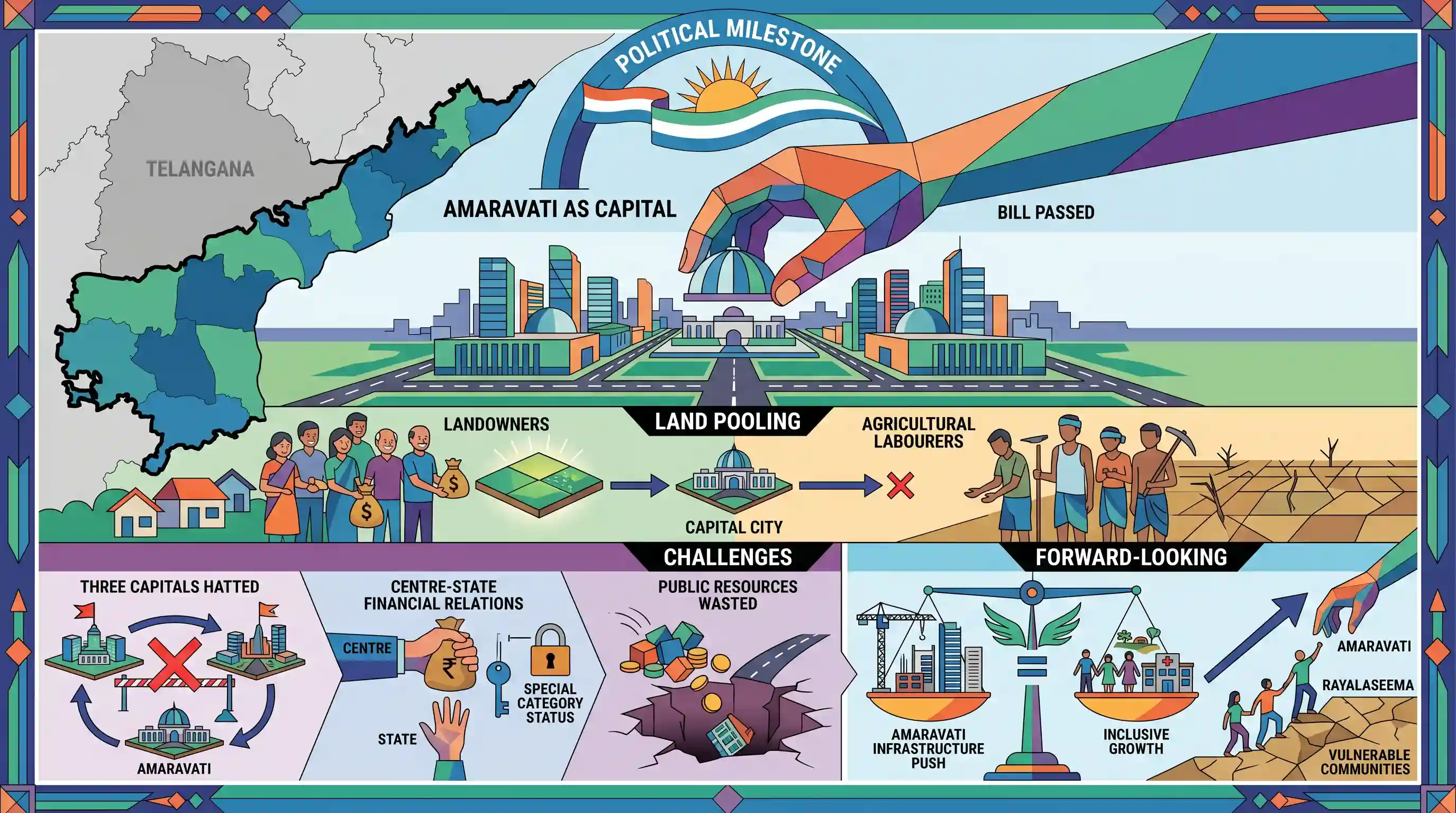
The passage of the Andhra Pradesh Reorganisation (Amendment) Bill recognising Amaravati as the state's capital marks a major political milestone but highlights lingering challenges of governance and equitable development. The capital's formation relied on the Land Pooling Scheme, which disproportionately benefited landowners over agricultural labourers. Over the past decade, political shifts—including a halted three-capital model and unfulfilled Centre-State financial commitments like Special Category Status—have wasted public resources. Moving forward, the state must balance Amaravati's infrastructure push with inclusive growth, ensuring that vulnerable communities and underdeveloped regions like Rayalaseema are not left behind.
Key Points
- Parliament recently passed the Andhra Pradesh Reorganisation (Amendment) Bill, officially recognising Amaravati as the state capital and marking a significant victory for CM N. Chandrababu Naidu.
- The original Land Pooling Scheme (LPS) to consolidate land for Amaravati favored property owners but left agricultural labourers economically vulnerable, highlighting issues of intra-generational equity.
- The unmet promise of Special Category Status for AP under the 2014 Reorganisation Act created deep friction in Centre-State financial relations and was a major electoral issue.
- Policy reversals, such as the previous government\'s three-capital proposal, stalled development and caused significant waste of public resources over the past decade.
- The editorial stresses that capital development must be balanced, ensuring that historically underdeveloped regions like Rayalaseema and north coastal Andhra are not economically sidelined.
Important Terms
Andhra Pradesh Reorganisation (Amendment) Bill, 2026

A 2026 legislative amendment designating Amaravati as the sole permanent capital of Andhra Pradesh, officially ending the "three-capital" model and resolving decade-long administrative uncertainty since the state's bifurcation.
UPSC context
GS2: Federalism/State Reorganisation. Tests knowledge of Parliament’s powers under Articles 2 and 3 to determine state boundaries and administrative seats.
Andhra Pradesh Reorganisation Act, 2014
The foundational Parliamentary act that bifurcated unified Andhra Pradesh into Telangana and residual Andhra Pradesh in 2014, establishing Hyderabad as a joint capital for a transitional 10-year period.
UPSC context
GS2: Indian Constitution. A key case study for state reorganisation, asset division, and the legislative procedure for creating new states.
Special Category Status (SCS)
An administrative classification for states with geographical or socio-economic disadvantages, granting them 90% central funding for Centrally Sponsored Schemes and significant tax concessions to spur development.
UPSC context
GS2: Centre-State Relations. Tests fiscal federalism, Finance Commission recommendations, and the evolution of central assistance criteria post-Planning Commission.
Land Pooling Scheme (LPS)
A land acquisition alternative where farmers surrender land for infrastructure development and receive a portion of "developed" land back, theoretically benefiting from the resultant appreciation in property value.
UPSC context
GS3: Land Reforms/Infrastructure. Tests urban development models and the socio-economic impacts on different stakeholders like landowners and landless laborers.
RFCTLARR Act, 2013
A national law requiring fair compensation, rehabilitation, and mandatory Social Impact Assessments (SIA) for displaced families, replacing colonial laws to protect agricultural livelihoods during industrialisation.
UPSC context
GS3: Land Reforms. Tests understanding of legal safeguards against arbitrary land seizure and the rights of marginalized rural populations.
Prelims Trap
"Special Category Status is a constitutional provision automatically granted to newly bifurcated states under the Reorganisation Act."
SCS is neither constitutional nor statutory. It was an executive classification introduced in 1969 (5th Finance Commission) and is not explicitly mandated by the AP Reorganisation Act.
Static Concepts Connected
What are the criteria and origin of Special Category Status (SCS)?
- Origin: It is not a constitutional provision. It was introduced in 1969 based on the recommendations of the 5th Finance Commission.
- Criteria: Hilly/difficult terrain, low population density, strategic border location, economic and infrastructure backwardness, and non-viable state finances (Gadgil formula).
- Current Status: The 14th Finance Commission largely dissolved the concept for general states, compensating them by increasing the divisible tax pool devolution to 42%.
How does the Land Pooling Scheme (LPS) differ from Land Acquisition?
- Voluntary Mechanism: Pooling involves landowners voluntarily surrendering land in exchange for a share of the developed commercial/residential plots and annuity payments.
- Compulsory Acquisition: Acquisition is a compulsory state takeover governed by the central LARR Act, 2013, which requires strict social impact assessments and compensation.
- Legal Bypass: Because LPS is framed under state urban development laws, it effectively bypasses the stringent rehabilitation mandates for landless labourers required by the 2013 central law.
Cross-Topic Patterns
Land Pooling & Intra-generational Equity
Amaravati's Land Pooling Scheme (LPS) highlights a development paradox: landowners reap massive capital gains via developed plots, while landless agricultural labourers face immediate livelihood destruction without LARR safeguards.
Multiple Capitals & Regional Decentralisation
AP's halted three-capital experiment (executive, legislative, judicial) reflects the classic administrative tension between creating a single massive growth pole and ensuring equitable regional development for backward areas.

Expect a GS3 Mains question comparing Land Pooling Schemes with LARR 2013, focusing on socio-economic impacts on landless labourers.
Linked PYQs · 5
Linked PYQs · 5
- 2025MainsGS2
Discuss the nature of Jammu and Kashmir Legislative Assembly after the Jammu and Kashmir Reorganization Act, 2019. Briefly describe the powers and functions of the Assembly of the Union Territory of Jammu and Kashmir.
- 2025MainsGS2
Examine the evolving pattern of Centre-State financial relations in the context of planned development in India. How far have the recent reforms impacted the fiscal federalism in India?
- 2024MainsGS2
What changes has the Union Government recently introduced in the domain of Centre-State relations ? Suggest measures to be adopted to build the trust between the Centre and the States and for strengthening federalism.
- 2023MainsGS3
State the objectives and measures of land reforms in India. Discuss how land ceiling policy on landholding can be considered as an effective reform under economic criteria.
- 2020MainsGS3
Explain intra-generational and inter-generational issues of equity from the perspective of inclusive growth and sustainable development.
